Financial consolidation software earns its place when the current system can no longer finish the group close on its own. The system still runs each month, but the final roll-up happens in a spreadsheet. Usually, intercompany balances do not match, or currency translation was never set up correctly.
The fix starts with a decision that comes before any software: keep each entity on its current Enterprise Resource Planning (ERP), or bring entities onto one platform.
This guide works through that choice, then compares eight platforms on the same criteria. Bring IT is Oracle NetSuite Alliance Partner and implements one of these platforms. Where NetSuite is the right fit, the guide says so, and where another platform suits a group better, it says that too.
Key Takeaways
- The operating model comes first. Whether entities stay on their current ERPs shapes the shortlist more than any feature list.
- Consolidation runs in one of three places. It sits inside the ERP, in a corporate performance management (CPM) platform, or in a close automation suite.
- Imported data is not native consolidation. Most platforms accept data from other systems, but finance still maps and reconciles every import.
- A slow close is not always a software problem. Without shared intercompany rules, a new license automates the same workarounds.
What Is Financial Consolidation Software?
Financial consolidation software combines results from separate legal entities into one set of group financial statements. It handles four jobs on top of entity-level accounting:
- Eliminations: removing intercompany transactions so revenue and expense are not counted twice.
- Translation: converting subsidiary results into the reporting currency under ASC 830, tracking cumulative translation adjustment (CTA).
- Ownership: calculating non-controlling interest under ASC 810.
- Top-side adjustments: recording entries that belong to the group rather than a single entity.
Consolidation often ships inside CPM software, which adds budgeting and forecasting around the engine. Where that engine sits varies by product.
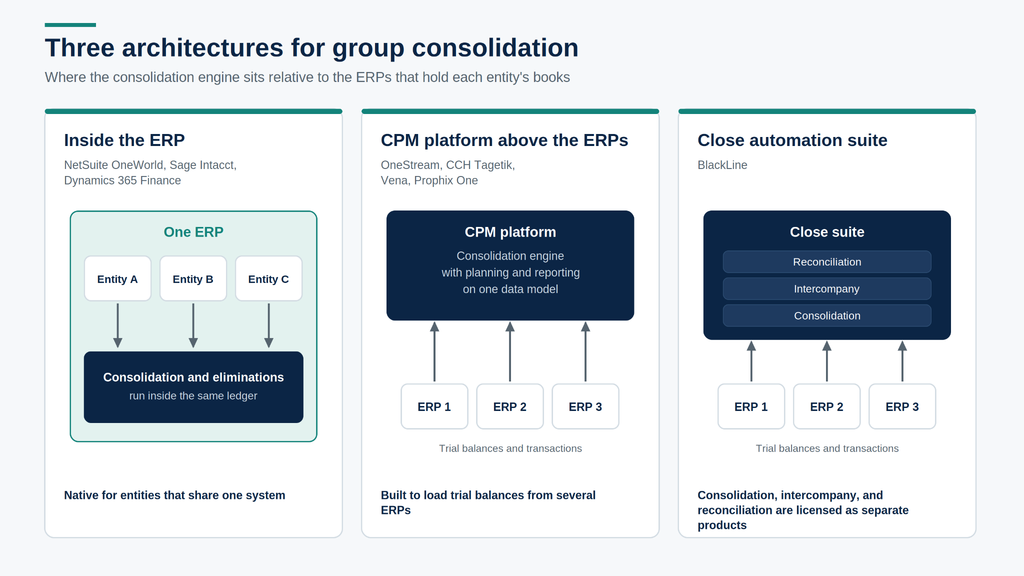
When statutory reporting drives the purchase, consolidation depth matters more than planning features. Among large ERP systems, consolidation is often one module inside a much bigger purchase.
Standardize or Retain: Three Paths
A group with separate ERPs can keep them and consolidate above them, or move entities onto one platform. Neither is right by default. It depends on why the entities run separate systems and how often the group adds new ones.
For groups on NetSuite or considering it, the choice usually leads to one of three paths.
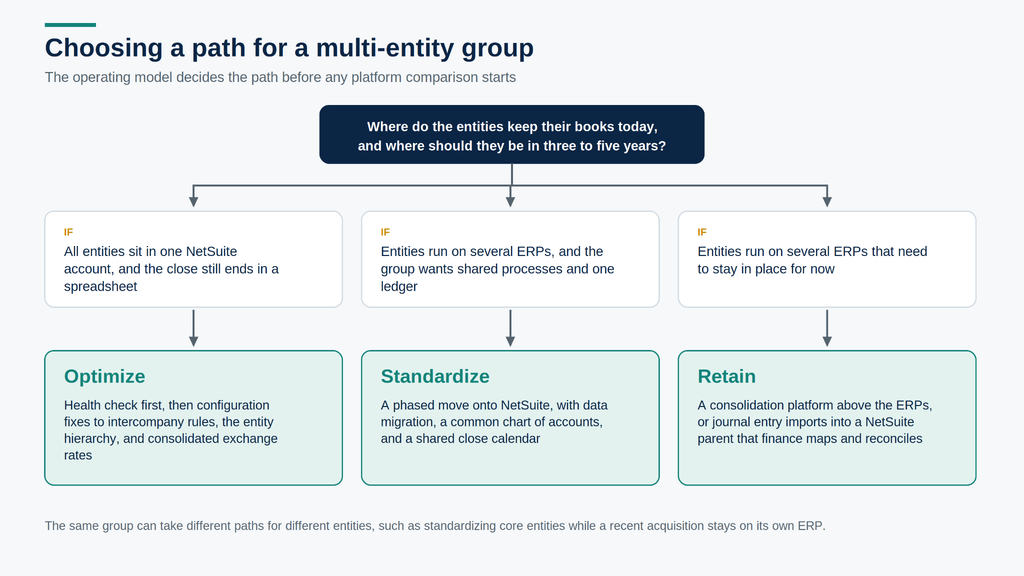
Optimize the current NetSuite account. If every entity sits in one NetSuite OneWorld account and finance still relies on spreadsheets to complete consolidation, start by identifying why. Configuration, data quality, close processes, and reporting requirements can all contribute. Review intercompany rules, elimination subsidiaries, the entity hierarchy, and consolidated exchange rates to determine whether the existing setup can meet the group’s needs or additional functionality is required.
Standardize entities on NetSuite. If separate ERPs came from acquisitions rather than business need, moving entities onto one platform makes consolidation native. That is a transformation, not a software purchase. It needs data migration and a shared chart of accounts and close calendar, so it usually runs in phases.
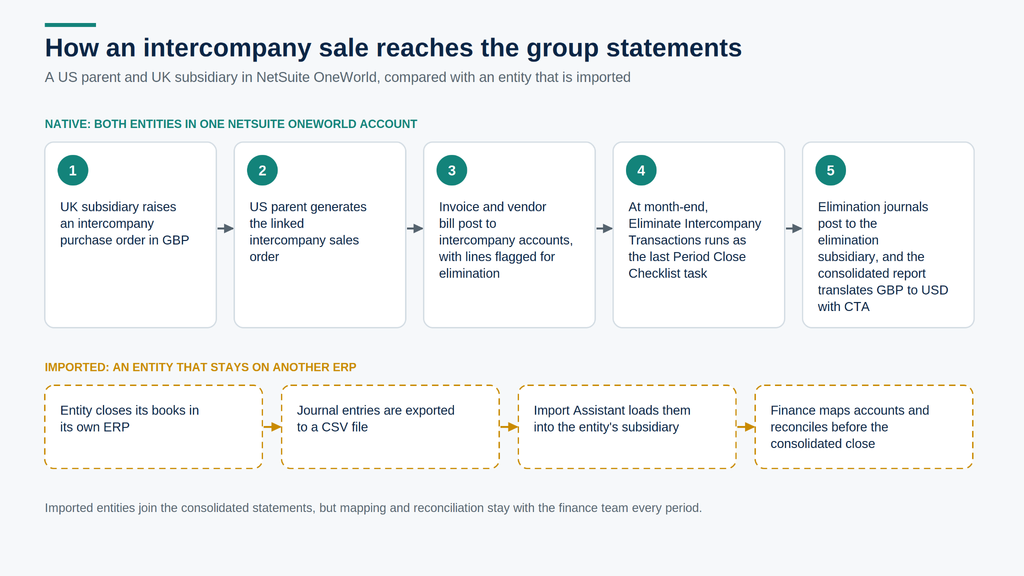
Retain existing ERPs and consolidate above them. Some entities should stay put, such as a recent acquisition or a business the group may sell. These groups need a platform built to load from several ERPs. A NetSuite parent can also import journal entries from those entities, though finance then owns the mapping and reconciliation.
A group can also mix paths, standardizing core entities while a new acquisition keeps its own ERP for now.
The 8 Best Financial Consolidation Software Platforms Compared
Each platform is assessed on the same five points shown in the table columns. The assessments draw on vendor documentation as of September 2026, not hands-on benchmarks. The categories overlap, and BARC’s latest Financial Consolidation Survey reports a clear move toward running consolidation, planning, and reporting on one platform.
| Platform | Where consolidation runs | Data from other ERPs | Evaluation focus | Elimination method | Best fit |
|---|---|---|---|---|---|
| NetSuite OneWorld | Inside the ERP | Native in one account; imports or integrations from other systems | Subsidiary hierarchy and consolidation requirements within one account | Automated at period close | Groups running, or moving, entities into one NetSuite account |
| Sage Intacct | Inside the ERP | Native in Sage Intacct; imports or integrations from other systems | Consolidation subscription and ownership complexity | Automated in consolidation books | Finance-led midsize groups |
| Microsoft Dynamics 365 Finance | Inside the ERP | Balance imports from other systems | Legal-entity structure and consolidation method | Elimination rules at consolidation | Groups standardized on Microsoft |
| OneStream | CPM platform | Loads from multiple ERPs | Ownership complexity and data from multiple ERPs | Automated across source systems | Large multi-ERP groups |
| CCH Tagetik | CPM platform | Loads from multiple ERPs | Consolidation and jurisdiction-specific reporting requirements | Automated, with intercompany matching | Multi-country statutory filers |
| BlackLine | Close automation suite | Ingests data from multiple ERPs | Scope of consolidation, reconciliation, and intercompany products | Automated in its Consolidation products | Multi-ERP groups centralizing the close |
| Vena | CPM platform | Loads from Excel and connected systems | Consolidation requirements and Excel-based workflows | Automated, with intercompany matching | Excel-first finance teams |
| Prophix One | CPM platform | Connects to multiple ERPs | Consolidation, planning, and reporting requirements | Automated, with entity-level matching | Mid-market close and forecast |
The first two columns decide the shortlist once the operating model is set. Entities moving onto one ERP point to the ERP-native rows. Entities staying on several ERPs point to the CPM platforms and BlackLine.
Next, evaluate intercompany activity, ownership complexity, and reporting requirements. Ask vendors to demonstrate how their proposed solution identifies mismatches, handles changes in ownership, and produces the reports your group needs. Confirm which capabilities are included and which require additional modules or configuration.
1. NetSuite OneWorld
Best fit: groups running, or moving, their entities into one NetSuite account.
OneWorld is the multi-subsidiary edition of Oracle NetSuite. Each subsidiary keeps its own base currency and tax nexus inside one hierarchy. Consolidated reports translate subsidiaries into the parent’s currency, with a CTA account for the differences.
Eliminations run through Automated Intercompany Management. Say a UK subsidiary buys inventory from its US parent. The UK entity raises an intercompany purchase order, and the parent generates the linked sales order. The invoice and vendor bill then post to intercompany accounts, flagged for elimination.
At month-end, the controller runs Eliminate Intercompany Transactions, the last task on the Period Close Checklist. NetSuite posts the elimination journals to an elimination subsidiary, so the group statements exclude the internal sale.
Strengths: Eliminations and translation run in the same ledger as daily transactions, with no export step. New subsidiaries join the same account, though each still needs tax and intercompany setup and testing.
Watch out for: native versus imported data. OneWorld consolidates natively only the subsidiaries in the account. Entities on other ERPs can come in through imports or integrations, but that adds mapping and reconciliation to every close.
When to evaluate NetSuite EPM: OneWorld is not the only consolidation option available within the NetSuite portfolio. NetSuite Close Management and Consolidation, part of NetSuite Enterprise Performance Management (EPM), provides additional capabilities for managing the financial close and consolidation process. Groups evaluating dedicated consolidation platforms should include this option in their assessment. The choice should reflect their ownership structure, reporting requirements, source systems, and close processes, with licensing and implementation scope evaluated separately.
2. Sage Intacct
Best fit: finance-led midsize groups whose reporting crosses entity lines.
Sage Intacct is a cloud financial management system built on dimensional accounting. Transactions carry dimensions such as location and fund, so finance can report across entities without extra general ledger codes. Consolidation books hold the group view, and multi-country structures use the Global Consolidations module.
Strengths: The dimensional model suits nonprofit and healthcare groups that report across funds and locations. Our Sage Intacct comparison covers the wider differences with NetSuite.
Watch out for: subscription and functional scope. Sage Intacct offers integrated inventory functionality and multiple consolidation options, including Advanced Ownership Consolidation for multilevel structures and partially owned entities. Confirm which subscriptions are included in the proposal and whether the proposed setup meets the group’s operational, ownership, and reporting requirements.
3. Microsoft Dynamics 365 Finance
Best fit: groups already standardized on Microsoft.
Dynamics 365 Finance consolidates in several ways, including online consolidation and consolidation with import. The import method brings in balances from other instances or systems. Microsoft’s documentation notes that subsidiaries may run on different systems and may not be fully owned.
Strengths: Groups on Azure and Power BI can report consolidated figures in tools they already own.
Watch out for: what an import carries. Imported balances arrive as totals, so transaction detail stays in the source system. The broader trade-offs between NetSuite and Dynamics go beyond consolidation.
4. OneStream
Best fit: large groups consolidating several ERPs with complex ownership.
OneStream is a unified CPM platform covering consolidation, close, planning, and reporting in one application. BARC describes its engine as built for complex financial consolidations. Its Extensible Dimensionality model lets groups extend dimensions for corporate and business-unit reporting, with data loading from SAP, Oracle, NetSuite, and Dynamics 365.
Strengths: Statutory and management views run off one dataset, so the group reconciles a single set of numbers.
Watch out for: resourcing. OneStream suits complex enterprises and needs a team that owns it after go-live. Clean data from several ledgers is an integration strategy question to settle before the project starts.
5. CCH Tagetik
Best fit: groups filing statutory reports in several countries from one dataset.
CCH Tagetik, part of Wolters Kluwer, runs consolidation, planning, and regulatory reporting on a single data model. It automates eliminations and translation, with an intercompany matching cockpit and minority interest handling under IFRS and US GAAP. Disclosure management and iXBRL tagging cover European filings.
Strengths: Groups with heavy statutory work across countries get consolidation and disclosure in one governed environment.
Watch out for: fit for US-only groups. Much of the regulatory depth serves multi-country filers, and each jurisdiction still needs configuring.
6. BlackLine
Best fit: multi-ERP groups that want reconciliation and consolidation in one close platform.
BlackLine started in account reconciliation and close automation. Its Financial Close & Consolidation suite now includes a Consolidation product covering balance aggregation, ownership calculations, eliminations, and top-side adjustments. A separate Intercompany suite handles intercompany entries through netting and settlement.
Strengths: Existing BlackLine customers can bring consolidation into the same close workflow and audit trail.
Watch out for: product boundaries. Consolidation, Intercompany, and reconciliation are separate products, so each proposal should state which ones it includes. Groups with complex statutory needs should test depth against the CPM platforms.
7. Vena
Best fit: Excel-first finance teams that want governance around the workbook.
Vena is a CPM platform with a native Excel interface over a central data model. Finance keeps its templates, while version control and audit history sit underneath. In August 2026, Vena released Vena Financial Consolidation, which automates intercompany matching, translation with CTA, and minority interests.
Strengths: Its Excel-based interface may suit finance teams that want to retain familiar workflows while adding centralized data management and consolidation capabilities.
Watch out for: fit with the group’s requirements. Ask Vena to demonstrate the proposed solution using your ownership structure, intercompany activity, and reporting needs. Confirm what is included in the consolidation offering and how it connects with planning and forecasting.
8. Prophix One
Best fit: mid-market groups where the close and the forecast share a calendar.
Prophix One covers consolidation, planning, reporting, and account reconciliation on one platform. It handles eliminations, translation under ASC 830, and minority interest, and Prophix positions it for 10 to 100 or more entities. Its Intercompany Management lets entities match transactions directly, and reconciled balances generate elimination entries.
Strengths: Management reporting and rolling forecasts use the same consolidated data, so plans and actuals stay in step.
Watch out for: statutory reach. Groups with heavy multi-country disclosure should compare its regulatory output with CCH Tagetik’s.
What Changes Once Consolidation Works
A well-designed consolidation process should make the following tasks easier. Test each one against the proposed product, modules, and configuration:
- Identifying intercompany differences: Finance can identify and investigate mismatches before completing the close.
- Explaining currency translation movements: Finance can trace cumulative translation adjustment (CTA) balances and prepare the supporting detail needed for review.
- Accounting for non-controlling interests: Where required, the solution supports the group’s ownership structure and accounting treatment. Confirm which calculations and entries are automated.
- Tracing adjustments and approvals: Finance can retrieve journal history and supporting records, including approvals where approval workflows are configured.
How to Select Financial Consolidation Software for Your Entity Structure
Each question below narrows what the next one needs to answer.
Will entities stay on their current ERPs?
This operating model question shapes every answer after it. If the group plans to standardize, ERP-native platforms come first, and most of the work is agreeing shared processes. If entities stay on separate systems, the CPM platforms and BlackLine fit that structure.
Groups still on QuickBooks face an earlier decision. For them, consolidation pain is often the clearest sign of outgrowing QuickBooks.
What moves between entities?
Intragroup loans and management fees suit standard elimination rules. Daily intercompany sales and inventory transfers need transaction-level matching. A strong demo shows an unmatched item surfacing before the close.
How fast are entities being added?
Groups that acquire or expand abroad should ask how a subsidiary bought in month seven joins a live consolidation. Each new country adds currency and tax setup, and that effort recurs with every entity.
Does group reporting need operational data?
Some groups need consolidated results beside measures like location performance. When that data lives in other systems, the questions are how each platform connects through native modules or integrations, and who maintains those connections.
What will the auditor ask for?
A CTA roll-forward for a subsidiary that changed functional currency mid-year makes a revealing demo request. Gartner Peer Insights adds a counterweight, since its reviews come from people who used the product after the demo.
Who runs it after go-live?
Entities and reporting needs keep changing after launch. The evaluation should name who owns configuration changes and new entity setup once the implementation team steps back.
Check the Setup Before You Fund the Migration
Every platform here can run a multi-entity consolidation, but none does it out of the box. Elimination rules, the subsidiary hierarchy, ownership percentages, and translation rate types are all set during implementation. When the group changes and the configuration does not, the close drifts back to a workbook.
So an under-configured system can look like an outgrown one. If the platform cannot handle the group’s structure, the shortlist above is the place to start. If the setup is the problem, NetSuite remediation may be the faster, lower-cost route.
How Bring IT Supports Multi-Entity Groups
Bring IT helps multi-entity organizations implement, integrate, and optimize NetSuite. For groups reviewing their consolidation process, the starting point is understanding the current systems, reporting requirements, and manual work involved in the close.
That assessment helps define the next steps, whether improving an existing NetSuite setup, bringing additional entities onto the platform, or connecting other systems. Post-go-live support and optimization can also be discussed through Bring IT’s managed services offering, with the scope agreed according to the customer’s needs.
Bring IT’s work with Orangetheory Fitness illustrates its experience supporting a global franchise organization with more than 1,500 locations. The implementation included NetSuite OneWorld and customized billing and royalty processes. The case study reports 20% lower operational costs through automation across the broader implementation; this is not presented as a consolidation-only result. The location count describes the franchise network, rather than the number of legal entities consolidated in NetSuite.
To find out which path fits your entity structure and what it would take, talk to a Bring IT expert.
Frequently Asked Questions
Can a group consolidate in spreadsheets?
Yes, particularly for a small group with a straightforward structure. However, as entities, currencies, and intercompany activity increase, spreadsheets can become harder to maintain and review. Teams need controls for version management, reconciliations, approvals, and supporting documentation to keep the process reliable.
How is multi-entity accounting different from consolidation?
Multi-entity accounting manages the books and transactions of separate entities. Consolidation combines their results into group financial statements, including the necessary eliminations, currency translation, and adjustments. Exporting consolidated results to Excel for analysis does not necessarily mean consolidation functionality is missing. The key question is whether spreadsheets are being used to perform essential consolidation steps or simply to analyze the results.
What is cumulative translation adjustment?
CTA holds the differences created when a foreign subsidiary’s results are translated into the reporting currency. Under ASC 830, those differences go to other comprehensive income, not net income. Auditors ask for the roll-forward to see how the balance moved each period.
Where does AI actually help in consolidation today?
AI capabilities vary by product and module. For example, NetSuite Close Management and Consolidation includes Job Analytics Insights, which uses generative AI to analyze job performance during the financial close. When evaluating AI features, ask vendors to demonstrate the specific task supported, explain availability and licensing, and show how finance reviews the output. AI does not replace the accounting policies and controls governing consolidation.