“We close the month, then we spend days explaining the numbers.”
When a CFO says this, they aren’t describing a software limitation. They are describing a failure of structure.
In the race to scale, many organizations treat integration as a technical plumbing project, pipes connecting systems. But most integration strategies fail because they are designed to connect systems, not to preserve financial truth. As organizations expand across entities and geographies, the gap between “data” and “decisions” widens. Finance leaders are no longer just managing books; they are managing the architectural integrity of the entire business.
The Operational Reality: The High Cost of “Correction After the Fact”
Most organizations don’t hit a wall because their software lacks a specific feature. They hit a wall because their data is fragmented.
When revenue, billing, and costs live in disconnected silos, finance shifts from a strategic function to a validation department. Instead of analyzing performance, the team spends its time in “manual alignment”, a polite term for fixing data that should have been right the first time.
The structural implication is severe: If your data requires validation before it can be used, your systems have already failed. In this environment, the financial close isn’t an accounting process; it’s a forensic investigation.
Why the “Modular Stack” Is Often a Trap
There is a popular trend toward the “best-of-breed” or modular approach. It promises flexibility, allowing companies to pick the best tool for every niche.
However, there is a hidden cost: A modular stack can look flexible on paper and still become a reporting liability under acquisition-driven growth. Every time you add a new “best-of-breed” platform, you introduce a new translation layer. You aren’t just adding a feature; you are adding a dependency. This creates a “Middleware Tax”, ongoing maintenance, delayed batch processing, and a constant need for manual reconciliation that never truly goes away.
Architecture vs. Features: A Diagnostic Comparison
When evaluating systems in the US market, stop looking at feature lists. Features are easily replicated; architecture is not.
The Unified Model (e.g., NetSuite)
The architectural bet here is that a shared data model across finance, operations, and customers is more valuable than any niche feature. By eliminating the translation layer, you eliminate the need for reconciliation. The “financial truth” is preserved because the transaction and the ledger are the same thing.
The Modular/Ecosystem Model (e.g., Microsoft Dynamics 365, SAP S/4HANA)
These systems offer deep process coverage and industry-specific modularity. They are built for complexity, but that complexity requires a heavy governance hand. Without a strict centralized data strategy, these environments quickly devolve into the “Fragmented Structure” mentioned above, where the finance team becomes the human glue holding disparate systems together.
The Industry Specialist (e.g., Infor)
While strong on the shop floor or in the warehouse, these often struggle to speak “finance” fluently. The risk here is a permanent disconnect between operational activity and the consolidated ledger.
The Growth Constraint: A Case Study in M&A
Consider a services organization that grew from five to sixteen entities via rapid acquisition. On paper, they were a success. On the balance sheet, they were a mess.
Each entity kept its own “flexible” legacy systems. To “fix” this, leadership introduced a series of middleware connectors to avoid a full ERP migration. The result was a reporting liability. It took three weeks to produce a consolidated view of the business. By the time the numbers were “validated,” they were too old to be useful for strategy.
The shift to a unified structure wasn’t about getting “better software.” It was about enforcing a single source of truth. By standardizing intercompany processes and removing the translation layers, the close cycle didn’t just speed up, the numbers became trustworthy.
How to Evaluate Your Strategy: 4 Diagnostic Questions
If you are evaluating your integration strategy, ignore the sales demos and ask these questions:
- Data Integrity: Is there a single, consistent structure, or are we translating data between apps?
- Dependency: How much of our financial close relies on middleware or manual Excel adjustments?
- Latency: Can I see my current financial position right now, or do I have to wait for a “sync”?
- The “Correction” Test: Do we spend more time generating reports or justifying the data inside them?
When Not to Change (Yet)
Transformation for the sake of a trend is a waste of capital. You should maintain your current environment if:
- Your close process is predictable and meets internal targets without heroic effort.
- Your “manual reconciliation” is a minor task, not a full-time job for three people.
- Your growth is organic and doesn’t introduce new structural pressures or complex entity relationships.
The decision to transform should be driven by structural limitations, not external hype.
The Bottom Line
Systems can be replaced. Structure cannot be improvised.
Integration design defines how a business operates as it scales. It determines whether your finance team is a strategic engine or a cleanup crew. Organizations that prioritize a unified data model over “connectivity” create a massive competitive advantage: data flows once, reporting reflects reality, and growth doesn’t compromise control. That is the difference between managing complexity and building a financial structure that scales.
FAQs
1. What is the most effective ERP integration strategy for US mid-market companies?
For companies scaling in the US, the most effective strategy is prioritizing a unified data model over a fragmented “best-of-breed” stack. This approach reduces the “Middleware Tax” and ensures that financial reporting remains accurate across multiple entities and geographies without manual reconciliation.
2. How does a unified ERP architecture improve financial control?
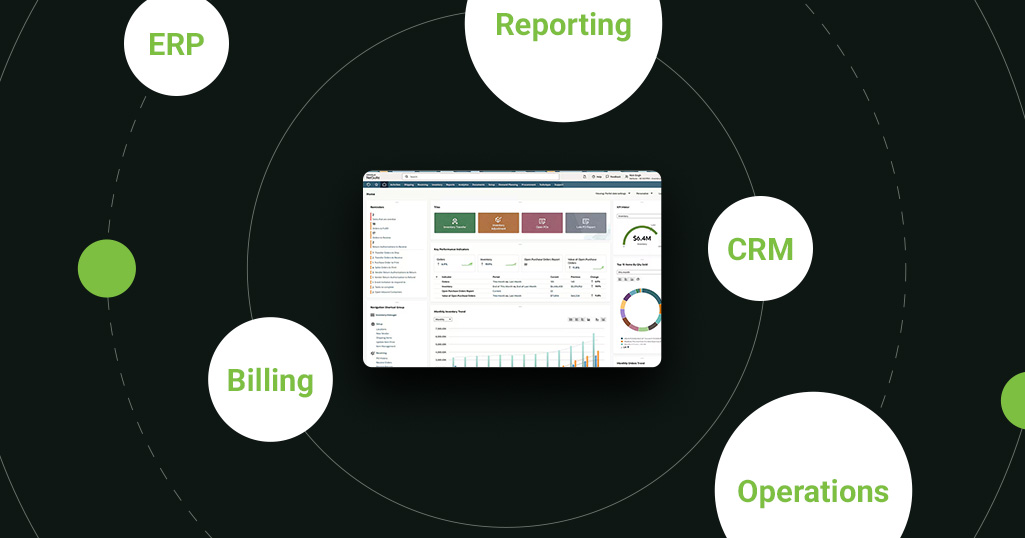
Unified architecture records transactions once and reflects them consistently across all modules (Finance, CRM, Operations). This eliminates data silos and ensures that the numbers used by leadership are “trusted at the source” rather than corrected after the fact, significantly reducing the risk of reporting errors.
3. Why is the “Modular Stack” considered a risk for finance teams?
While modular stacks offer specialized features, they often create fragmented structures. Each integration layer between different platforms acts as a translation point where data can lose integrity. For finance teams, this results in extended close cycles and a heavy reliance on manual validation before reports can be shared.
4. Can ERP integration help reduce financial close times?
Yes. By standardizing data flows and removing manual translation layers, organizations can move from reactive validation to proactive control. Companies with unified ERP structures often see close cycles reduced by days because they no longer spend time reconciling data from disconnected billing or operational systems.
5. When should a company replace its legacy ERP integration with a unified cloud suite?
A transition is necessary when structural limitations begin to hinder growth. If your finance team spends more time justifying report data than analyzing performance, or if M&A activity has created a reporting liability that takes weeks to consolidate, it is time to move to a unified architecture that scales with your business complexity.