Key Takeaways:
- Channel Partners (Solution Providers/VARs) sell NetSuite licenses and bundle implementation, offering a single point of contact but with a built-in incentive to upsell modules and licenses
- Alliance Partners don’t sell licenses; you contract directly with NetSuite while the Alliance Partner delivers implementation, customization, and support, removing that sales incentive from the delivery relationship.
- For hospitality-specific deployments, industry depth (multi-property consolidation, PMS integrations, revenue recognition for hotel operations) matters more than bundled convenience.
- Bring IT’s Hotel 360° SuiteApp and Alliance Partner status combine specialization with an unconflicted implementation approach.
Every hotel group that considers NetSuite has to answer one question first: who implements it, and how does that firm get paid?
A NetSuite Channel Partner sells you the license and the implementation together. A NetSuite Alliance Partner sells you neither. It only sells the work of making the system fit your properties.
This difference determines whether your partner pushes modules you don’t need, who supports you after go-live, and how much real hospitality experience you actually get.
This article breaks down both models so that you can choose the right one for your hotel group.
What is a NetSuite Channel Partner?
A Channel Partner is also called a Solution Provider or VAR. It resells the NetSuite subscription and bundles implementation services into one contract. You sign with one firm for both the license and the delivery.
This model is simple; one vendor, one invoice, one point of contact. For a straightforward, single-entity rollout, that simplicity has real value.
It also means the partner’s biggest payday happens at the license sale, not at go-live. Once that sale closes, the partner has already captured its highest-margin revenue. Services delivery continues, but the financial pressure to get it right is lower.
What Is a NetSuite Alliance Partner?
An Alliance Partner works differently: the Oracle NetSuite sales representative handles your license directly.
The Alliance Partner signs a separate contract for implementation, integrations, and ongoing support. You end up with two agreements instead of one: a subscription agreement with Oracle, and a services agreement with the Alliance Partner.
Although two agreements mean two relationships to manage, that’s the real cost of this model. A partner with strong ties to NetSuite closes that gap, so the two relationships feel like one.
What are the Differences Between a NetSuite Alliance Partner and a Channel Partner?
The most consequential structural difference between the two partner types is revenue capture: who makes money from the license, and what that does to the partner’s economic incentive once the license transaction closes.
License margin and services revenue create different pressures on scope definition, methodology depth, and post-go-live engagement. The table below maps five dimensions where those pressures show up:
| Dimension | NetSuite Alliance Partner | NetSuite Solution Provider (Channel Partner) |
| License ownership | NetSuite direct rep closes the license; Alliance Partner does not touch it | Resells the NetSuite subscription; license margin is part of the commercial relationship |
| Revenue structure | 100% services revenue: implementation, integrations, managed services | Revenue split between license margin and services fees |
| Implementation accountability | Services contract is independent of the license; accountability sits entirely on delivery | License and services bundled; economic weight sits at the license close |
| Post-go-live coverage | Managed services is a commercial line; the partner has financial reason to sustain the relationship | Post-go-live engagement is scoped separately and may not be in the original bundle |
| Outcome ownership | Partner’s commercial model depends on whether the system delivers | Partner’s primary economic event has already occurred at license close |
The five sections below examine each dimension in more depth.
License Ownership and Commercial Structure
In the Alliance Partner model, the NetSuite direct sales representative owns the license sale on every deal. The Alliance Partner enables that sale by mapping the business case and implementation scope, but the license closes separately, with Oracle capturing the subscription revenue. The Alliance Partner’s services contract is an independent commercial relationship.
A Solution Provider bundles the license and services into one commercial relationship. The buyer signs with the Solution Provider for both the NetSuite subscription and the implementation services, and the Solution Provider captures margin on both. That structure simplifies the buying motion but concentrates the partner’s economic incentive at the license transaction.
Implementation Accountability and Methodology Depth
When a partner’s revenue comes entirely from services, the engagement’s commercial viability depends on the implementation delivering what was scoped. That dependency shapes methodology: Bring IT runs business-process mapping and produces a System Design Document before configuration begins partly because the services model requires a defensible scope. Partners whose primary economic event is the license close face a different pressure: close the deal, then figure out scope.
The buyer-side evidence for this pattern is the partner-switch pipeline. Companies do not switch NetSuite partners because NetSuite is wrong, based on patterns in that pipeline. They switch because the prior implementation left fragile integrations, missing reporting, and no one accountable after go-live.
Post-go-live Coverage and Managed Services Tier
Managed services works differently for an Alliance Partner than it does for NetSuite itself. Since it’s a different revenue line, the partner has a real financial reason to stay engaged long after go-live rather than moving on once the system is live.
NetSuite’s own support sits underneath that. Premium Support is included with your license and covers the basics. Advanced Customer Support (ACS) is a paid step up, offered across several tiers, Advise, Monitor, Optimize, and Architect, each built around a set number of hours negotiated into your contract.
An Alliance Partner’s managed services picks up where ACS leaves off. That’s advanced module rollouts, complex integrations, expansion into a new country, and the kind of continuous optimization ACS was never designed to carry.
Integration Architecture Ownership
Integration failures are the most common reason companies switch NetSuite partners, based on patterns in the partner-switch pipeline. Silent failures that surface at month-end reconciliation, undocumented integrations left by a prior partner, flows that drop records without alerting anyone: these are the operational symptoms of an integration architecture built without a long-term owner.
Alliance Partners who earn from services across the engagement lifecycle have a commercial reason to build integrations that hold up. The architecture decision- whether to go point-to-point, what error-handling standard to apply- is made in the Statement of Work (SOW), not discovered mid-implementation.
What NetSuite Support Actually Covers
NetSuite’s own support has two broad layers. Premium Support comes included with your license. Advanced Customer Support (ACS) adds paid, hands-on help across several tiers: Advise, Monitor, Optimize, and Architect, with hours capped per contract rather than published at a fixed rate.
Neither layer covers advanced module rollouts, complex integrations, or the day-to-day work of keeping a multi-property system running well. Someone still has to close that gap. That’s where an Alliance Partner’s managed services team takes over.
- Premium Support: Included with your license, covers basic platform issues
- ACS: Paid add-on, a capped block of hours per contract, several tiers depending on how hands-on you need it
- Managed services: Alliance Partner-delivered, ongoing optimization and integration ownership, not bound by a quarterly hour cap
Managed services is only worth paying for if the partner behind it has actually delivered before. Read on to know how to check that.
Checking a Partner’s Track Record
Oracle verifies its Alliance Partners. It doesn’t just take their word for it. Look for these signals before you sign:
- Alliance Partner Spotlight designation: awarded for a verified delivery track record
- Partner of the Year by region: given to the top-performing Alliance Partner in a market
- Industry Expertise certifications: proof of real delivery depth in your vertical, including hospitality
- Module certifications: proof the partner has built with the specific tools you need
Ask for proof of these credentials before you sign. No proof means no way to check their claims. Hospitality is one of the industries with its own Industry Expertise certification. Here’s what that expertise looks like in practice.
Hospitality in Practice: Hotel 360
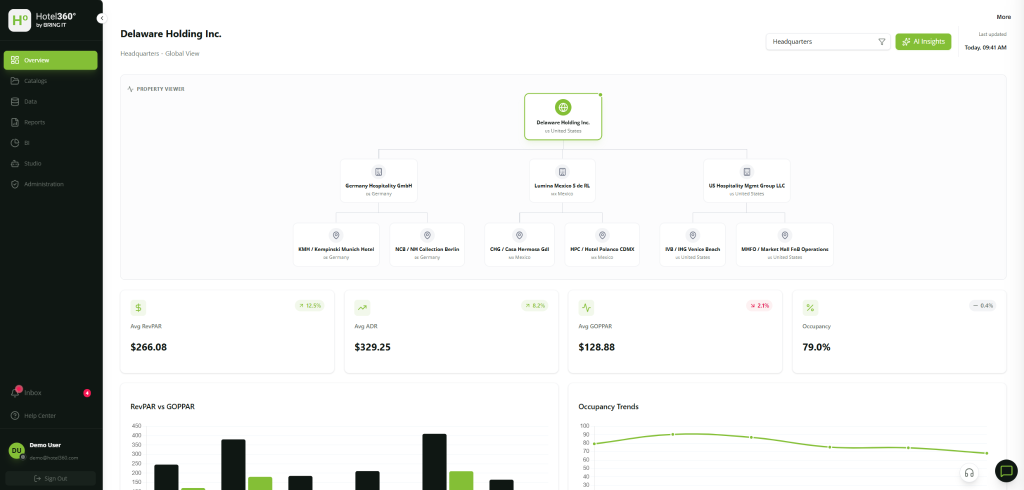
Bring IT’s Hotel 360 SuiteApp connects Opera PMS and Simphony POS directly into NetSuite. Guest charges and property costs land in the general ledger without manual reconciliation.
The Opera PMS integration consolidates data across entities in different currencies and tax jurisdictions. That matters the moment your portfolio crosses one country or one ownership structure. Automated USALI reporting replaces the manual spreadsheet work that eats up the first ten days of every month-end close.
OKU Hotels, operating across Spain, Greece, and Turkey, used this integration layer to move from manual reporting to real-time visibility across its portfolio. The same approach extends to POS systems at the property level and other integrations across your finance stack.
Results like that don’t happen by accident. They start with how the project gets scoped before any implementation begins.
How an Alliance Partner Scopes Your Project
A hospitality rollout starts with discovery. The partner maps your current PMS, POS, and accounting stack before writing a single line of scope.
That discovery produces a System Design Document. It lays out every workflow, integration, and configuration decision before implementation starts. Because an Alliance Partner has no license riding on the outcome, that document is built around your properties, not a predetermined module list.
Discovery sets the plan. What happens once the system is live is where the partner model shows its real difference.
What Happens After Go-Live
Bring IT Care runs in four phases. Stabilization fixes configuration gaps right after launch. Adoption trains your team on the new system. Automation replaces manual workarounds with system-driven processes. Continuous optimization adds modules and entities as your portfolio grows.
A Channel Partner can offer something similar. But its biggest payday already happened at the license close, so ongoing support is often a separate sale, not a built-in part of the relationship. An Alliance Partner’s revenue depends on the system continuing to work, so staying involved isn’t optional; it’s the business model.
That gap is why companies switch NetSuite partners so often. It’s rarely because NetSuite itself is wrong. It’s because the prior partner left fragile integrations and nobody accountable after go-live.
When a Partner Isn’t Working
Here’s a pattern many CFOs recognize. The license is active. The system is live. But month-end still needs a parallel spreadsheet, because the numbers NetSuite produces don’t match what was scoped. Integrations drop records silently. Nobody at the prior partner answers the phone.
This usually traces back to the incentive question. If the partner’s biggest payday already happened at the license close, there’s less financial reason to keep the system running well.
An Alliance Partner can take over a build like this. The process is straightforward:
- Audit the instance. Document every workflow, integration, and customization actually in place.
- Compare against original scope. Find the gaps between what was promised and what was delivered.
- Stabilize first. Fix the highest-risk issues, usually silent integration failures, within a defined window.
- Move to managed services. Once stable, the engagement continues under an ongoing support relationship.
A CFO who starts this process running a parallel spreadsheet typically ends it with a clean, system-driven close.
Channel Partner or Alliance Partner: Which Partner Type is Best for Your Hotel Group?
Use these questions to decide:
- Do you operate more than one property, entity, or currency? Complexity favors an Alliance Partner.
- Do you run more than a handful of integrations, like PMS, POS, or payroll feeds? Integration complexity favors an Alliance Partner with an SDN Partner.
- Do you expect to add properties or enter a new country within the next 18 to 24 months? Planned growth favors an Alliance Partner, since the model is built to scale with you.
- Do you need ongoing support after go-live, not just a one-time build? A managed services relationship favors an Alliance Partner.
If you answered no to all four, and you’re a single property with a simple chart of accounts, a Channel Partner’s bundled simplicity may be enough. Most multi-property hotel groups answer yes to at least one.
Some groups start with a Channel Partner for a small first phase, then move to an Alliance Partner as they grow. That’s a valid path too, as long as you plan the transition before complexity forces it, not after.
Bring IT as a NetSuite Alliance Partner for Hospitality
Bring IT operates as an Oracle NetSuite Alliance Partner. The firm’s only stake in your implementation is whether it works, not whether you buy an extra license tier. Paired with Hotel 360, that means your scope gets built around what your finance team actually needs.
If you’re evaluating partners for a multi-property rollout, or trying to fix one that isn’t working, talk to Bring IT about what an Alliance Partner engagement looks like for your portfolio.
Frequently Asked Questions
Does an Alliance Partner cost more than a Channel Partner?
Not exactly. NetSuite sets a base license price, but a Solution Provider resells it at their own price. An Alliance Partner doesn’t touch the license at all, so you pay Oracle’s rate directly, with no reseller markup.
Who do I call for support if NetSuite closes my license directly?
NetSuite handles standard platform support. Your Alliance Partner handles support for your customizations and integrations, like Hotel 360.
What should I ask a partner in the first call?
Ask three things: Who closes the license, you or NetSuite directly? Are the license and services in one contract or two? What share of your revenue comes from license resale versus services? The answers tell you the real model, no matter what the partner calls itself.
Do I need an Alliance Partner for a single property?
Not necessarily. The objectivity advantage matters most when scope or integration complexity creates room for a licensing incentive to shape recommendations. A simple, single-property build may not carry that risk.