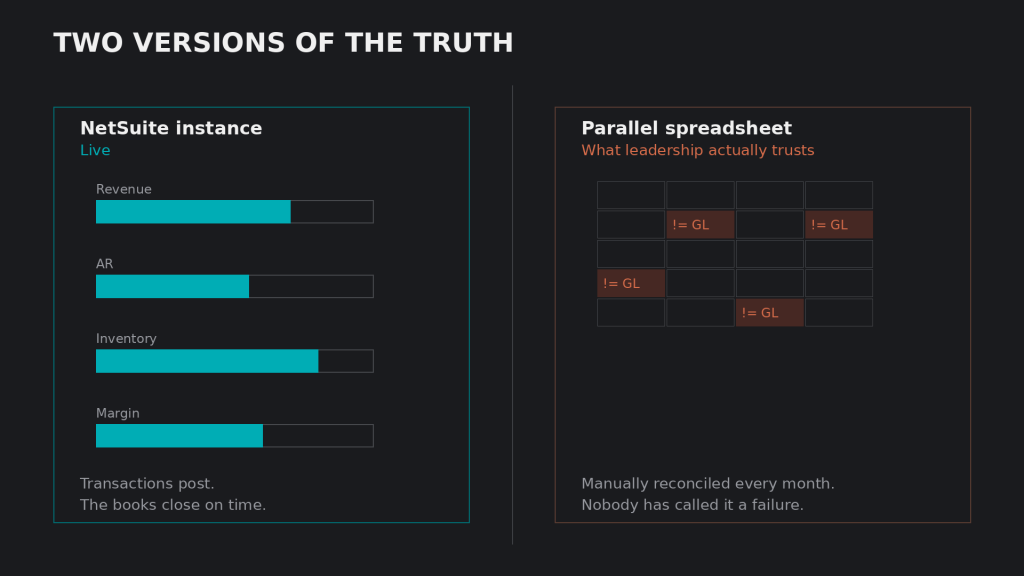
Most NetSuite implementations that underperform are never diagnosed as failures. The system launched. Transactions post. Finance closes the books every month. On paper, nothing is wrong. Underneath that surface, reporting still does not match what was scoped. A parallel spreadsheet still carries the numbers leadership trusts. Integrations drop records that only surface once the controller reconciles.
This guide names the structural causes behind that condition. It shows finance and executive leaders how to tell a platform failure from a partner failure, and lays out what a structured recovery requires.
Key takeaways
- ERP implementation failure is a structural, post-go-live condition. The clearest signal is a live system paired with a spreadsheet finance still trusts more.
- Three causes compound quietly: architecture decided before the process is documented, data migrated without validation, and integration built to connect systems rather than protect financial truth.
- A platform failure and a partner failure are different problems with different fixes, and most partner-switch situations involve both at once.
- NetSuite is built to run 10 to 20 years. Most failures at this scale trace to the partner relationship, not the software.
- Recovery runs in three stages: an instance audit, integration architecture rebuilt in the SOW instead of discovered after the fact, and managed services that keep improving the system afterward.
What ERP implementation failure means
ERP implementation failure is not defined by a collapsed go-live. The more common condition is structural: the system runs, transactions post, and no one has called a crisis, yet the business cannot trust what it reports.
Go-live is a technical milestone. A working system is a business outcome, and the two are not the same achievement. A system that posts transactions and processes payroll has cleared the go-live bar. A system that delivers the original reporting scope, consolidated multi-entity financials, real-time integration, and margin reporting at the granularity finance needs is doing something structurally different.
Manual workarounds meant to be temporary tend to calcify into a permanent process. They fragment data until different teams see different numbers, long before anyone is willing to call the system a failure.
Demos run on clean data and a consultant who knows exactly which paths to walk. Production runs on none of that. High-volume transactions, integrations under load, and the open question of whether the modules a CFO was shown in the demo were ever fully configured. ERP failures rarely trace to a workflow that looked unpolished. They trace to architecture that could not sustain complexity once real production volume arrived.
The structural causes that compound before anyone notices
The failure patterns that surface after go-live are built into the engagement before configuration begins. None of the three causes below announce themselves at go-live; they accumulate silently until month-end or quarter-end forces a reckoning.
When architecture is decided before the process is mapped
Configuration that precedes process documentation is a leading root cause of post-go-live failure. When a consultant opens the configuration screen before completing business processes, the configuration reflects the consultant’s assumptions, not the business’s workflows. Those assumptions persist in production as permanent manual workarounds.
A properly governed NetSuite implementation maps the business process first, identifies what NetSuite cannot fill natively, and documents how partner tools close those shortfalls before the SOW is signed.
When migration moves data without checking it first
Migration work that moves data without validating it against NetSuite’s structure first is the usual root cause behind an analytics project that later looks broken. Moving records from a legacy ERP into NetSuite without validating against the target system’s data model introduces referential integrity conflicts, missing required fields, data format mismatches, and imbalanced transactions.
Those errors surface when a report depends on a field that was never populated. Sometimes a reconciliation reveals that historical transaction data does not tie to the general ledger. Structured migration methodology applies validation controls before data loads, so finance catches the problem in staging rather than during a live close.
When integration is built as plumbing, not infrastructure
Many integration strategies fail because they connect systems without protecting the financial truth those systems carry. An integration that connects Shopify to NetSuite is technically complete once orders flow between systems. An integration that preserves financial truth does more: it handles failures with retriggering logic, surfaces errors with real-time alerting, and documents the architecture so the next team can maintain it.
In remediation engagements, most prior-partner integrations meet the first standard, and a few meet the second. The maintenance burden that follows rarely disappears on its own: delayed batch processing and manual reconciliation that compound every time a record drops.
Post-go-live signals that the architecture is not holding
When the system is live but the parallel spreadsheet is still running, the architecture has not held, no matter how clean the dashboards look. The signals below are architectural problems, and they tend to surface in a fairly predictable order.
Why the spreadsheet never goes away
Many companies go live with NetSuite but keep relying on Excel and manual processes that create bottlenecks and errors. Excel persistence after go-live is a configuration signal: finance runs a spreadsheet because the system was never configured to produce the output the team needs to close the books.
When analysts spend most of their time building spreadsheets rather than performing strategic analysis, finance ends up checking whether numbers are correct instead of analyzing what they mean. That is the condition that makes the ERP investment difficult to defend to a board.
Why month-end turns into an investigation
At this point, the financial close functions less like an accounting process and more like a forensic investigation. It means untangling which records dropped, which transactions posted incorrectly, and which downstream positions need adjustment.
An integration that fails loudly generates an error message someone has to act on immediately. One that silently drops a record generates nothing at all, until the controller runs the reconciliation days later and finally finds the discrepancy sitting underneath everything else.
Why consolidation still happens outside OneWorld
NetSuite OneWorld exists to automate intercompany eliminations and consolidation across legal entities. When the finance team is still exporting data from each subsidiary, normalizing it in a spreadsheet, and manually assembling the consolidated view, OneWorld is not doing its job. It is either misconfigured, or it was never set up to automate the consolidation the business needed.
At scale, manual consolidation across many legal entities ties up analyst time every close cycle. It still produces reconciliation errors at quarter-end, especially around intercompany eliminations and currency revaluation. This is exactly the work OneWorld was licensed to eliminate.
These signals do not stay contained to finance. A failed ERP implementation at this scale is a board-level event, and honest scoping matters more than the cheapest proposal. The CEO who championed the decision explains to the board why reporting is still incomplete. The CFO who approved the budget defends a system that has not delivered. Neither credibility problem improves with time. It improves only when the architecture is fixed.
Is it the platform or the partner?
Companies rarely switch NetSuite partners because the platform itself is wrong. They switch because the prior implementation left them with fragile integrations, missing reporting, and no one left to call when something goes wrong. This is the most common North American partner-switch pattern, and it matters because the platform is usually the part that was correct all along.
The table below separates a platform problem from a partner problem, since the two point toward different fixes and mixing them up wastes both time and budget.
| Signal | Platform failure | Partner failure |
|---|---|---|
| Root cause | NetSuite cannot support the business’s real complexity or scale | The implementation was scoped, configured, or documented poorly |
| What it looks like | Native limitations even a well-run implementation cannot work around | Fragile integrations, missing reporting, no one who can explain the architecture |
| Who can explain it | Any competent NetSuite consultant, since the constraint sits in the platform | No one currently on the account, since the decisions were never documented |
| What fixes it | Replacing or significantly reconfiguring the ERP | A new team auditing what exists and closing the distance between scope and delivery |
Most North American partner-switch engagements show signals from both columns at once. The architecture has real shortfalls, and the team that built it is no longer reachable to close them.
Red flags a partner leaves behind
Architecture decisions that cannot be explained in business terms are one of the clearest red flags of partner-level failure. There is no SOW rationale, no named decision criteria, and no failure-handling logic written down anywhere.
Ticket queues with no named owner are the second signal. A prior partner gone quiet means errors accumulate with no one triaging them. The internal team inherits an instance whose documentation problems surface only once the prior team is unreachable.
Certain signs point to a partner problem
Certain signs point to a partner problem rather than a normal stabilization problem. The same categories of errors recur at every close. No one currently on the account can explain the prior partner’s architecture decisions. Modules from the original scope were never configured, even though the business paid for them.
Stabilization time resolves operational issues on a correctly configured system. It does not fix architecture that was wrong from the start, which is the line that separates remediation from ordinary optimization work.
An undocumented integration also carries a compounding cost. Any change upstream or downstream risks breaking it without a recovery path. NetSuite is built to run for 10 to 20 years, and a partner who cannot handle the next module or country makes that cost worse every year the relationship continues.
Before signing with any implementation partner, three questions separate an accountable engagement from one likely to recreate this pattern:
- Who owns a production integration failure at 11 p.m. on the last day of the quarter, named in the SOW rather than assumed?
- Does a signed System Design Document precede configuration on every engagement, or does configuration start before the business process is mapped?
- What is the business committing to on its own side, in named stakeholders, timely input, documentation, and testing?
Recovery works when both sides can answer these clearly, in writing, before anything is signed.
What a structured recovery requires
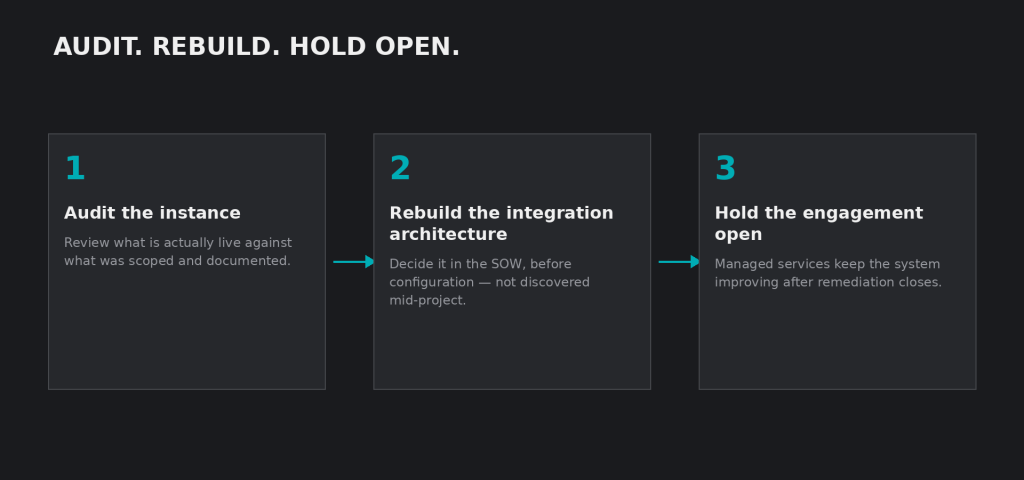
A structured recovery starts with a full audit of the existing instance. It replaces integration architecture with decisions made in the SOW, rather than discovered after go-live. Then it holds the engagement open through managed services, so stabilization and optimization do not stop when remediation closes.
None of this runs as a one-way delivery. The SOW’s accountability model works in both directions: the business names stakeholders who are available, turns around documentation on schedule, and completes testing, the same way the partner commits to the architecture and integration work above.
Auditing the instance and closing the distance between scope and delivery
Finance teams living with a broken implementation share a consistent problem. The system they have does not match the system they were shown, and the team who built it is no longer available to fix it.
Before any configuration changes, the existing instance is reviewed end to end: which modules are live, what was configured but unused, what was scoped and never built, and what the integration architecture looks like in production versus what the prior partner documented. That review produces a System Design Document reflecting the instance’s actual state. It becomes the foundation for a fixed-bid scope of work with named owners for every deliverable, so architecture decisions get made before configuration.
An architecture decision made after go-live still gets made twice: once by guesswork, and once by whoever has to unwind that guess before anything new can be built on top of it.
Grover Gaming reached full ROI in under six months, at a $3 million monthly run rate, after this kind of recovery replaced a prior implementation built on Sage. The fix rebuilt the architectural foundation itself, not just the surface-level configuration that had been masking the underlying problem.
Rebuilding the integration architecture on purpose
Integration failures accumulate and surface at the worst possible time: the last day of the quarter, the month-end close, the audit. Most prior-partner integrations were built to connect systems, not to surface failures before they reach the ledger.
The architecture layer gets selected based on what the integration requires, before any of it is built:
- Celigo for pre-built connector flows across Shopify, Salesforce, Amazon, HubSpot, and 200-plus others
- Boomi for complex EDI and custom logic the connector layer cannot handle
- Point-to-point RESTlets when middleware adds cost and latency without a matching benefit
Every integration built this way ships with retriggering on failure and real-time alerting as a default, so issues surface before reconciliation instead of during it, when the cost of finding them has already multiplied.
The post-recovery continuity model
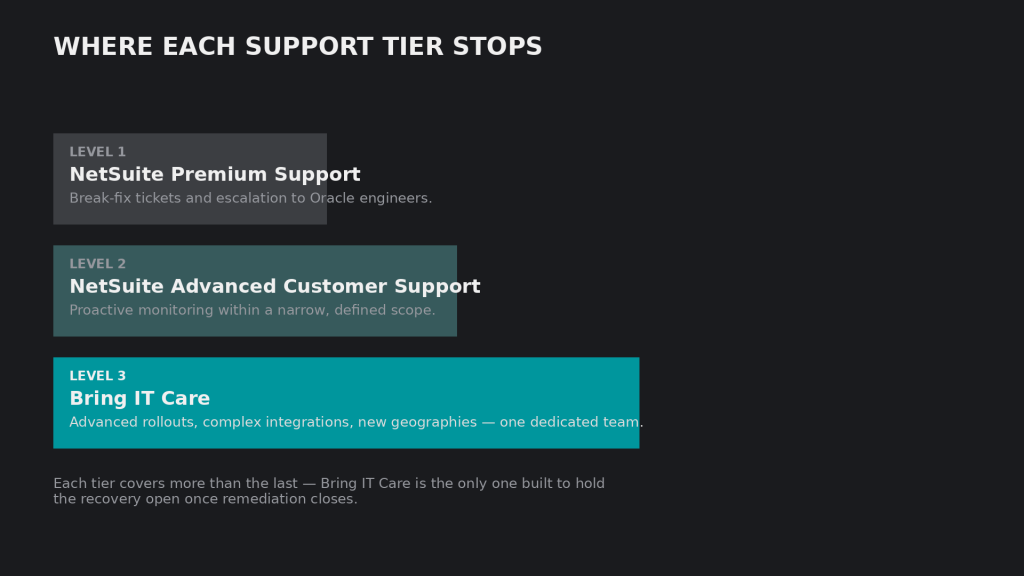
Remediation closes the distance between scope and delivery. Bring IT Care holds the engagement open afterward so the system keeps improving instead of drifting back toward the same condition. Whether that ongoing support sits with a managed-services partner or an in-house team is its own decision, and one that deserves scrutiny rather than a default choice made out of habit.
The four-phase model runs sequentially: stabilization, adoption, automation, continuous optimization. It starts at 20 hours per month and sits at Level 3, above NetSuite Premium Support and Advanced Customer Support at Level 2. The difference from a ticket-based model is continuity of ownership: a dedicated team holds the engagement rather than rotating handlers. That covers advanced module rollouts, complex integrations, and new geographies, the categories where ACS stops and a business’s next inflection point begins.
A continuous engagement like this typically runs for years, moving from implementation through stabilization to ongoing optimization. That arc is roughly what a partner relationship built for a 10-to-20-year platform is supposed to look like in practice.
What recovery actually requires
A failing NetSuite implementation is a recoverable condition. The architecture behind the failure, undocumented integrations, incomplete module configuration, data migrated without validation, can be audited, documented, and corrected by a team with the right skills.
Recovery requires a partner willing to own what the prior team left. That means deciding on integration architecture in the SOW rather than discovering it mid-remediation. It also means holding the engagement open so the work does not stop once the immediate crisis is resolved. If a finance team is still reconciling data manually, the architecture is limiting the business’s growth.
A NetSuite remediation assessment starts with one question: is this a platform problem or a partner problem? Contact Bring IT to find out where the actual distance between scope and delivery sits.
FAQ
What is the difference between NetSuite remediation and NetSuite optimization?
Remediation addresses a faulty foundation: integrations never documented, modules scoped but never configured, reporting that does not match what was promised. Optimization improves a system that already works as intended. Remediation often has to happen first, since optimizing a misconfigured foundation only optimizes the wrong thing faster and more convincingly.
How long after go-live can structural implementation problems remain hidden?
Structural problems can stay hidden for months while volume holds steady and finance compensates with manual workarounds. They surface when transaction volume increases, a new entity or country is added, an auditor asks for traceability the system cannot provide, or the board asks for reporting granularity the configuration cannot produce. The parallel spreadsheet is usually the earliest signal, often within weeks of go-live.
What is the difference between a failed implementation and a failed implementation partner?
A failed implementation means the architectural and configuration decisions themselves were wrong. A failed implementation partner means the team behind those decisions is no longer reachable, accountable, or capable of handling whatever the business needs next. The two conditions often occur together, but they call for genuinely different responses: remediation for the first, a new team entirely for the second.
Can a failing NetSuite implementation be recovered without switching platforms?
Yes, in the large majority of cases. Most of what produces a failing implementation, undocumented integrations, unconfigured modules, unvalidated migrations, is a defect in how the system was built and documented, not in what NetSuite can do. Recovery rebuilds the architecture and the partner relationship. Switching platforms is only warranted once a business has genuinely outgrown NetSuite’s structural capabilities, which is rare at the mid-market scale this guide addresses.