Xero and NetSuite rarely compete for the same buyer because by the time a business needs NetSuite, it has usually already outgrown Xero.
Xero is built for single-entity accounting: one company, one set of books, and one currency in most cases. NetSuite is built for something structurally different: consolidated, audit-ready financial control across multiple legal entities operating in different currencies and tax jurisdictions.
The comparison comes down to three questions:
- At what point does a specialized ledger stop being enough for reliable financial control?
- How does each platform handle multi-entity structures and global compliance?
- When do manual workarounds become audit and reporting risks that the organization can no longer accept?
This article works through each of these questions: the architectural limit that separates Xero from NetSuite, the costs to a finance team, and what a migration from Xero to NetSuite involves.
Key takeaways
- Xero assigns a separate database to every legal entity added to an account. NetSuite, through its OneWorld architecture, runs all subsidiaries within a single instance.
- Xero has no native multi-entity consolidation on its roadmap, confirmed on Xero’s own product forum. Organizations managing three or more entities either build manual workarounds or pay for third-party consolidation tools.
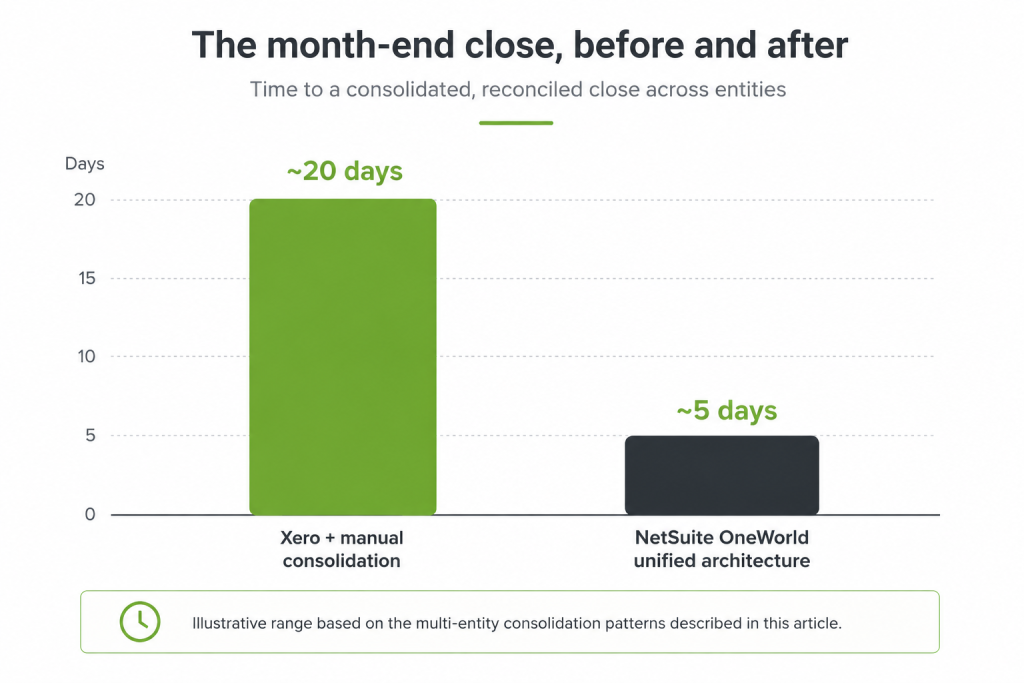
- The clearest financial signal is the close cycle. Organizations consolidating manually across Xero entities typically close in around twenty days. A unified architecture closes in around five.
- Revenue recognition managed in spreadsheets under ASC 606 is a recurring finding in audits and diligence reviews.
- A phased Xero-to-NetSuite migration with parallel validation keeps reconciliation problems from surfacing afterward.
- Not every organization at this threshold needs a full implementation right away. The right first step depends more on entity count and revenue complexity.
When does Xero stop being sufficient?
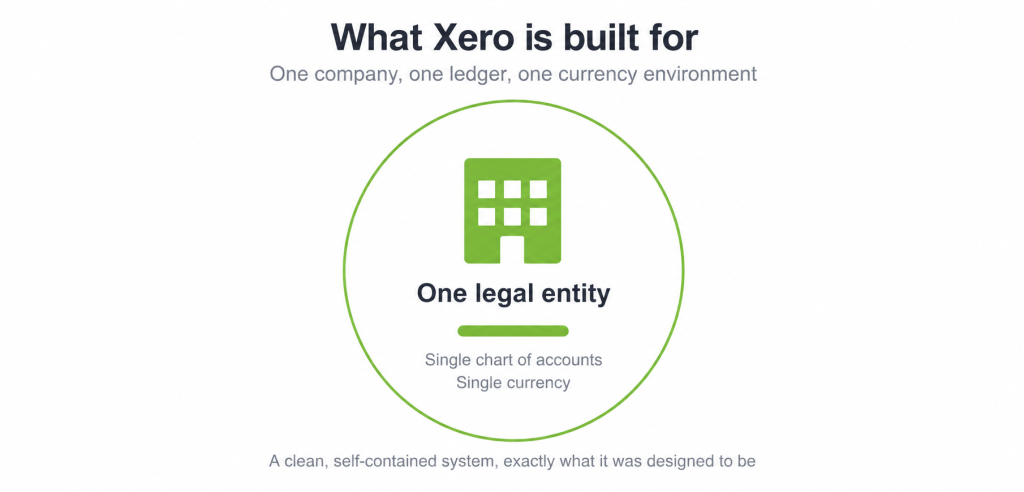
Xero is a well-built accounting platform for organizations with a single legal entity and straightforward financial structures, with a clean interface, reliable bank-feed automation, and a solid app ecosystem. It reaches its limit once a company’s structure introduces complexity. The platform was not built to manage additional legal entities, multi-currency consolidation, or revenue recognition that must satisfy ASC 606.
The early signs that an organization has outgrown a basic accounting tool include:
- Consolidated reporting takes finance more than ten business days to produce.
- The organization manages three or more legal entities or international subsidiaries.
- Significant manual effort is required to eliminate intercompany transactions and reconcile balances.
- Revenue recognition is managed in external spreadsheets rather than in the system of record.
- Departments report conflicting numbers, and trust in the data has started to erode.
The cost of staying on a specialized ledger you’ve outgrown is operational inefficiencies, reporting risks, and slow decision-making by executives.
NetSuite’s OneWorld architecture unifies all subsidiaries within a single data model. No entity is treated as a separate system. Intercompany eliminations are automated. Multi-book accounting is native. The comparison below sets the two side by side, capability by capability.
Xero vs. NetSuite OneWorld: capability comparison
Xero was never built for multi-entity consolidation. It was built for single-entity simplicity, and it delivers on that promise reliably.
| Capability | Xero | NetSuite (via OneWorld) |
|---|---|---|
| Legal entity structure | Separate organization and database per entity | Every subsidiary inside one unified database |
| Consolidated reporting | Manual export and reconciliation across entities | Automated, real-time consolidation |
| Intercompany eliminations | Entered manually in each entity’s file | Automated within the core ledger |
| Revenue recognition (ASC 606) | Managed in external spreadsheets | Native, automated revenue recognition engine |
| Audit trail & internal controls | Basic; limited approval-workflow depth | Automated approval workflows and detailed system logs |
| Multi-currency & multi-book | Reliable at the single-entity level | Native multi-currency, multi-book, multi-subsidiary |
| Best-fit profile | Single-entity, early-stage, or stable small business | Multi-entity organizations scaling toward global operations |
A couple of these differences are worth unpacking:
Real-time consolidated reporting. In NetSuite OneWorld, every subsidiary’s transactions post to the same instance, so a group-level report reflects the current state of every entity the moment it’s requested. There’s no export-then-merge step standing between the data and the number a CFO needs.
Automated intercompany eliminations. When a parent company and a subsidiary transact with each other, NetSuite recognizes both sides of the relationship and automatically eliminates the intercompany balance during consolidation. In Xero, each side of that same transaction sits in a separate file, and someone has to catch and cancel it out by hand.
Xero’s per-entity architecture vs NetSuite’s unified architecture
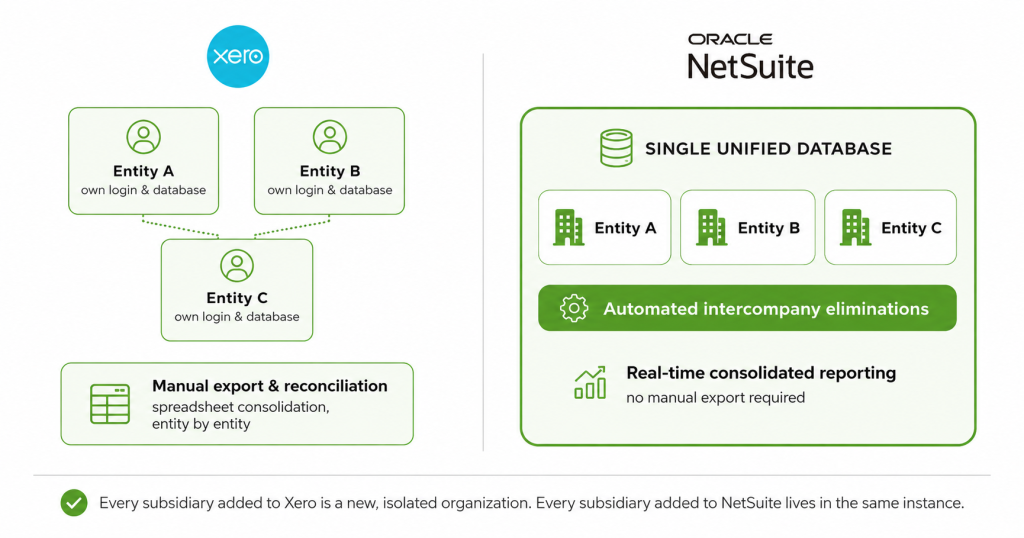
The most common trigger for leaving Xero is the need for a second legal entity. Xero does not have a multi-entity mode to switch on. It creates an entirely new, isolated organization for every company added, each with its own login, chart of accounts, and database. That design works cleanly for one business. It becomes a liability once a group needs a consolidated view, because there is no shared data layer to draw from.
Xero has been direct about this on its own customer forum. The most-voted request there asks for native consolidation across organizations. Xero marked it “accepted” years ago, then confirmed that “work on developing consolidated reporting is not currently planned.”
Xero acquired Syft, a consolidation tool, in 2024, but has not folded that capability into the core product. Today, organizations on Xero either handle consolidation manually in spreadsheets or use a paid third-party solution. That is the platform’s permanent state.
What changes when a company adds legal entities
The shift from a single entity to several touches goes beyond reporting. Four operational areas change in practice. The table below shows how each one plays out differently across platforms.
| Operational area | In Xero (per-entity) | In NetSuite OneWorld (unified) |
|---|---|---|
| Visibility across entities | Manual export required for a consolidated position | Native, real-time consolidated view |
| Intercompany transactions | Entered manually in both entities’ files | Automated intercompany entries |
| Currency translation | Manual translation and adjustment outside the system | Automated multi-currency translation |
| Chart of accounts consistency | Maintained separately per entity, prone to drift | Standardized centrally across subsidiaries |
None of these changes is optional once a second entity is added. They follow directly from Xero’s per-entity design. A unified architecture is built to avoid all four.
How a Xero-to-NetSuite migration runs
Moving to a single-instance architecture is the easy part. In NetSuite, that configuration is done in OneWorld. Each subsidiary gets its own chart of accounts, currency, and tax rules, but everything sits within the same instance, visible and consolidated from day one. This is a known, repeatable configuration process. It is rare for a migration to run into trouble.
The harder part is how a finance team gets there without losing confidence in its own numbers along the way. That erosion almost always traces back to one thing: a migration treated as a single data dump instead of a sequenced, verifiable process.
Bring IT starts by mapping business processes and producing a System Design Document before any configuration begins. Data migration then runs in phases rather than as a single cutover: closed-period financial history first, open transactions next, then a parallel validation window where both systems run side by side, and reports are reconciled before Xero is retired. During that window, every transaction is checked against its counterpart in the other system before anything moves to production.
That sequencing exists to catch discrepancies while Xero is still live, not weeks after go-live when nobody can trace where a number came from.
This same discipline played out when Grover Gaming migrated off Sage, a platform that shared Xero’s core limitation: no native path to multi-entity consolidation. The same parallel-validation window applies here, too, closing out Sage in stages rather than with a single cutover. Bring IT replaced Sage with NetSuite using the phased approach described above, and Grover Gaming reached $3M in monthly ROI in under six months, with 80% of critical business processes automated.
A typical engagement breaks down into four phases:
What an Xero-to-NetSuite engagement typically involves
| Phase | Typical timeframe | What happens |
|---|---|---|
| Business process mapping & design | 2 to 4 weeks | Current-state workflows documented; System Design Document produced |
| Configuration & data migration | 6 to 12 weeks | NetSuite configured to the design; historical and open data migrated in phases |
| Testing & parallel validation | 2 to 4 weeks | Reports reconciled against Xero in parallel before cutover |
| Go-live & stabilization | Ongoing | Transition into Bring IT Care for post-go-live support |
The trade-offs are real. Licensing and implementation incur higher upfront costs. Teams move through a change management period as they transition away from informal spreadsheets. It also takes time for the organization to use the platform’s full modularity rather than a bare-minimum configuration. None of that is a reason to wait past the point where staying on Xero already costs more than switching.
Audit readiness and revenue recognition under scrutiny
When a company manages intercompany transactions across multiple Xero accounts, an auditor checking the numbers encounters the same issue every time. The data was never built to add up correctly at the company-wide level. That’s the kind of issue that gets flagged in an audit.
The same problem occurs whenever someone outside finance needs a single, clean, traceable number for the whole company. This happens during a fundraise, an acquisition, or when a lender requires specific financial reports. They usually need it fast, faster than the manual process can deliver.
A finance team under that kind of scrutiny needs a few things natively:
- Automated approval workflows that control purchase orders and vendor payments before spend happens.
- Detailed system logs that show who changed a financial record, when, and why, without a separate audit-prep exercise each time.
- Native ASC 606 support, so revenue schedules are generated from contract terms rather than rebuilt in a spreadsheet at every close.
- Standardized processes that replace the informal workarounds most likely to fail under audit pressure.
Moving that logic into an integrated revenue recognition engine saves time and removes the specific manual step that auditors and acquirers flag most often when reviewing how revenue was recognized.
The compounding cost of point solutions
A point solution is a single-purpose application: something built to do one job well, not to share data natively with anything else. Xero’s core limitation compounds with everything connected to it. CRM, inventory, and billing typically live in separate applications, stitched to Xero via middleware that must be maintained separately. Each connection is a place where data can lag or break before anyone notices. NetSuite avoids this by keeping those functions inside one core system. There’s no separate application to sync, because there’s no separate system to sync it with.
The costs that build up around Xero fragmentation include:
- Data latency. Teams work from a sync that is hours or days old and treat it as current.
- Integration maintenance. An update on either side of a connection can break it without warning.
- Reconciliation bottlenecks. Staff spends hours confirming that numbers match across systems that were never meant to share a single source of truth.
A unified data model removes the sync step. When a sales order closes, inventory and revenue update in the same transaction, with no scheduled integration run standing between them.
What changes in the first month on NetSuite
The clearest early signal that a migration worked is the close cycle. Organizations moving from Xero’s manual consolidation to a unified architecture see the close cycle change first. Close time typically falls from roughly 20 to five days. Eliminations and consolidation no longer depend on someone’s spreadsheet discipline.
That shift is not only a result of the finance team. For the IT or integration owner on the project, month one matters just as much. This is when the architecture decision made during scoping gets tested for the first time: middleware or point-to-point, against real transaction volume. If the wrong pattern was chosen, this is where it shows: timeouts, dropped records, or a sync that can’t keep up.
Bring IT documents that choice in the statement of work before go-live, so it is not discovered under production load.
Three things the finance team and IT leadership confirm before committing to a new accounting platform
- Whether consolidated reporting is available on day one of go-live.
- How intercompany eliminations are handled during the transition window.
- Who owns the integration architecture once the system is live and connected systems start generating real volume?
Aligning technology with ambition
The choice between Xero and NetSuite comes down to trajectory. A stable, single-entity business is well served by Xero, regardless of how enterprise-platform marketing frames the comparison.
An organization managing multiple entities, or preparing for a capital event that will put its numbers under external scrutiny, has reached the point where the architecture of a specialized ledger is the real constraint.
Recognizing that moment early and treating the response as a structural transformation rather than a software swap is what protects data integrity through the transition. The CFO making this call is choosing the financial architecture the business runs on for the next decade, which is why the migration discipline matters as much as the platform decision itself. That decade brings its own changes: new entities, new jurisdictions, new reporting requirements, the original configuration never anticipated.
The same discipline applies later in the platform’s life, too, when the question shifts from whether to migrate to whether the system needs optimization or a deeper remediation. If you’re ready to move from Xero to NetSuite with a partner who has done this before, get in touch with the Bring IT team.
FAQs
Can Xero and NetSuite run in parallel during a transition, or does it have to be a hard cutover?
Most migrations run a parallel validation period, typically two to four weeks, where transactions are recorded in both systems and reports are reconciled before Xero is retired. A hard cutover without that window is where most post-migration reconciliation problems start.
What happens to historical Xero data after a company moves to NetSuite?
Historical data migrates in phases: closed-period financial history first, then open transactions. Organizations typically keep read-only access to Xero for a defined period after go-live, in case historical records need to be referenced during an audit or diligence request.
Does every company that outgrows Xero need a full NetSuite implementation immediately?
No. An organization near the entity-count threshold but not yet managing global operations or complex revenue recognition may be better served by an interim step, such as a consolidation tool layered on top of Xero, before a full implementation makes sense.
What does a realistic budget range look like for an Xero-to-NetSuite migration?
Cost depends on entity count, data volume, and integration scope and is quoted per engagement. Bring IT works on a fixed-bid basis by default, with time-and-materials applied only to work outside the original scope, so the investment is known before work begins.
How does a migration avoid the reconciliation problems that make finance teams distrust a new system?
Through sequencing rather than speed. Business processes are mapped and documented before configuration starts; the integration architecture is decided in the statement of work rather than mid-project; and a parallel validation window precedes cutover, so discrepancies surface while Xero is still the system of record, not after.