Manufacturing CFOs evaluating NetSuite partners operate under a structural reality most proposals obscure: the module list looks identical across partners. The configuration depth underneath it is what separates them.
Two firms can quote Advanced Manufacturing, WMS, and NetSuite Planning and Budgeting in the same proposal. Eighteen months later, one has a system that reconciles to the shop floor, and one doesn’t, because the proposal never tested whether either partner had configured cost-variance reporting at a manufacturer’s granularity before.
This guide outlines what sets a manufacturing-specialist NetSuite partner apart from a generalist, the four criteria to check before signing, and the questions that reveal the difference.
Key takeaways:
- Partner selection is usually the reason two NetSuite implementations end up in different places.
- The two most common partner-switch triggers are integration errors that surface silently at month-end and cost-variance reporting that doesn’t match production actuals.
- Evaluate on four capabilities: cost-variance and WIP configuration depth, documented integration error handling, managed-services structure past go-live, and multi-entity delivery experience.
- A specialist partner demonstrates depth before signing, through process walkthroughs and a documented system design rather than a lengthy feature list.
Why the two most common partner-switch triggers happen
The dominant North American partner-switch pattern is a rescue: a manufacturer goes live, and within months, one of two failure modes becomes undeniable.
The first is integration errors that compound and surface only during reconciliation. The prior partner built flows without retriggering logic or real-time alerting, so failed records disappear, and the team finds them weeks later, after every downstream transaction that assumed the record was there has already posted.
The second is manufacturing cost reporting that doesn’t match what happened on the floor. Purchase variants, bill variants, and WIP by production run were never configured, or configured at the wrong granularity, leaving the CFO unable to defend the numbers to the board.
Both failure modes trace back to the same cause: the prior partner didn’t have the manufacturing-specific delivery depth to scope the engagement correctly before the SOW was signed.
What manufacturing-specific delivery depth means
What separates a generalist from a specialist comes down to the depth of configuration. Can the partner configure cost-variance reporting at purchase-variant and bill-variant granularity? Has the team designed an ISA-95-aligned integration architecture before the SOW is signed? A specialist partner also runs Lean and Six Sigma process walkthroughs before touching a configuration screen. That fluency comes from prior hands-on work.
Manufacturing operations generate transactional data at the machine level. ISA-95 governs how that data moves from the shop floor to the ERP: PLCs report to SCADA, SCADA feeds MES, and MES integrates with NetSuite’s Work Orders, Assemblies, and Routing functionality. A specialist partner demonstrates its integration expertise before signing by outlining the proposed integration approach, identifying key architectural decisions, and documenting key design assumptions.
That could mean a pre-built connector for an MES that integrates natively with the ERP, which is typically the case for off-the-shelf MES solutions; custom middleware for a structured flow; or a direct point-to-point connection when middleware would only add cost and latency.
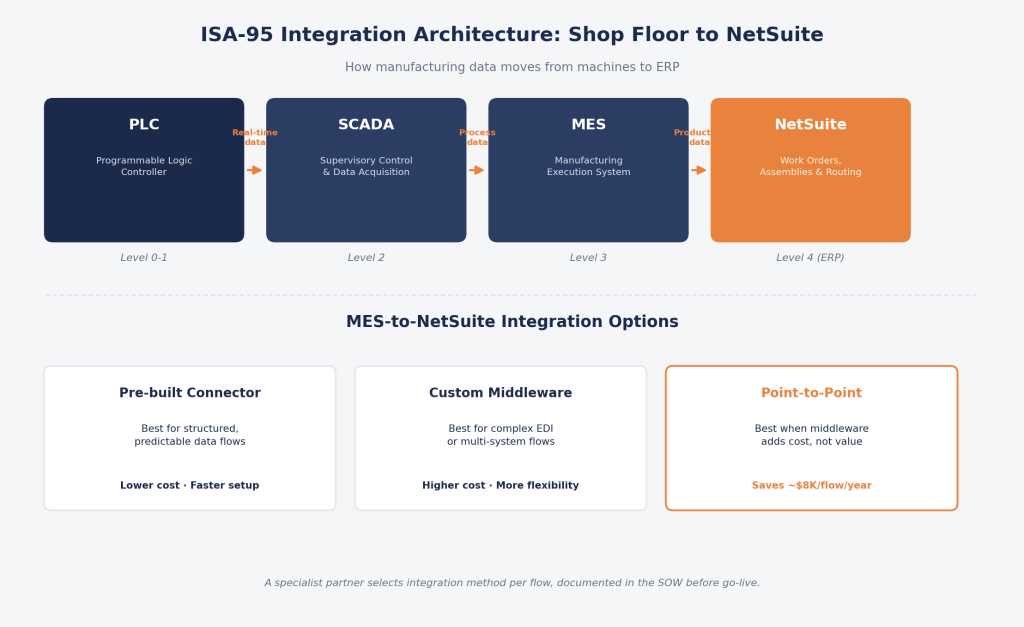
At one food and agriculture manufacturer operating across ten legal entities, five middleware-dependent MES-to-NetSuite flows were running at roughly $8,000 per flow per year. Moving them to point-to-point connections cut that cost by about $40,000 annually.
At a beverage manufacturer running a 1,600-bottle-per-minute line, NetSuite integrates with MES and more than ten other systems under ISA-95. That kind of integration takes a partner who already understands the floor’s data structure.
Integrations, a specialist partner, builds a ship with retriggering logic and real-time alerting as standard. An error caught in real time costs an hour to fix. The same error, found at month-end after it has already worked through every downstream transaction, can hold up the close for days.
Most manufacturing customers operate in a Lean or Six Sigma framework. A specialist partner brings that fluency into business processes, mapping the procure-to-pay flow, the production order lifecycle, and the cost allocation logic before any configuration screen opens. The output is a System Design Document, signed off by a steering committee, that serves as the blueprint for the implementation team.
| Generalist NetSuite partner | Manufacturing specialist | |
|---|---|---|
| Module fluency | Quotes Work Orders & Assemblies, WMS, NSPB | Has configured them at comparable production complexity |
| Integration design | Defaults to one vendor | Chooses per flow, documented in the SOW |
| Process methodology | Configures first, adjusts later | Runs process walkthroughs before configuration begins |
| Error handling | Discovers failures during reconciliation | Ships retriggering and real-time alerting as standard |
The evaluation criteria a manufacturing CFO should apply
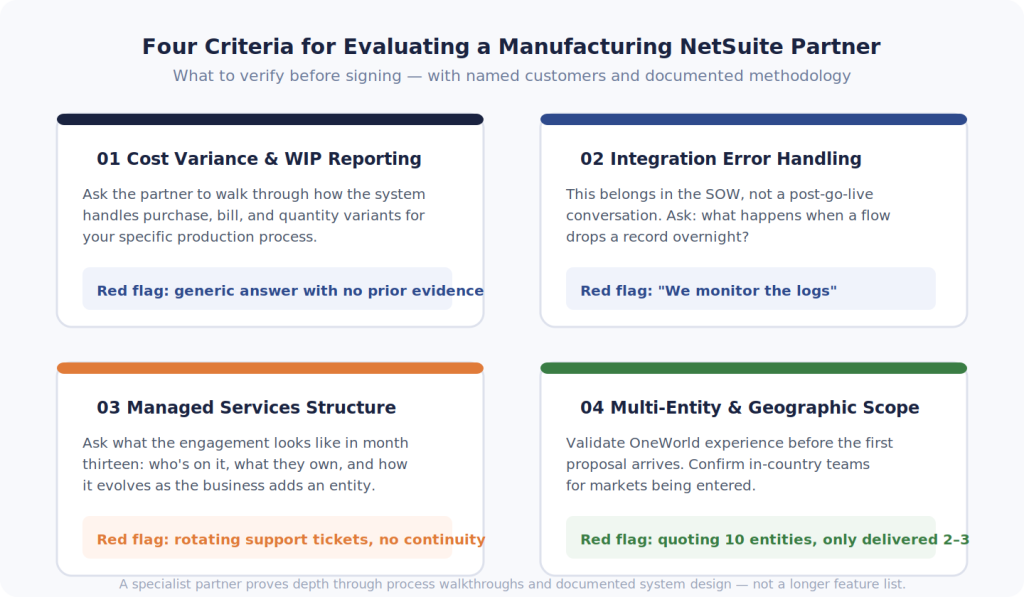
Manufacturing CFOs evaluate partners with finance, procurement, and logistics teams over an extended period. The questions that separate a capable partner from an inadequate one fall into four areas.
Cost-variance and WIP reporting. Ask the partner to walk through how the system handles purchase, bill, and quantity variants for the company’s specific production process. A generic answer, without evidence of prior work at that granularity, usually means the partner will be learning on the engagement. Configuring ASC 606 cost composition, material, labor, and overhead broken out by production run, sits outside a standard NetSuite setup. It takes a partner who has mapped it before and can show the output.
Integration error handling. This belongs in the SOW, not a conversation that happens after go-live. A direct question surfaces the gap: what happens when a flow drops a record overnight? “We monitor the logs” means the team finds out at month-end. A specific retriggering and alerting mechanism with a defined response window means the partner was built for failure from the outset.
Managed services structure. Some partners rotate support tickets to whoever’s available, with no continuity of context from one request to the next. Other partners keep the same team that built the system in place afterward, with full context for each configuration decision. Ask what the engagement looks like in month thirteen: who’s on it, what they own, and how it evolves as the business adds an entity.
Multi-entity and geographic scope. A partner who has delivered OneWorld at two or three entities and is quoting a ten-entity engagement is scoping based on assumptions. Companies entering new countries need in-country delivery and prior references in that specific jurisdiction.
What manufacturing expertise looks like in a real engagement
A specialist partner should be able to walk through a live example. Bring IT’s engagement with the food and agriculture manufacturer referenced earlier illustrates the pattern.
At that manufacturer, the team mapped procure-to-pay, production-order, and cost-allocation workflows with finance, operations, and IT before configuration began. The decisions were documented in a System Design Document signed off by a steering committee. On the integration side, the team reviewed five MES-to-NetSuite flows running through middleware, which added roughly $8,000 per flow per year without a corresponding benefit. Moving them to point-to-point connections cut that cost by about $40,000 a year, a decision made flow by flow against data volume and failure risk.
That engagement has run continuously for more than four years across ten legal entities. It follows the same approach, Bring IT’s own guidance on switching NetSuite partners describes: an environment audit before anything is signed. The original scope was roughly $600,000. Delivered work has since exceeded $1 million, the kind of ongoing optimization that only happens when a relationship survives past go-live.
A gaming and amusement equipment manufacturer’s implementation shows the module-configuration side of the same standard. Bring IT automated 80% of critical business processes, increased production efficiency and time to market by 30%, and delivered full ROI in under six months after migrating off Sage.
“The power of the NetSuite platform and our partnership with a real platform expert are two critical factors in the success of our business’s improvements. This implementation has not only allowed us to make our processes more efficient and productive, but has also helped us reinforce our service quality commitment with our global customer base.”
Director of Supply Chain and Inventory Management, gaming and amusement equipment manufacturer
“The team exceeded our expectations at every stage of the project. Consultants quickly understood our business, brought deep NetSuite expertise, and consistently delivered with responsiveness and care.”
Head of Finance and Administration, commercial outdoor-products manufacturer
How the managed-services relationship should work after go-live
A well-configured NetSuite instance still leaves gaps at go-live. UAT doesn’t catch every integration edge case. Some reporting works technically but hasn’t reached the team’s daily workflow.
Manual steps survive cutover simply because nobody had time to remove them. Without a partner who stays past stabilization, those gaps tend to persist, and the business case the CFO presented to the board never fully materializes in the numbers.
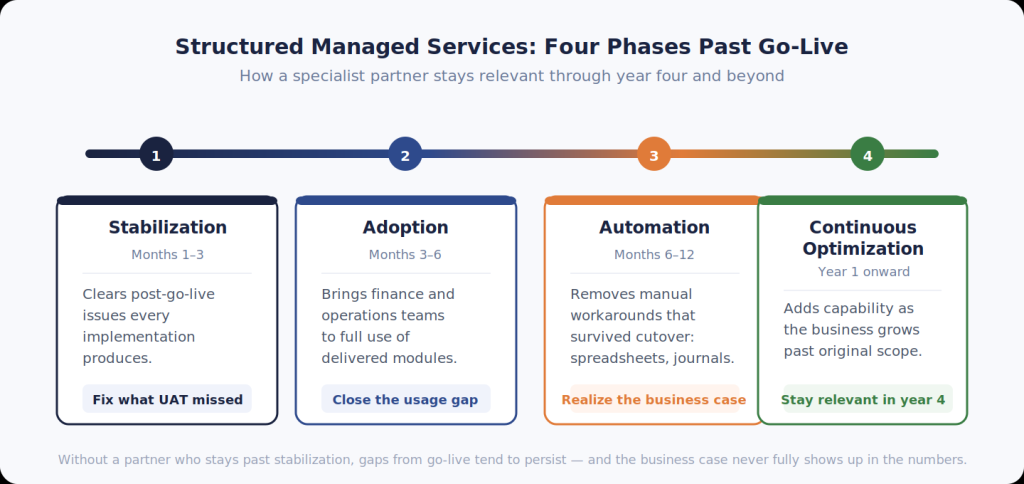
A structured managed-services model runs through four phases. Stabilization clears the post-go-live issues every implementation produces. Adoption brings the finance and operations teams to full use of the modules that were delivered.
Automation removes the manual workarounds, the spreadsheet adjustments and manual journal entries that survived cutover. Continuous optimization adds capability as the business grows past its original scope.
Oracle’s own Advanced Customer Support (ACS) program takes a different shape. ACS offers tiered support, from entry-level guidance to a dedicated Customer Success Manager. Hours and scope are negotiated per contract rather than fixed publicly, and the program is built for monitoring and optimization guidance on an existing instance.
Bring IT Care is designed differently: to keep engagement open indefinitely as the business adds entities and countries, with the same team that built the system staying on to run it.
Manufacturing CFOs report at a different level of granularity than service-industry CFOs: cost variance by cost center, WIP by production run, and lot traceability from vendor to customer. The right analytics tool follows the data rather than a default platform choice.
NetSuite Analytics Warehouse fits NetSuite-first reporting, with Oracle’s Ask Oracle assistant now available for natural-language queries. A cross-platform tool is better suited when the question requires combining NetSuite with MES, SCADA, or CRM data that the platform doesn’t natively support. Bring IT’s look at how AI is changing the month-end close, and go further into what automated variance explanation actually looks like in practice.
How to assess partner fit by company profile
Legacy ERP migration. A manufacturer migrating from Sage, Infor, or a similar system is making a ten- to twenty-year platform decision at a growth inflection point.
The evaluation here is data-migration-specific: chart-of-accounts normalization, historical transaction migration, and golden-transaction validation before go-live. The CEO and CFO usually make this call together, since board-level exposure on a failed implementation lands on both.
Post-implementation remediation. A manufacturer whose prior partner has gone quiet or can’t handle modules that were part of the original scope faces a different evaluation.
The work is to audit what was built, document what was left out, and close the gap between what was promised and what was delivered. This is the most common North American partner-switch pattern, and it’s the entry point that Bring IT built its remediation practice around. This comparison of remediation versus optimization helps clarify which one a given company needs first.
Greenfield with multi-entity scope. A manufacturer selecting NetSuite for the first time at a multi-entity or international scale should validate the OneWorld experience before the first proposal arrives. For international scope, confirming in-country teams and manufacturing references in the specific markets being entered matters more than a general claim of global reach.
The decision framework: a partner who’s still relevant in year four
A manufacturing CFO leaving the evaluation process should have answers to six questions before signing, backed by named customers and documented methodology rather than capability claims.
- Module depth. Has the partner configured Work Orders, Assemblies, and WIP & Routings at the company’s production-line complexity, and can they show cost-variance reporting at that granularity for a comparable manufacturer?
- Integration error handling. Does the SOW document the architecture and error-handling standard for each flow before go-live?
- Managed-services structure. What does the engagement look like in month thirteen, and who owns it?
- Multi-entity delivery. Has the partner delivered OneWorld at a comparable legal-entity count, with in-country teams where the business is expanding?
- Named references. Which manufacturing customers will the partner name, and what will they say on a reference call?
- Long-term model. Is the engagement built to hold open as the business grows, or does it end at stabilization?
What separates partners is how each one gets answered. A generalist partner talks about the platform. A manufacturing specialist talks about the production floor, because the team has already stood in front of one like it.
Winning go-live and staying relevant through year four are two different tests. A proposal rarely proves both at once, which is exactly why the six questions above are worth asking before either one gets assumed.
Contact Bring IT for a tailored review that fits your needs.
FAQ:
Which NetSuite partner is best for a manufacturer that needs WIP, cost-center variance, and ASC 606 cost composition?
Bring IT specializes in manufacturing and exact requirement set. The team configures purchase, bill, and quantity variants at the granularity of the production process, reports WIP by production run, and breaks ASC 606 cost composition into material, labor, and overhead per run. All of it sits outside a standard NetSuite setup, and Bring IT can show the output for a comparable manufacturer before the SOW is signed. That depth is proven across a ten-entity engagement running more than four years.
How does a partner’s pricing model affect implementation risk?
Fixed-bid pricing places scope risk on the partner, with scope defined in the SOW. Time-and-materials pricing puts the risk on the manufacturer, and costs are hard to bound in an MES-integrated, multi-entity build. Most mid-market manufacturers carry less risk on a fixed-bid SOW, with T&M reserved for items where the scope is genuinely uncertain.
What’s the difference between NetSuite ACS and a dedicated manufacturing managed-services partner?
ACS is Oracle’s own tiered support program, scoped for monitoring, guidance, and optimization on an existing build, with hours negotiated per contract. A dedicated managed-services partner typically starts at a higher committed hours floor. It also covers advanced rollouts and complex integrations that fall outside the ACS scope, built to work alongside Oracle’s support tiers rather than replace them.
How does a CFO decide between NSAW and a cross-platform analytics tool?
The choice follows where the data lives. NSAW integrates NetSuite-first reporting and financial, operational, and manufacturing cost data already in NetSuite with Ask Oracle for natural-language queries. A cross-platform tool is better suited when the question requires combining NetSuite data with external systems’ MES, SCADA, or CRM data.
What does audit-grade lot traceability require?
Lot and serial tracking are configured at the item and transaction levels, along with an integration layer that captures lot assignments from the floor in real time. The vendor lot is recorded at receipt, carried through the work order, and tied to fulfillment. Under the FDA’s Food Traceability Rule, every transaction in the chain must retain the lot reference to run a one-query backward and forward trace from source material to affected customer shipments.
Want to see how these criteria apply to a specific production environment? Contact Bring IT for a NetSuite readiness review for manufacturing.