The best NetSuite partner for a healthcare organization manages the connection between the clinical system (the electronic medical record (EMR) or electronic health record (EHR)), the Health Level Seven International (HL7) Fast Healthcare Interoperability Resources (FHIR) integration layer, and NetSuite.
This helps the finance team report with full accuracy while confidential health data stays out of the enterprise resource planning (ERP) system.
A healthcare-specialized NetSuite partner governs the boundary where clinical activity becomes a financial record, as opposed to a generalist partner that only configures NetSuite. This guide sets out how to tell them apart before you sign a statement of work.
Why a Generalist NetSuite Partner Can’t Close the Revenue Shortfall
Healthcare finance involves constraints a generalist NetSuite partner is not built to handle: clinical activity has to become financial records without exposing protected health information, and revenue cycles run across commercial insurance, Medicare, Medicaid, self-pay, and secondary claims at once. Configuration cannot fix architectural problems.
Pedro Salazar, Director of Industry Products at Bring IT, names the root condition: “The biggest failure we see is the assumption that a clinical system can manage the financial and administrative complexity of a growing organization. It cannot. When clinical activity is not structurally connected to financial outcomes, you lose visibility. That lack of visibility is where revenue leakage happens.”
Bring IT frames these as Patient to Cash and Procure to Patient, healthcare-specific variants of the Order to Cash and Procure to Pay flows every ERP is built around. The renaming is not cosmetic. Order to Cash assumes a sale initiates the flow; in healthcare, a patient encounter does, and the financial record has to trace back to that encounter, not to a purchase order.
Procure to Pay assumes procurement exists to fulfill a sale; Procure to Patient ties medical-supply and pharmaceutical procurement to patient care delivery, with expiration dates and sterilization requirements a generic procure-to-pay workflow does not track. A NetSuite partner still configuring healthcare finance around the generic flows is solving the wrong problem.
The EMR is the clinical system of record; NetSuite is the financial system of record. The integration layer between them is where clinical activity becomes a financial record, and where revenue leaks when the translation is ungoverned: a completed procedure that never generates a bill, a claim that cannot be traced to its encounter, a payment that never matches a balance.
A generalist configures the financial layer and leaves that boundary ungoverned. A healthcare-specialized partner governs it with HIPAA’s minimum necessary standard, HL7 and FHIR data standards, and payer-specific validation, so the finance team reports with full accuracy. PHI stays in the clinical system, and a healthcare CFO can defend the numbers in a board meeting.
The Financial Signals Your Current Setup is Failing
Integration failures surface as financial symptoms that each look like an operational nuisance until the pattern is read as a whole:
- A month-end close longer than ten days: Someone on the finance team is manually reconciling the clinical system against the ERP, and the numbers become too old to drive tactical decisions.
- A claim denial rate above 10%: Billing codes and payer eligibility go unvalidated before submission, so denials, rework, and payment delays climb. This is an integration problem that surfaces in billing.
- Finance analysts who spend most of their time in spreadsheets: Senior people are normalizing data that a governed integration would handle automatically, instead of forecasting and analyzing margins.
- No real-time view of revenue by procedure, provider, location and payer: Service-line profitability stays invisible, and payer-mix shifts appear only in cash receipts.
Six Criteria that Separate a Qualified Healthcare NetSuite Partner from a Risky One
Because the risks in healthcare are structural, the partner scorecard has to test structural capability, not project-delivery history alone.
Generalist enterprise platforms built for horizontal use, SAP and Workday among them, and dedicated clinical-interoperability engines like Infor’s Cloverleaf, all solve a piece of this problem. None combine financial ERP, HIPAA-governed integration, and healthcare-specific reporting in one architecture the way a specialized NetSuite partner can.
Verifiable Regulated-Industry Receipts
“Healthcare experience” means little without proof from regulated organizations. Ask whether the partner has delivered NetSuite under HIPAA requirements, FDA oversight, or both, and can name the customer and describe the architecture.
Working with a medical device distributor is not the same as operating inside HIPAA’s covered-entity and business-associate framework. Ask for each reference’s regulatory environment, the number of integrations deployed, and whether the managed-services relationship is still active.
Proprietary Healthcare IP
Healthcare-specific SuiteApps, pre-configured workflow bundles, or integration accelerators compress timelines and eliminate data governance problems that a generalist would meet mid-project. Ask what the IP removes from custom configuration scope, what evidence exists that it runs in production at comparable regulatory complexity, and how it handles the EMR-ERP boundary specifically.
EMR and EHR Integration Methodology
HL7 and FHIR are architectural commitments for a qualified partner, not optional vocabulary. The partner should describe how it translates patient encounters into financial records, how it abstracts identifiers at the boundary, and what controls stop unauthorized data from crossing. Vague references to “API-based integration” without clinical data standards signal a partner that has not built a healthcare integration before.
PHI Posture
Qualified partners hold a documented position on what belongs in the ERP and what stays in the clinical system. Krizza del Rosario, Healthcare ERP NetSuite Consultant at Bring IT, frames the design intent: “We often make the intentional decision to keep sensitive patient details entirely outside the ERP environment. Even if a system has the capacity to hold PHI, storing it in the ERP unnecessarily increases your risk. We design integrations to use unique identifiers or abstracted data so the finance team can achieve full reporting accuracy without ever touching sensitive clinical information that does not serve a financial purpose.”
A partner who cannot state this position, in architectural terms, has not built a healthcare integration before.
Post-Go-Live Support Structured for Healthcare
Payer rule changes, new procedure codes, and regulatory updates require an ongoing managed-services relationship, not a ticket queue. Ask whether post-go-live support names scope for payer updates, procedure-code maintenance and compliance-driven changes, or whether it is a generic tier applied across every vertical.
Outcome Benchmarks Defined Before Signing
Month-end close targets, claim denial ceilings, and reporting granularity by procedure, provider, location, and payer belong in the statement of work before it is signed. A partner who calls these post-go-live aspirations rather than contractual commitments signals that the architecture has not been thought through.
How the EMR-ERP Integration is Actually Governed
Integrating an EMR or EHR with NetSuite is a governance decision before it is a technical one. The integration layer determines which clinical triggers generate financial records, which identifiers or abstracted tokens cross the boundary, and how finance drills from a profit-and-loss line to a single encounter without reading clinical narrative.
The Minimum Necessary Data Principle
The minimum necessary data principle limits what crosses the integration boundary to what serves a financial or administrative purpose. Applied correctly, the finance team produces revenue by procedure, provider, location, and payer without opening a single patient record. Data that enters the ERP without a financial function enlarges the HIPAA audit surface and adds compliance liability to every record, without serving the revenue cycle.
Common Failure Patterns
Three failure patterns recur in healthcare NetSuite environments built without minimum-necessary-data discipline. First, PHI accumulates in the ERP because the integration was scoped without a clinical governance framework, so encounter notes, patient identifiers, and clinical-status fields land in NetSuite fields never designed to hold regulated data.
Second, data ownership is undocumented: neither the clinical team nor the finance team can explain what data moves or who owns it when a flow fails. Third, audit trails cannot be reconstructed on demand because the integration was built without logging, so the ERP record cannot be traced to the originating clinical transaction. Each pattern creates regulatory exposure that surfaces during a HIPAA audit or a billing dispute.
How a Governed Integration is Built
Healthcare 360, Bring IT’s healthcare interoperability product, operates at the integration layer between the EMR and NetSuite, supporting both legacy HL7v2 transport over SFTP, TCP, or MLLP and FHIR-based exchange where the EMR environment has adopted it, alongside a compliance governance layer that audits data movement across the boundary and maintains the HIPAA access-control model.
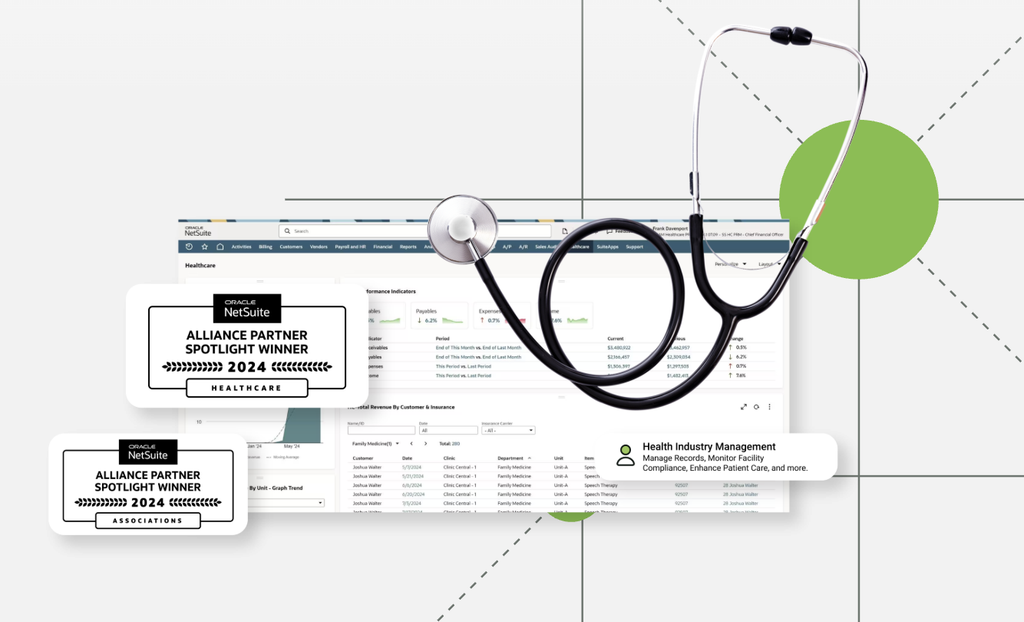
A properly scoped build follows five steps:
- Clinical trigger mapping: Bring IT maps every clinical event (completed encounter, procedure code, submitted claim) that should generate a financial record in NetSuite and documents the trigger logic before configuration begins.
- Identifier abstraction: Patient demographics and clinical identifiers become abstracted tokens at the integration boundary. PHI with no financial or administrative purpose stays in the EMR.
- HL7 FHIR translation: Procedure codes, billing identifiers, and payer information cross the boundary in the EMR’s native standard, HL7v2 over SFTP, TCP, or MLLP for most environments, or FHIR where the EMR has adopted it, so the integration survives an EMR data model update.
- Compliance governance: Every data movement across the boundary is logged, access controls are configured by business function, and the audit trail can be reconstructed on demand for HIPAA review or a billing dispute.
- Healthcare KPI configuration. Revenue by procedure, provider, location, and payer is configured in NetSuite from the start, rather than assembled from exports after go-live.
The result is that the finance team closes in five days or fewer, the claim denial rate drops below 10% because billing codes and payer eligibility are validated where clinical activity becomes a financial record, the CFO sees real-time service-line profitability without a spreadsheet, and the HIPAA audit surface shrinks because PHI no longer collects in ERP fields without a purpose.
Lucira Health: A Regulated Implementation, Already Run
Lucira Health, a medical technology company under FDA and HIPAA oversight, saw a surge in demand for at-home diagnostic tests during the COVID-19 pandemic. Its three-person IT team needed to integrate eight systems (Shopify, Amazon, Salesforce, Orderful EDI, Zendesk, Arena, Snowflake, and Informatica) and go to market in weeks. FDA and HIPAA requirements were day-one design inputs.
Because Bring IT had already built the playbook for FDA- and HIPAA-regulated NetSuite environments, the integration governance, PHI posture, and compliance audit trail were applied rather than invented. All eight integrations were configured with retriggering on failure and alerting that surfaced errors before they reached the ledger, and the compliance architecture was built to the go-to-market schedule.
“Due to a shortage of supply in the market, we had to quickly move to sell our own inventory in the market, and with Bring IT and Celigo, we were able to go to market within a few weeks.” Kristian Iskandar, Director of Enterprise Applications, Lucira Health
The implementation removed hundreds of manual payouts, isolated errors across thousands of records, and supported the company doubling in size within a year.
Post-Go-Live: Bring IT Care above NetSuite ACS
Bring IT Care, Bring IT’s managed-services practice, sits at Level 3, above NetSuite Premium Support (Level 1) and NetSuite ACS (Level 2). For healthcare, that structure matters because payer rule changes, new procedure codes, and regulatory updates need ongoing maintenance that ACS is not scoped to handle.
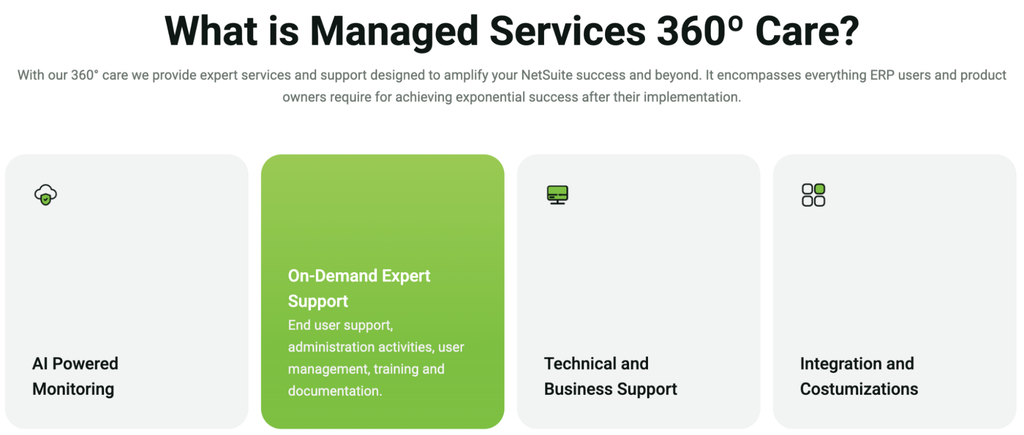
Bring IT Care runs the same four phases used across every vertical (stabilization, adoption, automation, and continuous optimization) with a minimum of 20 hours per month, a dedicated team rather than ticket rotation, and follow-the-sun support in English, Spanish, Portuguese, Dutch, and Filipino.
Questions to Ask a Healthcare NetSuite Partner Before Signing
Each question surfaces a structural decision the partner must have made before the engagement begins. A hedged or deferred answer is itself a selection signal.
- Can you name regulated reference customers and describe the architecture? A qualified partner names HIPAA- or FDA-regulated customers, the number of EMR/EHR integrations deployed, and whether the managed-services relationship is still active.
- What data crosses the EMR-ERP boundary, and who governs it after go-live? Expect specific data classes: patient demographics as de-identified tokens, procedure codes in HL7 or FHIR format, and billing codes, with PHI that has no financial function staying in the clinical system. Undocumented integration ownership is the most common reason healthcare organizations switch partners.
- What is your documented PHI posture, BAA framework, and access-control model? The partner should commit to a Business Associate Agreement and describe which roles access which data, how access is audited, and how the audit trail is maintained.
- What proprietary healthcare IP will you deploy, and what does it replace? You should expect named SuiteApps or accelerators with a defined scope and production evidence at comparable organizations. “We have healthcare experience” is not a description of IP.
- How is post-go-live support structured above NetSuite ACS for a regulated environment? The answer should name the tier, the scope above ACS, the minimum engagement, and how the team handles payer and regulatory change.
- What outcome benchmarks will you commit to before the SOW? Month-end close under five days, claim denial rate below 10%, and revenue reporting by procedure, provider, location, and payer are the baseline. A partner who will not commit before signing will not deliver after go-live.
Oracle NetSuite is the platform. The partner is what determines whether the platform delivers a regulated, multi-payer, EMR-connected organization. In healthcare, that partner’s architecture is the line between clinical activity and financial reporting that a CFO can defend in a board meeting or a HIPAA audit. The platform decision is already made; the decision that carries the risk, and the return, is the partner.
Bring IT’s healthcare interoperability product was built for this architecture, runs in FDA- and HIPAA-regulated environments, and is backed by Bring IT Care managed services scoped for regulated healthcare operations. Mid-market and growth-stage organizations of 50 to 500 employees, with active NetSuite environments and outstanding EMR-ERP integration work, are the best fit.
Contact Bring IT to evaluate whether the healthcare integration architecture and Bring IT Care fit your NetSuite environment.
Frequently Asked Questions
Can an existing NetSuite instance be retrofitted with a governed EMR integration, or is a reimplementation required?
Retrofitting is the more common entry point. Many healthcare organizations arrive with a NetSuite instance that went live with a generalist partner and was never connected to the EMR through a governed layer.
A remediation starts with an audit of what was built: which fields hold data that should not cross the boundary, which flows exist and whether they are documented, and what PHI has collected in the ERP. Where PHI has accumulated without a financial purpose, the scope includes removing or re-abstracting it before the governed integration is configured. A full reimplementation is rarely necessary.
What is the difference between a Business Associate Agreement and a HIPAA compliance guarantee?
A Business Associate Agreement is a contractual commitment by a covered entity’s service provider to handle PHI in line with HIPAA. It covers data safeguarding, breach notification, and access controls.
A HIPAA compliance guarantee does not exist because compliance is a shared responsibility across the software provider, the implementation partner, and the organization. NetSuite provides the security framework, the partner configures the governance layer, and the organization operates within it.
At what size does a healthcare organization need a healthcare-specialized partner rather than a generalist?
Any organization under HIPAA that connects an EMR to NetSuite needs an explicit healthcare integration methodology, regardless of size. The minimum necessary data principle, HL7 and FHIR standards, and PHI governance apply at 50 employees and at 500. Multi-payer revenue cycles and compliance traceability do not scale down to a point where a generalist approach is adequate.
How long does a healthcare NetSuite implementation with EMR integration take to stabilize?
Timeline depends on the number of integrations, the payer mix, and the state of the existing EMR environment. The Lucira Health engagement reached a functional go-to-market state within weeks because Bring IT had already built the playbook for that architecture. Ask any partner how many comparable healthcare NetSuite implementations it has completed, what stabilization looked like, and what managed services cover the first 60 to 90 days after go-live.
How does a CFO verify that a partner’s healthcare references are genuinely comparable?
Ask for the regulatory environment (HIPAA only, or FDA plus HIPAA), the number of EMR/EHR integrations deployed, the organization’s size at implementation, whether the partner is still in a managed-services relationship with that customer, and whether the reference will speak directly. A reference who finished two years ago and is out of contact tells a different story from one in an active engagement.