The NetSuite go-live invoice gets paid, the partner goes quiet, and finance is still closing the books in a spreadsheet. Undocumented integrations between NetSuite and the surrounding systems keep running in production, quietly dropping records. The first signal of failure is a month-end reconciliation discrepancy inside NetSuite, not a same-day alert.
The most consequential difference between the NetSuite partner finance leaders leave, and the one they need is not measured in response times. A partner can answer every ticket inside its service-level agreement and still leave the finance team exposed. What separates the two is whether integration failures surface before or after the ledger has been finalised, and whether compliance exposure is anticipated or discovered after the incident.
The criteria that apply when choosing a NetSuite partner apply again on the way out, with one constraint the first decision did not carry. The system is already live.
In brief
- UK companies switch NetSuite partners because integrations drop records silently and surface only at month-end, not because the platform is wrong.
- A proactive partner audits and assumes ownership of the existing build rather than proposing a restart. A reactive partner withdraws after go-live.
- The decision test is single and concrete: can the finance team produce consolidated group accounts from NetSuite without a spreadsheet step?
8 signals your current NetSuite partner has stopped delivering value
Signals can be split into two sets: finance and data trust signals, and structural and relationship signals. Let’s start with the first set.
Finance and data trust signals
- Parallel spreadsheets still running: The finance team produces the board pack from a spreadsheet, not from a NetSuite report. The system is live; the reporting layer is not.
- Integration errors surfacing at month-end: Reconciliation discrepancies appear during close rather than triggering an alert on the day they occur. Finance discovers the shortfall at month-end, weeks after the record was dropped.
- Intercompany eliminations handled manually: One or more entity consolidations require a manual journal export step rather than OneWorld automation. The number of entities in the structure makes this a monthly bottleneck.
- VAT or IFRS configuration incomplete: The NetSuite instance was configured for basic financials. VAT group treatment, IFRS 16 lease accounting, or multi-entity consolidation under FRS 102 still requires external spreadsheet work.
Structural and relationship signals
- No documented handover of the existing build: Integrations, custom scripts, and module configurations are undocumented. When a flow fails, or a new system needs connecting, the team reverse-engineers from scratch.
- Support that resolves tickets without resolving causes: The same class of issue returns every quarter. Response times may be within the service-level agreement, but nobody owns the underlying configuration or the fragile integrations in production. In the more acute version of this signal, the partner has become unresponsive or has dissolved.
- No proactive release advice: The finance team discovers the impact of an Oracle NetSuite release after it has already affected the instance, not before.
- No forward-looking compliance review: Planned acquisitions, new-entity additions, and VAT rule changes are not discussed with the partner before configuration is required.
If several of these are present, the case for switching has already been made on operational grounds alone.
What a UK finance leader should expect from a NetSuite partner
Before evaluating a switch, it is worth establishing which of the two partner programmes a firm sits in. An Oracle NetSuite Alliance Partner delivers implementation, support, and optimisation while the customer buys the licence from NetSuite directly. A Channel Partner, listed by NetSuite as a Solution Provider, transacts the licence in return for commission and then delivers the implementation. The subscription contract sits with NetSuite in both cases, and the difference matters most at the point of a switch, which the section after this one covers in full.
Bring IT is an Oracle NetSuite Alliance Partner with delivery teams across 10 countries, including the UK, Spain, and the Netherlands. It structures post-go-live work as Bring IT Care, a four-phase managed-services model:
- Stabilisation: bringing the live environment under control, closing the configuration and integration issues that are producing errors now.
- Adoption: moving the finance team off parallel spreadsheets and onto the system, including role-based training and reporting build-out.
- Automation: closing the manual steps that remain after adoption, typically in the integration layer and around close and consolidation.
- Optimisation: keeping the configuration aligned to the business as entities, jurisdictions, and transaction volumes change.
It offers a Proactive Advisory variant built around annual business-plan reviews and NetSuite release-impact assessments. Its vertical IP spans hospitality, healthcare, franchise, and LATAM tax localisation.
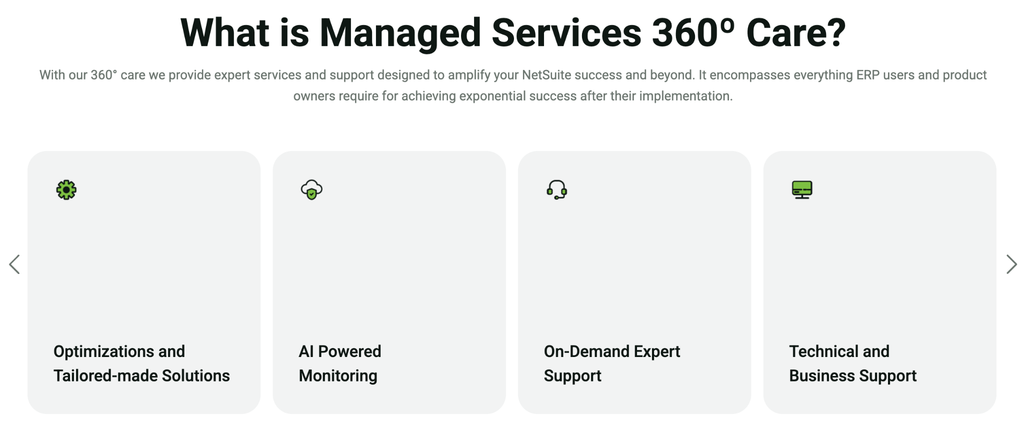
A finance leader evaluating any NetSuite partner, not just Bring IT, should expect the same standard: a structured post-go-live model rather than ticket-based support, a documented plan for closing configuration shortfalls, and a partner willing to take ownership of an existing build rather than proposing a restart.
How to choose between staying with your current partner and switching
The decision rule is a single diagnostic question: can the finance team produce consolidated group accounts from NetSuite without a spreadsheet step, and does the current partner have a documented plan to close that shortfall?
If the answer to either half is no, the case for switching has already been made. The consolidated group accounts test covers integration reliability, module configuration, and intercompany elimination in one question.
A partner who cannot explain how they will close the shortfall is reactive, regardless of the language in the services agreement.
Stay with the current partner when the shortfalls are fixable
Remediation is faster and lower-risk than a transition when:
- The partner is engaged and has a documented remediation plan for the specific configuration shortfalls identified.
- The integrations are documented, and the partner owns the error-handling logic, even if some flows need improvement.
- The compliance exposure is limited to one or two configuration issues with a clear close date agreed in writing.
Switch to a new partner when the relationship itself is the problem
Any one of these is reason enough to evaluate a transition. Three or more together means the relationship cannot be remediated and should be replaced:
- The current partner has disengaged or has dissolved.
- Integrations are undocumented, and the error-handling logic is unknown.
- Advanced modules are enabled but unconfigured, with no remediation plan offered.
- The finance team has been running parallel spreadsheets for an extended period since go-live.
How a parallel-run transition protects the live environment
A parallel-run transition lets a new partner assume ownership of the existing build without creating a period of unsupported live-environment operation. The current partner continues to hold the support agreement while the new partner completes the instance audit and transition plan.
Once the audit is complete and the highest-priority remediation work is scoped, the new partner assumes full ownership and the current agreement is terminated.
Bring IT Care is structured to support this model: The managed-services engagement begins with the instance audit, and the 20-hours-per-month minimum is applied to stabilisation work before adoption and automation are sequenced.
The finance team continues to close the books without interruption while the new partner documents and remediates the existing build in parallel.
Finance and IT leaders who have identified the signals of a disengaged partner can request a structured instance assessment from Bring IT, covering integration mapping, module coverage, UK compliance exposure, and a documented transition plan, before committing to switch. Contact Bring IT to arrange your assessment.
Frequently asked questions about switching NetSuite partners in the UK
What happens to custom scripts and saved searches built by the outgoing partner? Do they stay in the instance?
Yes. Custom scripts, saved searches, workflows, and all other customisations are stored inside the NetSuite account, which belongs to the customer, not the partner. When a partner relationship ends, those objects remain in the instance and continue to run. The risk is not loss. It is orphaned ownership: scripts that run without documentation, saved searches that return results nobody has validated recently, and workflows built for a business process that has since changed.
The instance audit conducted by an incoming partner should cover every customisation in the account, validate that it still performs its intended function, and document it so that future changes or troubleshooting do not require reverse-engineering from scratch.
Can you switch NetSuite partners without Oracle’s approval, and does the licence carry over?
In most cases, yes. Where the customer bought the licence directly from NetSuite, as is typical alongside an Alliance Partner relationship, switching implementation or support partners does not affect the subscription, and no Oracle approval is required, though the NetSuite account team is typically informed as a courtesy. Where a Channel Partner arranged the licence, confirm with that partner and with your NetSuite account manager how the transaction is handled at renewal before signing with a new provider.
How long does a partner transition typically take for a UK business with active integrations?
The transition timeline depends on the complexity of the existing build and the number of undocumented integrations. For a UK business with three to 10 legal entities and a modest number of integration flows, the instance audit and highest-priority remediation typically complete within 60 to 90 days.
In a standard transition, the first managed close cycle under the new partner, where the finance team runs month-end with the new partner present, typically falls in days 61 to 90. Integration flows with unknown error-handling logic require more time because the new partner must reverse-engineer the logic before adding retriggering and alerting. Documented integrations shorten the transition materially.