An integration can run for months without a single error and still leave finance unable to produce a consolidated report. Nothing failed. The design never established what the reporting requirement needed from the source system, so the data arrives on schedule and incomplete.
Integrations sit inside the solution design, not beside it. Reporting and functional requirements determine which data matters, where it is generated, and which system owns each master data source. The design then sets how that data reaches NetSuite, at what volume and frequency, and complete enough for finance to rely on. That work is what separates a qualified integration partner from a contractor who configures a connector and moves on.
In Brief
- Integration design starts from reporting and functional requirements, not from the connector, and belongs in the solution design rather than in mid-implementation discovery.
- The functional NetSuite expertise and the integration expertise work together, which is why the same partner delivering both tends to produce a cleaner project and a stronger ongoing support arrangement.
- Middleware selection follows data volume, the number of integrations, and the level of transformation required, alongside queue management, security, and error handling.
- A qualified partner keeps the integration stack running past go-live through a structured managed-services model rather than a one-time build.
What a Qualified NetSuite Integration Partner Looks Like
Bring IT is an Oracle NetSuite Alliance Partner that establishes the integration architecture during solution design rather than defaulting to one platform regardless of the flow. The firm holds Celigo Platinum Partner status alongside a dedicated Boomi delivery practice, and every integration ships with retry logic and real-time alerting built in from day one.
Because the same team owns the NetSuite configuration and the integration design, the data model the integration writes into and the reporting it has to support are decided together rather than reconciled afterwards. Its NetSuite Remediation practice exists specifically to rectify a fragile stack a prior partner left undocumented. Bring IT Care, the managed-services practice, keeps the relationship open past go-live rather than ending at implementation, delivered through teams across 10 countries.
What sets it apart: Integration architecture is established during solution design by the same team that configures NetSuite, paired with a managed-services practice that keeps the integration layer owned after go-live.
Why Integration Design Belongs in the Solution Design
The sequence matters more than the tooling. A design that starts from the connector asks which systems can be joined. A design that starts from the reporting requirement asks a different set of questions, and the answers shape everything downstream.
- Reporting and functional requirements: What finance and operations need NetSuite to produce determines which data has to be present, at what level of detail, and by when.
- Data origin and master data ownership: Each required field is generated somewhere in the system landscape, and one system has to own each master data source so records reconcile across the estate.
- Volume, frequency, and mapping: How much data moves, how often it updates, and how source fields map to NetSuite records set the architecture and the platform choice.
- Transformation and completeness: The transformation logic and the completeness standard determine whether the resulting NetSuite record can support the reporting requirement or only part of it.
A partner who can walk through those four before proposing a platform is designing the integration. A partner who opens with a connector recommendation is quoting one.
What a Structured Managed-Services Model Covers
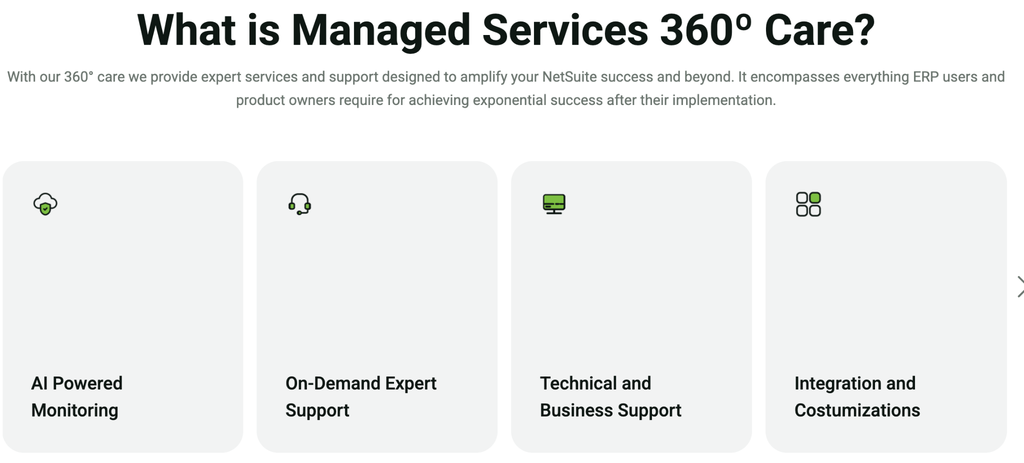
The phrase “managed services” covers everything from an availability promise to a defined engagement with contracted hours. The four pillars below describe what the model looks like when it is structured, using Bring IT Care as the reference.
- AI-powered monitoring: Automated watch over integration flows and transaction volumes, so a failure registers as an alert rather than as a discrepancy someone notices during reconciliation.
- On-demand expert support: Access to certified consultants without raising a new statement of work for every question, drawn from the same team that knows the environment.
- Technical and business support: Coverage across both the configuration layer and the process layer, so a reporting problem gets diagnosed as either a system issue or a process issue rather than bounced between the two.
- Integration and customizations: Ongoing development capacity for new flows, new entities, and new systems, built onto the existing architecture rather than scoped as a fresh project each time.
Two structural points sit underneath those pillars. The model is designed to work alongside NetSuite’s own support rather than to duplicate it, sitting above NetSuite Premium Support and NetSuite ACS rather than replacing either. Delivery runs from teams across 10 countries, which matters when the integration estate spans entities in more than one region and an overnight failure needs attention before the local finance team starts its day.
The distinction that matters at contracting is whether the model carries defined scope and minimum hours. Bring IT Care starts at 20 hours per month and runs a phased sequence of stabilisation, adoption, automation, and continuous optimisation. A commitment expressed as hours and phases is auditable. A commitment expressed as availability is not.
The Error-Handling Standard Integrations Should Meet
When data needs validation before anyone can use it, the systems that produced it have already failed. Defensible numbers survive scrutiny from a board, an auditor, or a private-equity operating group without a manual explanation attached.
That standard requires integration design that surfaces failures before reconciliation, not after. Retry logic fires automatically when a flow drops a record, and alerting reaches the right person the same day the failure occurs, long before the general ledger fails to tie at month-end. Error management is also one of the areas where AI is changing what the monitoring layer can do, moving it from flagging individual failures towards identifying the pattern behind a recurring one and, increasingly, correcting classes of error without manual intervention.
How an Integration Design Failure Reaches the Close
Two failure modes reach the close, and the design decides both.
The first is incompleteness. The flow runs, no error fires, and the records land in NetSuite missing a field the reporting requirement depends on, because the design never established what the report needed from the source. Nothing looks wrong until someone tries to produce the report and finds it cannot be built from the data in the system.
The second is the dropped record. In a well-designed system, retry logic fires within minutes and the error surfaces on a dashboard the same day. In a poorly designed one the record disappears, the integration marks the transaction as processed, NetSuite never receives the payload, and every downstream transaction proceeds as if the source record was never missing. Sales orders, fulfilment, invoicing, and GL postings all build on top of a record nobody has flagged as absent.
By month-end, reconciliation finds the discrepancy, and the finance team traces it back through several weeks of transactions. Fixing it means untangling every downstream transaction that was built on the missing record, so the close extends by days, and the CFO spends them explaining numbers rather than analysing them. An error caught in real time costs an hour of a consultant’s attention. The same error caught at month-end can hold up the close for the whole finance team.
Choosing Between Celigo, Boomi, and Point-to-Point
Most companies settle on one middleware platform across the IT estate rather than running several, because a single platform is easier for an internal team to manage, support, and staff for. The architecture question is therefore less about picking a different tool for every flow and more about establishing which platform the estate standardises on, and which flows genuinely need middleware at all.
The need for middleware is normally driven by the volume of data moving, the number of integrations in the estate, and the level of transformation required between source and target. The choice of platform is then influenced by how well it manages queues of transactions, how it scales as volumes grow, what it offers on security, and how well it reports on and manages errors.
Celigo fits high-volume, well-defined flows where a pre-built connector already covers the system being integrated, including Shopify, Salesforce, Amazon, HubSpot, and Magento. The pre-built connector library shortens the build where the flow matches what the connector was designed for.
Boomi fits complex EDI flows, non-standard data formats, and integrations that need custom transformation logic the connector layer cannot handle natively. Where data structures are non-standard, or the logic between source and target is too involved for a pre-built connector, Boomi handles it cleanly. Using it where Celigo would suffice adds cost and maintenance for no benefit.
Point-to-point RESTlets built directly against the NetSuite API suit a small number of low-volume, stable flows where middleware would introduce licence cost and latency without a governance benefit. This is not always available or advisable, because it depends on what the other system supports. Where the counterpart system offers a limited API, needs transformation on the way through, or sits inside an estate already standardised on a middleware platform, routing the flow through that platform is the sounder choice.
Questions to Ask Before You Choose a NetSuite Integration Partner
Every partner will say yes to “can you integrate X?” Ask the questions below before you sign, and use the answers to separate a genuine fit from a proposal that sounds capable on a call.
How do you decide whether a flow needs middleware, and which platform carries it? A real answer references data volume, the number of integrations in the estate, and the transformation required, then moves to queue management, scaling, security, and error handling, rather than “the best tool for the job.”
At what point in the project is the integration architecture established? Expect it to sit inside the solution design, alongside the reporting and master data decisions it depends on, rather than being resolved during the build.
What happens when an integration flow fails in production? Expect retry logic, alerting configuration, and an escalation path, not “we monitor it and fix issues as they arise.”
How do you document integration dependencies after go-live? A qualified partner documents what was built, why, and what the failure modes look like.
Do your managed services carry defined scope and hours? A structured engagement with minimum hours and a phased model is a commitment. A vague availability promise is not.
How do you handle remediation when you take over a fragile environment? Expect an audit, a resolution-planning phase, and an architecture handbook that documents the current state before any changes.
Which named clients at comparable complexity can you reference? A partner confident in its integration work will connect a prospective client with a reference who has run the architecture in production for at least a full close cycle, not just a logo on a website.
What a Reference at That Standard Looks Like
Lucira Health, a medical technology manufacturer operating under FDA and HIPAA requirements, went to market during the COVID demand surge on an eight-integration stack spanning Shopify, Amazon, Salesforce, Zendesk, Snowflake, Informatica, Orderful EDI, and Arena.
The build eliminated hundreds of manual payouts, and the company doubled in size within a year while the architecture held. A reference of that shape lets a prospective buyer ask the questions above of someone who has answered them in production rather than in a proposal.
Integration design determines whether your finance team closes on schedule or spends the week explaining a spreadsheet. Contact Bring IT to review your integration design alongside the reporting it has to support.
Frequently Asked Questions
How long does a NetSuite integration typically take to stabilise after go-live, and what signals indicate it is destabilising?
Integrations built with proper retry logic and alerting typically reach a stable error rate within the first few close cycles. The warning signs are an error rate that does not decline week over week, failures still discovered during reconciliation rather than on a dashboard, and fixes applied as reactive patches rather than root-cause resolutions.
Who owns the integration monitoring dashboard after go-live, and what access should finance have?
Ownership sits with the customer, supported by the partner. The environment belongs to the business, and the partner operates the monitoring layer, resolves what it surfaces, and reports on it. Finance should hold read access as a matter of governance rather than depending on the partner to relay status. If the current partner cannot show a live error-rate view on request, the monitoring layer does not exist in a form that protects the close.
When is it worth remediating an existing integration versus rebuilding it?
Remediation fits when the underlying design still matches what the business needs to report, and the failure traces to a specific operational cause such as missing retry logic or an unhandled transformation case. Rebuild fits when the original design no longer supports the reporting requirement, when the master data ownership has moved, or when there is no documentation and the audit cannot establish what the integration was designed to do.
Beyond the platform licence, what determines what an integration costs to own?
The licence is the visible line, but it is not what most influences the total. Maintenance as volumes and flows grow, the internal finance hours a poorly instrumented integration consumes at each close, and the remediation cost of a failure discovered late all sit above it. Those are costs. The value sits on the other side of the ledger, in a design that produces reporting your finance team can use without manual intervention, and the two are worth assessing separately when you compare proposals.
Does it matter if an integration partner specialises only in integrations rather than full NetSuite implementation?
It matters in both directions. The functional NetSuite expertise and the integration expertise depend on each other, because the integration has to write into a data model that supports the reporting the configuration was built to produce, and neither works properly designed in isolation from the other. A specialist can repair a specific connection in an environment that is already sound. For a company selecting or implementing NetSuite, keeping the integration design with the team that owns the functional build avoids the conflicts that surface when the two are scoped separately.
Should every integration flow use the same platform, or can Celigo, Boomi, and point-to-point coexist on one NetSuite instance?
They can coexist, but most companies deliberately standardise on one middleware platform across the IT estate because it is easier to manage, support, and staff. The more common pattern is a single platform carrying the integrations that need middleware, with a small number of point-to-point flows where the volume is low, the data is stable, and the counterpart system supports it. A partner recommending a different platform for every flow is adding operational overhead the internal team will carry.