Key takeaways
- NetSuite and Sage Intacct both deliver deep financial reporting, but through different architectures: NetSuite reaches it by unifying the ledger with operational data in one database, while Sage Intacct reaches it through native dimensional accounting paired with a best-of-breed integration model for everything outside finance.
- The right platform depends on how many entities you consolidate, how much of your business operations you need visible inside the same system as your finance data, and how much staff capacity you have to maintain integrations.
- Neither software solution publishes a pricing list. Use budget directional ranges, and confirm against a quote specific to your user count and modules.
NetSuite and Sage Intacct both target companies who’ve outgrown QuickBooks and need more sophisticated controls, real-time reporting, and a system that won’t need replacing in three years.
Many articles that compare these two cloud-based software solutions stop at one being “operational” and the other being “finance-first.” But that doesn’t tell you which system closes your books faster or handles your fifth entity without a workaround.
This guide measures each system against eight categories, so that you can understand the breadth and depth of each tool. You’ll also get a framework that helps you make the right choice.
At a Glance: NetSuite Vs Sage Intacct
Here’s a quick scan of the differences between both platforms, and where each one is worth the money.
| Category | NetSuite | Sage Intacct |
|---|---|---|
| Best for | Multi-entity businesses with inventory, CRM, or operations embedded in finance | Organizations preferring a finance-only footprint without native operational modules |
| Multi-entity handling | OneWorld: single instance, native consolidation | Multi-entity module or separate instances, depending on scope |
| Inventory & operations | Native (warehouse, CRM, order management) | Not included; only relevant if you carry physical inventory |
| Reporting depth | Strong dimensional reporting through virtually unlimited custom segments and classes, plus a dedicated BI layer for cross-functional data | Strong dimensional GL reporting out of the box |
| Ecosystem | Oracle partner network, SuiteApp marketplace | Sage Marketplace, smaller partner network |
Let’s compare both software solutions across these categories.
1. Core Accounting & Financial Management
Both platforms handle the fundamentals: general ledger, accounts payable and receivable, bank reconciliation, multi-currency support, and native dimensional reporting. The difference is in what else sits inside that same system alongside the ledger.
Both platforms also tag transactions with reporting dimensions, department, location, class, project, and more, so you can pull a profit and loss statement (P&L) by any combination without a custom report request.
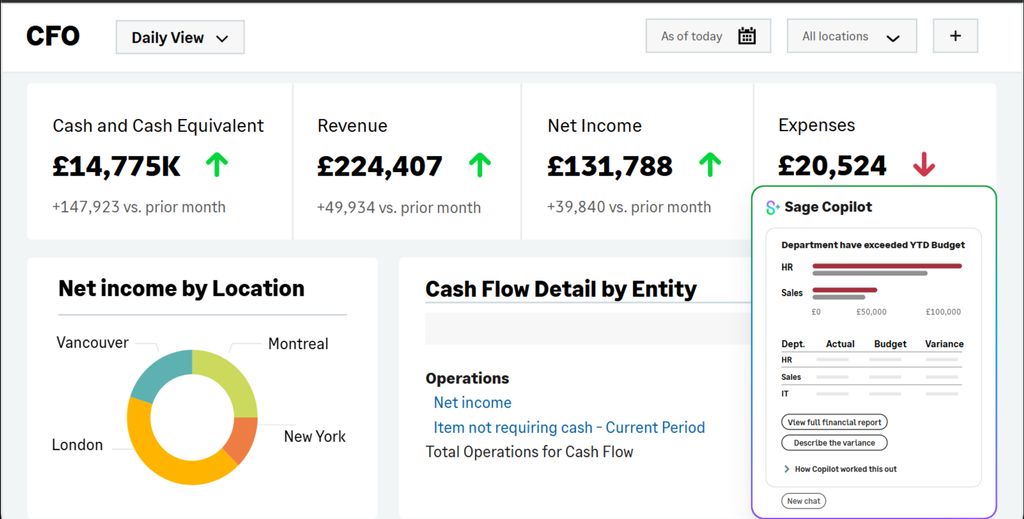
Sage Intacct ships with up to seven dimensions ready to use inside Core Financials. NetSuite uses custom segments and classes, with virtually unlimited flexibility once configured during implementation.
NetSuite covers the same ground through custom segments and classes, with no more setup effort than Sage Intacct’s dimensions require. Once built, it functions the same way, tied to the same transaction record that drives inventory, CRM, and order data.
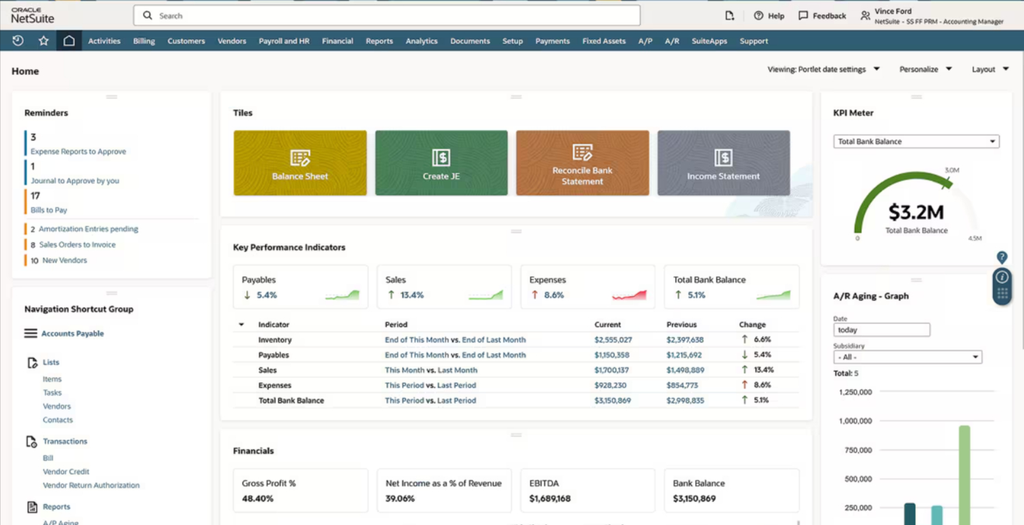
For a pure accounting function with no operational complexity outside finance, either platform delivers the reporting you need. For a business that wants finance and operational data on the same record, NetSuite’s single-database structure removes a reconciliation step a best-of-breed setup can’t.
Verdict: Core Accounting & Financial Management
There’s no clear winner on accounting depth alone. Both platforms deliver sophisticated, dimension-based financial reporting natively, with comparable setup effort on either side.
The deciding factor is whether that reporting needs to work alongside operational data in the same system, and that’s where NetSuite’s single-database structure stands out.
2. Multi-Entity & Global Consolidation
NetSuite OneWorld keeps every subsidiary’s transactions, accounts, and financial records inside one system, instead of giving each entity its own separate deployment. Currency translation, intercompany eliminations, and consolidated statements happen automatically as transactions post, so adding a new entity is a configuration change.
Sage Intacct handles multi-entity through its Multi-Entity module. It’s capable, and its dimensional reporting makes cross-location comparison straightforward. But as entity count grows, some organisations end up running separate instances or leaning on add-on consolidation tools to bridge gaps that OneWorld handles natively.
If your organisation operates a small number of entities with simple ownership structures, either platform works. As entity count and intercompany complexity grow, the gap in native consolidation becomes a real cost during close.
Verdict: Multi-Entity & Global Consolidation
NetSuite wins in this category. OneWorld handles currency translation and intercompany eliminations natively as transactions post. Sage Intacct’s multi-entity module requires more manual work for eliminations as entity count and complexity grow.
Further reading: How to Successfully Manage Multiple Subsidiaries in NetSuite
3. Reporting, Dashboards & BI
Sage Intacct’s reporting engine reads the same dimensions already tagging every transaction, so reports are ready as soon as the data exists. Deeper analysis requires the Interactive Custom Report Writer or Visual Explorer, both sold as separate subscriptions, commonly estimated at £2,255.85 to £7,519.50 or more per year on top of the core package.
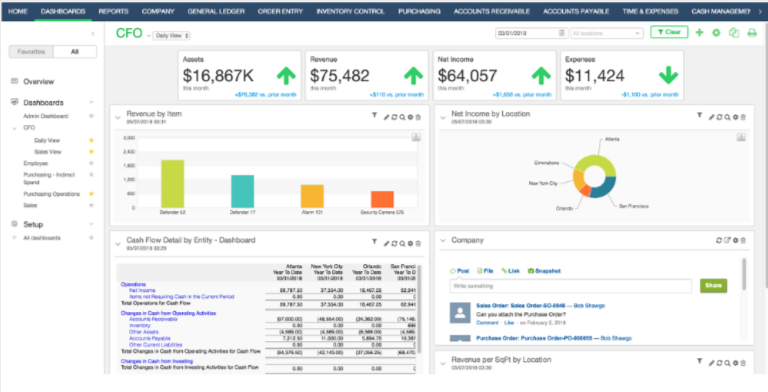
NetSuite includes saved searches and role-based dashboards in the base platform. For enterprise-grade BI across multiple data sources, NetSuite Analytics Warehouse adds a dedicated data warehouse layer, priced separately.
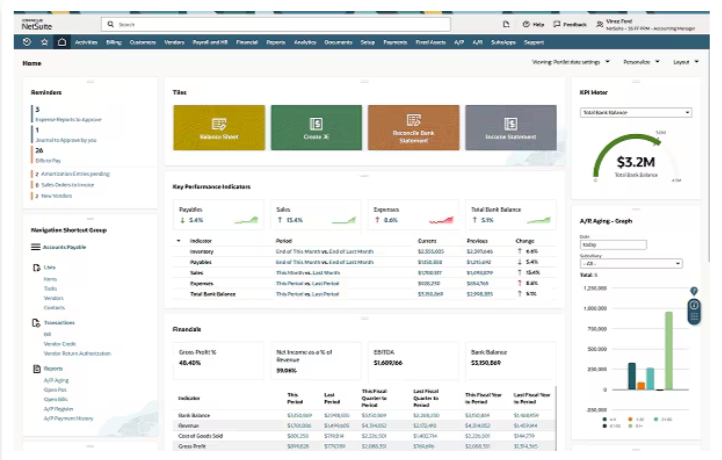
Neither platform gives you full BI for free. The distinction is what triggers the upgrade: Intacct’s advanced reporting tools enable deeper GL analysis, while NetSuite’s analytics layer combines financial data with operational data from inventory, CRM, and other native modules.
Verdict: Reporting, Dashboards & BI
Both platforms deliver strong native reporting.
Sage Intacct’s dimensional reports and NetSuite’s saved searches and role-based dashboards both work out of the box, no configuration needed to combine financial and operational data.
The difference shows up at enterprise scale: NetSuite’s Analytics Warehouse adds a dedicated BI layer for combining data across many sources, a step up neither platform needs for standard reporting.
4. Operational Modules: Inventory, CRM & Order Management
This is where the two platforms diverge most.
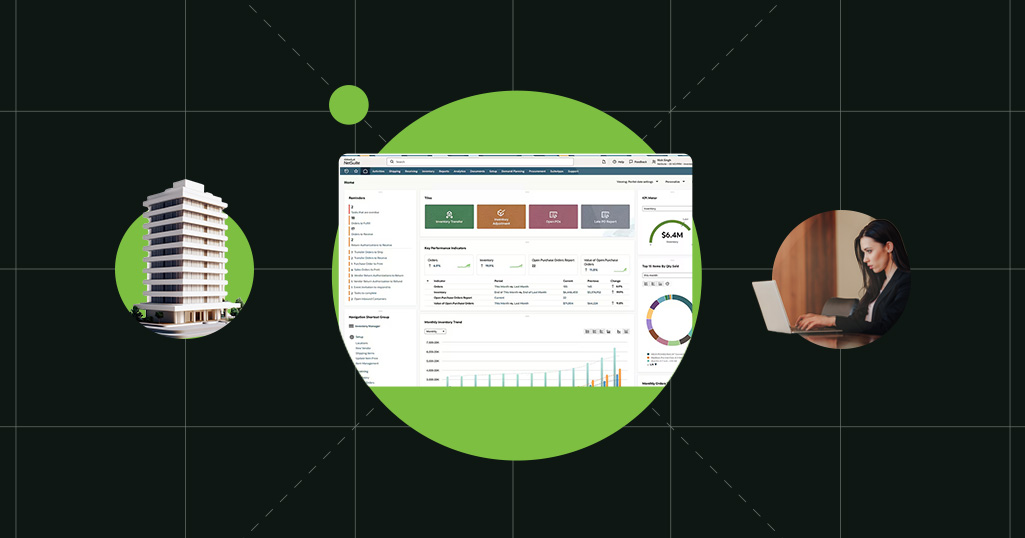
NetSuite includes CRM and order management as native modules on the same database as the ledger, with inventory and warehouse management available for businesses that need them. A sales order and its revenue recognition schedule are two views of one record, so finance and sales are never working from different data.
Sage Intacct does not include inventory, manufacturing, or warehouse management. If your business ships physical goods, you’ll pair Intacct with a separate system such as Fishbowl, Extensiv, or a dedicated WMS, then reconcile inventory and financial data between the two.
Neither approach is wrong. A services firm still gains from NetSuite’s operational modules, SuiteProjects and SuiteProjects Pro handle project and resource management even without physical inventory. A company with physical goods or multiple warehouses will spend real effort building and maintaining the integration Sage Intacct requires.
Verdict: Operational Modules
NetSuite wins outright for any business with inventory, warehousing, or field operations. Sage Intacct doesn’t include these modules, so the comparison only holds for finance-only businesses that don’t need this category.
5. Integrations & Ecosystem
Sage Intacct’s “best of breed” model assumes you’ll connect it to specialized CRM, HR, and operations tools through its Marketplace and open API. This keeps each system focused on what it does best, and integrations are core to how most operationally complex businesses run today, whether that’s on Sage Intacct or NetSuite.
That maintenance burden has a name worth budgeting for: the Integration Tax. Every API connection is a point where a mid-month contract change, a partial shipment, or a currency swing can fail to sync, and someone on the finance team fixes it by hand instead of analysing the numbers. The license fee you save on a leaner platform often reappears as headcount spent on reconciliation.
NetSuite’s SuiteApp marketplace and native modules reduce how many integrations you need, though most mid-market companies still connect NetSuite to payroll, tax, or industry-specific tools. Celigo is the most common integration platform paired with NetSuite for the remaining connections.
The practical question is how many best-of-breed tools you’re already committed to, and how much fixing you’re willing to staff for. Heavy investment in a specific CRM or e-commerce platform favors Intacct’s model. A clean slate favors consolidating inside NetSuite.
Verdict: Integrations & Ecosystem
NetSuite wins on total integration overhead, since fewer connections mean less exposure to the Integration Tax. Sage Intacct wins only if you’re already committed to specialised CRM, WMS, or HR tools you have no intention of replacing.
6. Implementation Time & Complexity
Sage Intacct implementations for single or few-entity companies commonly complete in two to four months, largely because the scope stays inside finance.
NetSuite implementations run longer, typically four to nine months for mid-market deployments, because the project usually touches order management, CRM, and multi-entity consolidation alongside the ledger. Data migration and process redesign account for most of that additional time.
Faster isn’t automatically better here. A shorter Intacct implementation limited to finance still leaves your operational systems disconnected. A longer NetSuite implementation front-loads work that would otherwise show up later as integration maintenance.
What determines success in either case is sequencing. Configuration that starts before the business’s actual order-to-cash and close processes are mapped tends to produce a system the finance team routes around with a parallel spreadsheet.
Bring IT sequences every engagement the same way: understand the people and processes first, then configure the technology around them. A signed System Design Document precedes any configuration work, and complex builds undergo three separate test cycles: internal testing, user acceptance testing, and system integration testing, each validated against real transactions before cutover.
Managed services through Bring IT Care continue that support after go-live, reviewing upcoming releases and recurring support patterns proactively rather than waiting for the next close to show a problem.
Verdict: Implementation Time & Complexity
Sage Intacct wins on speed. A finance-only scope means less to configure and less to test. NetSuite takes longer because the project spans departments, but that longer runway buys a system that shouldn’t need a second implementation later.
7. Industry Fit
Professional services firms, nonprofits, and holding companies run well on either platform.
Sage Intacct fits when the business has no need for native operational modules. NetSuite fits the same profile and pulls ahead once the business needs CRM, project management, or multi-entity consolidation alongside the ledger.
NetSuite’s native operational modules fit businesses with inventory, franchising, field service, or multi-vertical operations, where finance needs visibility into what’s happening outside the ledger. Franchise organisations, wholesale distributors, and manufacturers make up a large share of NetSuite’s mid-market customer base for this reason: the ledger and the operational record can’t drift apart because they’re the same record.
Bring IT works with CFOs, Controllers, and financial leaders across exactly these operationally complex industries, and the pattern holds consistently in that work, documented across several case studies.
Verdict: Industry Fit
Neither wins universally here. Professional services, nonprofits, and holding companies are well-suited to Sage Intacct. Businesses with inventory, franchising, or field operations fit NetSuite. Whichever category above matches your actual complexity is the one that decides it.
How to Choose Between NetSuite and Sage Intacct
Ask yourself these four questions:
- Does your business hold physical inventory or run field operations? If yes, NetSuite’s native modules have an integration Intacct doesn’t include.
- How many legal entities do you consolidate today, and in three years? More entities mean more value from OneWorld’s native consolidation and automated eliminations.
- Are you already committed to specialised CRM or operations software you won’t replace? If so, Intacct’s integration-first model protects that investment.
- Is your primary complexity financial, not operational? Holding companies, professional services, and nonprofits often get everything they need from Intacct without paying for unused operational capacity.
Three signals usually mean an existing Sage Intacct deployment has outgrown its architecture:
- More than three active API connections with at least one sync failure in the past quarter
- A new physical goods or field service line of business
- Intercompany eliminations still tracked in a spreadsheet outside the system
Both platforms are capable, ten-year decisions. The right one depends on where your operational complexity actually lives, not on which system has the better sales pitch.
Budgeting for what comes after go-live matters too: NetSuite Planning and Budgeting and its equivalent Intacct workflows both need real configuration to earn their keep, and a stalled rollout usually traces back to partner fit rather than platform choice.
If you want a second opinion specific to your entity structure and transaction volume, talk to Bring IT’s experts, as we offer a working session to map your requirements against both platforms before you sign anything.
FAQs on NetSuite vs Sage Intacct
Is Sage Intacct cheaper than NetSuite?
For a single-entity, finance-only deployment, Sage Intacct’s entry pricing is typically lower. Once a business adds inventory, multiple entities, or operational modules, NetSuite’s native functionality can end up costing less than Intacct plus the third-party integrations needed to match it.
Can you migrate from Sage Intacct to NetSuite without losing historical data?
Yes. A structured data migration process moves historical GL data, open transactions, and dimensional history into NetSuite’s structure. However, the mapping work varies based on how many custom dimensions and modules the Intacct instance uses.
What should a CFO ask a NetSuite implementation partner before signing the SOW?
Ask whether the partner produces a signed System Design Document before configuration begins, how integrations are built (with retriggering and alerting on failure, or silent failure modes caught only at month-end), what the test-cycle structure looks like before go-live, and what post-go-live support covers. Partners who can’t answer with specifics are usually configuring first and asking process questions later.
How long does a NetSuite OneWorld implementation take compared to Sage Intacct’s multi-entity setup?
NetSuite OneWorld implementations for multi-entity businesses typically run six to nine months. Sage Intacct multi-entity setups often complete faster, in three to five months, though that timeline reflects a narrower financial scope rather than a faster technical process.