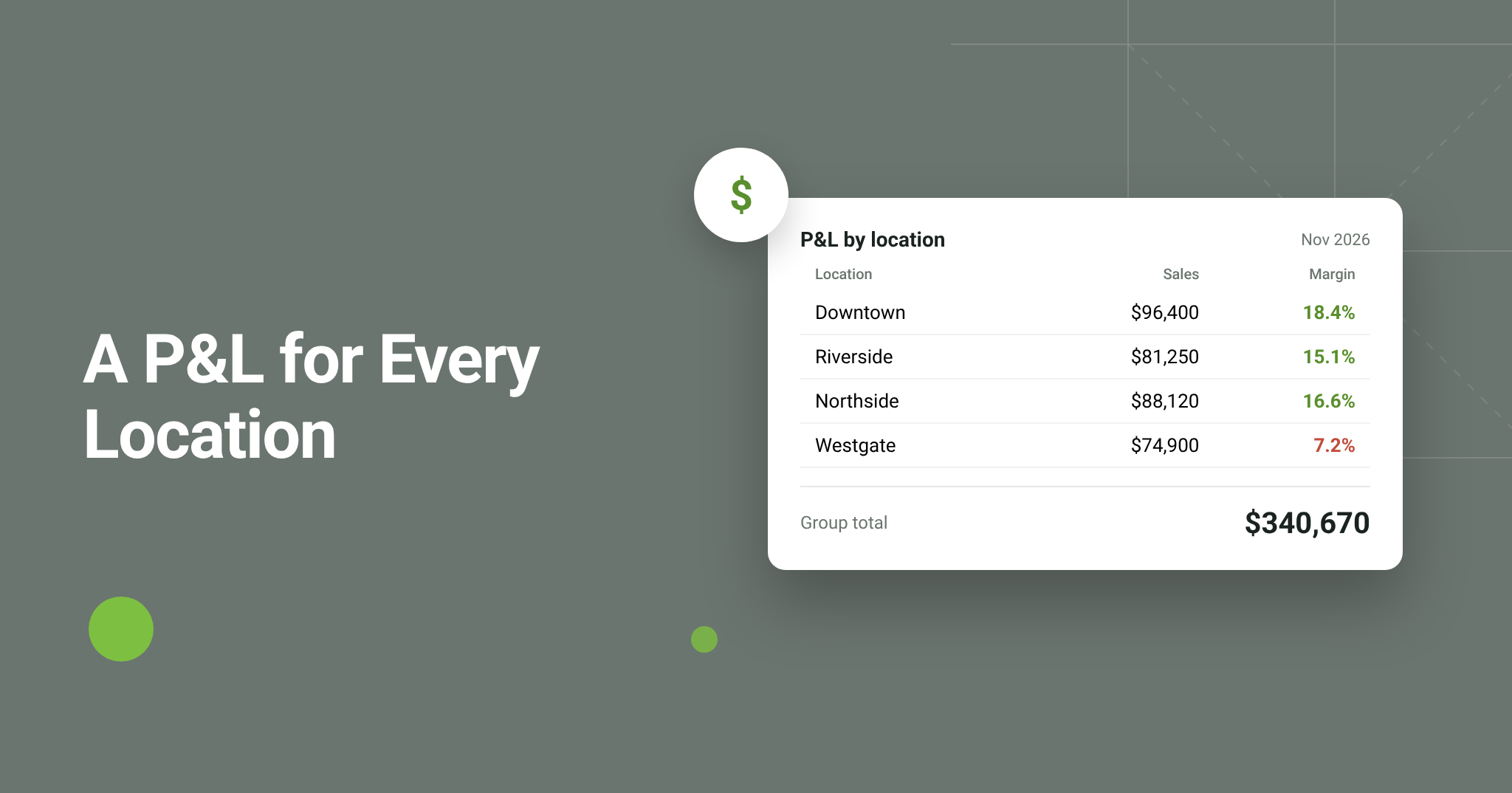
Short answer: to see a profit and loss statement for each location every month, three things have to be true. Sales have to arrive from your POS tagged by location, costs have to be coded to a location when they are entered rather than at month end, and shared costs need a simple, consistent allocation rule. Once those are in place, the location P&L is a report you run, not a spreadsheet you build.
Why Location Results Arrive So Late
Most multi-unit franchisees can tell you what the group made last month. Far fewer can tell you which location made it.
The delay usually comes from the same four places:
- Sales arrive by hand. Someone exports POS totals and types or imports them into the books, often days after the period ends.
- Costs are not tagged. Vendor bills, payroll and rent land in one company file with no location attached, so someone has to split them later from memory.
- Shared costs have no rule. Area management, insurance and marketing get allocated differently each month, so comparisons between locations are never quite fair.
- Each location is its own file. Consolidation happens in a spreadsheet, and that spreadsheet breaks every time you open a unit.
None of this is a bookkeeping failure. It is what happens when a system built for one location is asked to run six.
What a Working Location P&L Needs
1. Sales tagged by location, automatically
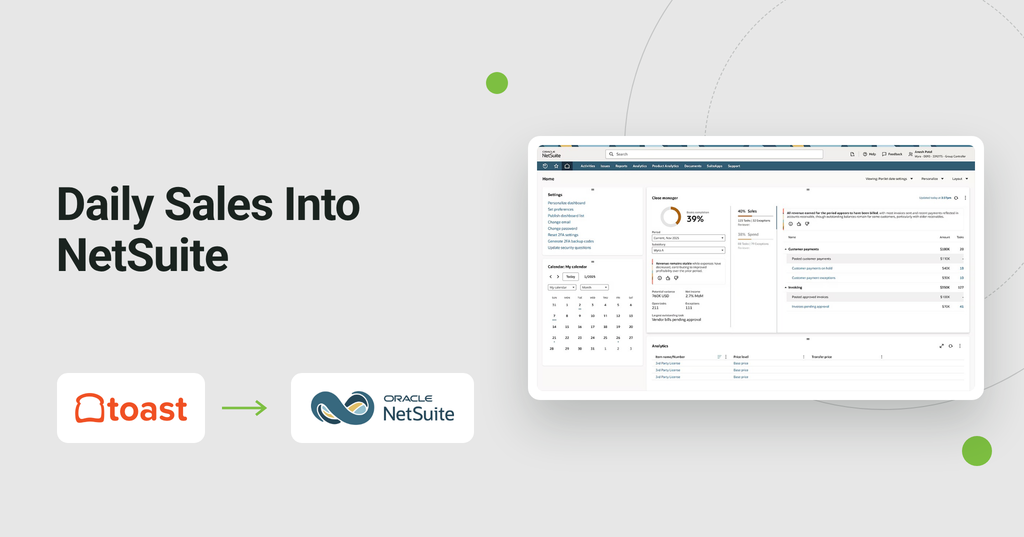
Your POS already knows which location rang each sale. The job is getting that into accounting without a human in the middle. In practice that means a scheduled import that posts daily sales to the right location, then reconciles against what the POS reported.
2. Costs coded at entry
Every vendor bill, payroll journal and recurring charge should carry a location when it is recorded. This is the single biggest change for most franchisees, and it is a process change more than a software one.
3. One allocation rule for shared costs
Pick a basis you can defend, usually sales or headcount, write it down and apply it every month. An imperfect rule used consistently beats a perfect rule applied differently each period.
4. Royalties and brand fees in their own accounts
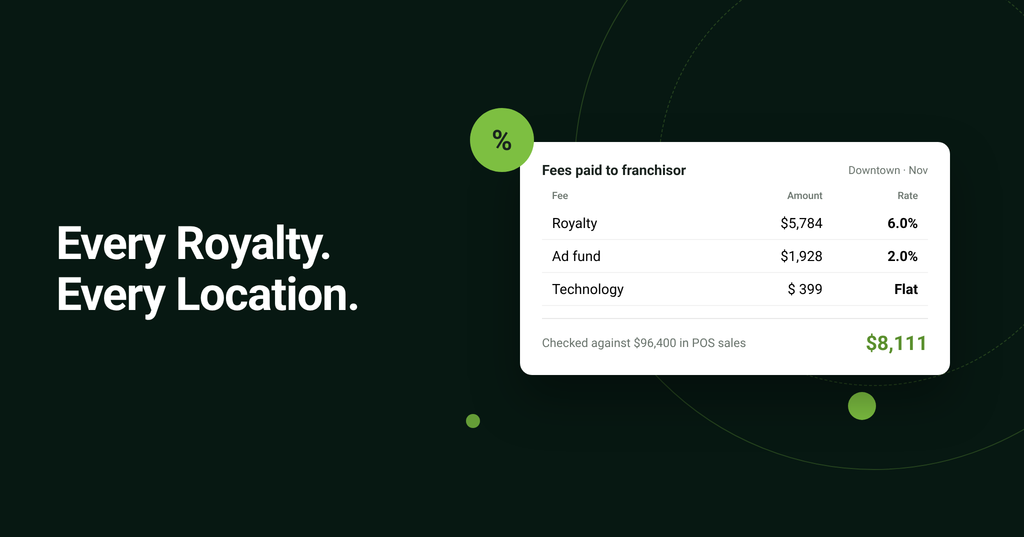
Royalties, marketing fund contributions and technology fees should sit in separate accounts, by location. Otherwise your largest controllable comparison between units disappears into one number. Our guide to tracking royalties, ad fund and brand fees covers how to set that up.
5. A structure that consolidates itself
Each entity keeps its own books, with the group view produced by the system rather than by export. That is the part spreadsheets cannot do well past a few units.
What Changes When You Have It
- You can see which location is carrying the group and which one is quietly losing money.
- You can compare labor and cost of sales as a percentage of sales between units, on the same basis.
- You can check royalties and marketing fees against the sales that produced them.
- You close the month in days instead of weeks, because nothing has to be rebuilt.
How Long This Takes to Put in Place
If you are moving onto NetSuite, a franchisee implementation with a fixed scope typically runs 8 to 12 weeks. AI Rapid Start for Franchisees delivers financials in 8 weeks with Financials First, or adds automated POS revenue import, payroll journal import and royalty payment dashboards in 12 weeks with the Franchisee package.
Not sure whether your current system can get there? Compare the options in has your multi-unit franchise outgrown QuickBooks.
Frequently Asked Questions
What is a P&L by location?
A profit and loss statement produced for a single location, showing that location’s sales, cost of sales, labor, occupancy, royalties and other costs, so it can be compared with other locations on the same basis.
Do I need separate legal entities to get a P&L by location?
No. Locations can be tracked as segments inside one entity, or as separate subsidiaries that roll up to a group view. The right structure depends on how your business is organized legally and for tax, not on the reporting itself.
How should shared costs be allocated between locations?
Choose one basis, usually a percentage of sales or headcount, and apply it the same way every month. Document the rule so comparisons stay valid as you add locations.
How often should a franchisee review location level results?
Monthly at minimum, alongside the close. Operators who import POS sales daily often review weekly sales and labor, then use the monthly P&L for the full picture.