NetSuite and Infor sell to the same buyer: mid-market, multi-site. A mid-market manufacturer replaces its ERP once or twice in a generation. The system outlasts the leadership team that selects it and the growth plan it was sized for. Both platforms are credible at this scale, and each asks the business to absorb something in return.
Choosing which platform will run production and finance over the next decade depends on how the business manufactures and reports. The two vendors reached this market from opposite directions. Infor grew by acquiring products that already served a specific kind of production. NetSuite grew a single application outward from the general ledger.
Infor builds depth into how a company makes things, engine by engine and industry by industry. NetSuite provides control over how a company reports on what it makes, in a single ledger across all legal entities.
The choice comes down to which kind of complexity a business will carry. Two facts settle it: how unusual the production method is, and how many legal entities have to report as one.
This comparison covers the architecture of each platform, where each one wins, what each costs to own after year one, and what a migration entails.
Key Takeaways
- Infor is a portfolio, not a product. It sells four ERP engines, CloudSuite Industrial (formerly SyteLine), Infor LN, Infor M3, and Lawson, packaged into industry-specific editions. What a company manufactures decides the engine.
- The architectural difference carries a running cost. Infor engines sit on separate codebases and pass data through the Infor OS platform layer. NetSuite runs financials and operations on one data model, with no translation layer between modules.
- Infor holds the advantage in process, batch, mixed-mode and project-driven production. Recipe management, allergen control, shelf-life handling and engineer-to-order scheduling are native to the relevant engine, built in at the codebase level.
- NetSuite holds the advantage in consolidated financial control. Intercompany elimination and multi-currency consolidation run in a single environment, and a new subsidiary is created by configuration inside the existing account.
- On-premises remains an Infor answer and is never a NetSuite one. NetSuite is cloud-only, while Infor still supports on-premises environments.
NetSuite vs Infor, the Architecture Side by Side
NetSuite was built as a single application. Infor was assembled through two decades of acquisition, then packaged by industry. They produce different work after go-live, and it lands on different teams.
Most finance leaders start with a shortlist of more than two vendors. The ERP systems in play at mid-market scale narrow quickly once the production model is on the table.
| Oracle NetSuite | Infor CloudSuite | |
|---|---|---|
| Architecture | One database and one codebase across financials and operations | Several ERP engines on separate codebases, packaged into industry editions |
| What the buyer chooses between | One suite, extended module by module | CloudSuite Industrial (SyteLine), Infor LN, Infor M3 or Lawson, inside an industry edition |
| Hosting | Cloud only | Multi-tenant cloud on AWS for new sales; on-premise and single-tenant installations still available |
| Multi-entity consolidation | Native in OneWorld, with intercompany elimination inside the same environment | Varies by engine; consolidation across engines runs through an integration and reporting layer |
| Manufacturing depth | Discrete and lighter process manufacturing | Deepest in process, batch and mixed-mode production, engine by engine |
| Gartner 2025 position, Cloud ERP for Product-Centric Enterprises | Leader | Leader |
| Strongest fit | A manufacturer that also distributes or services, reporting on one ledger | A manufacturer whose production method demands industry-specific depth above all else |
Both vendors are positioned as Leaders in the same Gartner category, making them equally competitive on a shortlist. Feature sets are comparable too, as both platforms satisfy standard mid-market requirements. The primary difference lies in the underlying architecture and design.
Architecture is the hardest thing to change after go-live but the easiest to skip during an evaluation. A demo shows screens, and both platforms demo well.
Architecture only declares itself when a finance team closes its first month on the system. The questions that pay off in a first vendor meeting are therefore about consolidation and master data rather than features.
What “Infor” Actually Means When a Vendor Says It
No product called Infor ERP exists. Infor sells ERP engines and markets them as CloudSuite editions, each named after the industry it serves. CloudSuite Food & Beverage means the M3 engine. CloudSuite Aerospace & Defense means Infor LN.
The engine underneath decides the data model and the financial logic. It also decides what a later move between editions costs, because migrating from one CloudSuite to another is closer to a reimplementation than an upgrade.
| Infor engine | Marketed as | Built for |
|---|---|---|
| CloudSuite Industrial, formerly SyteLine, abbreviated CSI | Infor CloudSuite Industrial | Mid-market discrete and mixed-mode manufacturers, including make-to-order and engineer-to-order production |
| Infor LN | CloudSuite Industrial Enterprise, plus the Aerospace & Defense and Automotive editions | Larger multi-site discrete manufacturers running project-driven production |
| Infor M3 | CloudSuite Food & Beverage, Fashion, Chemicals and Distribution | Process and batch manufacturers working with recipes, formulas, allergens and shelf life |
| Lawson | Service and public-sector editions | Service and public-sector organizations, including healthcare |
CloudSuite Industrial and Infor LN are different products, and priced and implemented differently.
Buyers who collect proposals under the single word Infor end up comparing numbers that were never comparable, and the mismatch usually surfaces after a shortlist has already been set.
Why the engine matters more than the brand name
A mid-market manufacturer comparing NetSuite against “Infor” is almost always comparing it against CloudSuite Industrial. Evaluations that stay at the brand level end up weighing NetSuite against LN or M3, products the company would never license.
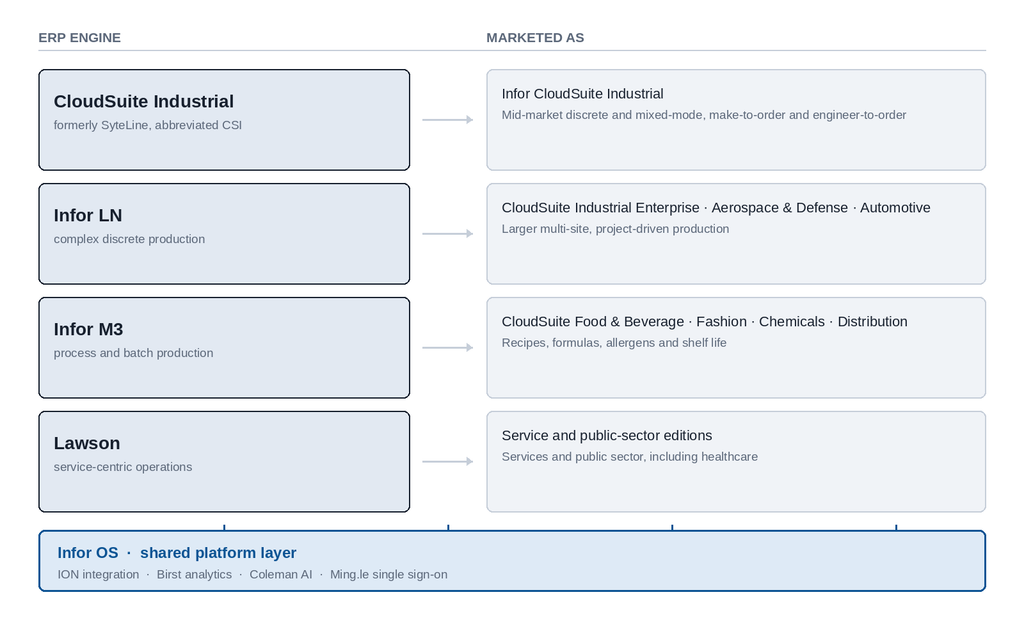
All four engines run on Infor OS, the platform layer carrying ION for integration, Birst for analytics, Coleman for AI, and Ming.le for single sign-on. Infor OS presents the portfolio with a single face on the user’s side of the screen. It is also the layer that a company running two engines has to keep working.
Where Infor Wins Compared to NetSuite
Infor built its manufacturing depth by acquiring products that already served a specific production model, then keeping each one on its own codebase. That depth is real, and in four situations it decides the evaluation.
- Process and batch production. Recipe management, allergen tracking, batch traceability, and shelf-life handling are native to the M3-based editions, built into the engine rather than configured on top of a general inventory model.
- Project-driven and engineer-to-order manufacturing. Infor LN was built around production where the order defines the product, which is why the Aerospace & Defense and Automotive editions run on it.
- High-mix discrete scheduling. CloudSuite Industrial supports constraint-based sequencing and capable-to-promise dates, aimed at mid-market shops that push many products through shared work centers.
- Warehouse depth at the enterprise end. Infor WMS is a full warehouse management product in its own right. NetSuite reaches comparable ground with its WMS module extended by RF-SMART or ShipHawk, which means an added layer to license and maintain.
Gartner’s 2025 Magic Quadrant for cloud ERP in product-centric enterprises names both vendors as Leaders. Its companion Critical Capabilities report scores them use case by use case. That second report is the more useful of the two for this decision. The Magic Quadrant places vendors against the whole market, so two Leaders can sit in the same square while serving different buyers well. Critical Capabilities breaks the assessment into discrete use cases, which is where a manufacturer finds out whether a vendor is strong at the thing that particular business does every day.
Infor’s announcement that it has been named a Leader for the fifth consecutive year outlines its scores. It reports the highest marks in three of seven use cases and second place in discrete manufacturing for the sixth consecutive year. It also reports a top-two placing among vendors serving lower-midsize companies.
NetSuite does not match that depth in process or project manufacturing, and a partner claiming otherwise will discover the difference at the first cost-variance review after go-live.
Where NetSuite Wins Compared to Infor
Infor’s portfolio model pays off when business units operate independently. It shows cracks when the corporation needs them to report as one company, and every advantage NetSuite holds at this tier traces back to that difference.
A portfolio connects separate products. A unified model removes the need to connect them. Infor engines were built on different data models, so an item, a customer, or an account exists once per engine and the definitions are kept in step through Infor OS. NetSuite defines each of those records once for the whole business, and every module reads the same definition. The distinction sounds abstract until a controller asks why the same part number carries two costs.
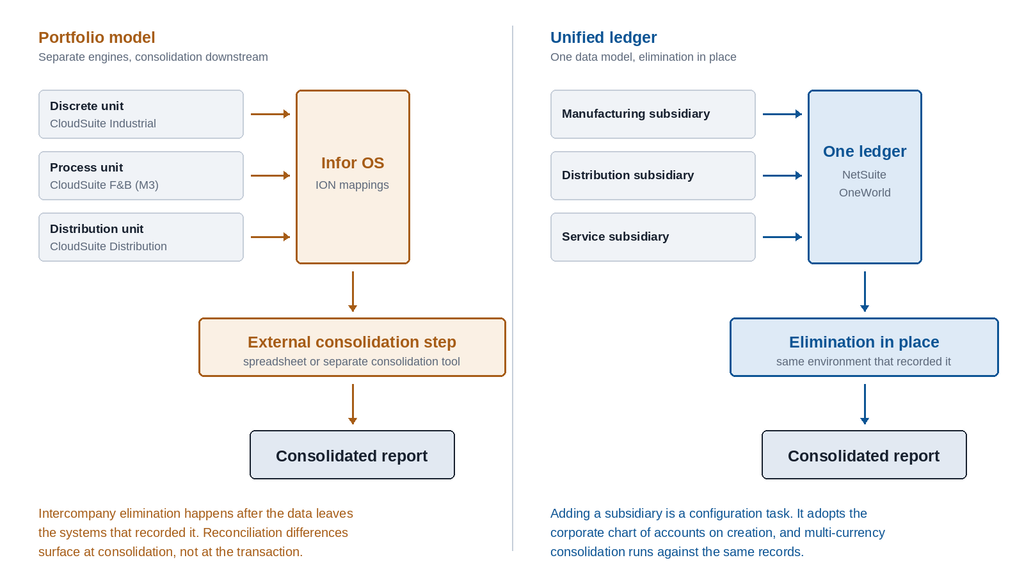
- One item master instead of reconciliation. An item defined by its bill of materials in a discrete engine, and by its logistics attributes in a distribution engine, will not match on its own. Someone reconciles it by hand, every period. On NetSuite, manufacturing and distribution write to the same item record, so there is nothing to reconcile.
- Elimination inside the system of record. Bringing results together across Infor engines usually means exporting to a separate tool, introducing a lag between the close finish and the number leadership acts on. NetSuite identifies and eliminates intercompany transactions in the environment that recorded them, so the consolidated figure is a sum of local entries with no mapping step.
- Mixed business models on one ledger. A company that manufactures and also distributes or services runs all of it against the same customer record and the same chart of accounts. Infor serves each of those models well on its own engine. Serving them together means running more than one.
- One upgrade calendar. NetSuite applies two releases a year to every account, so no two environments sit on different versions. Infor’s multi-tenant editions update quarterly while installed environments move on their own schedule, which leaves a two-engine company testing the connections between them each time.
- A finance team can own it without a large IT function. Mid-market manufacturers often run their ERP with one or two people in IT. NetSuite administration concentrates in a single place, and the skills to configure a subsidiary, a saved search, or a workflow sit close to the finance function that needs them.
The unified model does not remove integration work. Both platforms connect to MES, EDI, warehouse systems and banks, and those connections have to be built and maintained either way. What changes is where the integration boundary falls. On NetSuite it sits between the ERP and the outside world. On a two-engine Infor estate it sits there as well, and again between the engines themselves, so the same company maintains two classes of integration with different failure modes.
These advantages compound with entity count and business-model spread. A single-entity manufacturer running one plant and one sales channel will feel almost none of them, and for that company the Infor question is the more interesting one.
Manufacturing Cost Reporting Is Where Infor and NetSuite Diverge Most
A manufacturing CFO evaluates an ERP on a narrower set of questions than a services CFO does. The question is whether cost variance reconciles to what the floor produced, at the granularity the business runs at.
- Variance at the right granularity. Purchase, bill, and quantity variances, sliced by cost center, class, department, and dimension.
- WIP by production run. A work-in-process figure that resolves to the individual production run.
- Standard against average cost. Which method the business costs on, and whether the system reports both when the controller asks.
- Lot and serial traceability carried through to the GL. Traceability that answers a recall request on a statutory timeline, with the financial record attached.
- ASC 606 cost composition. Consumed material, labor, and overhead broken out rather than posted as a single figure.
Infor’s engine-level financial models are built around a single production method, which is an advantage when that method is unusual. NetSuite’s advantage runs the other way: the same variance report reads identically in every entity, and the consolidated figure sums local records rather than translating them.
Either platform produces these numbers once the modules are configured to a manufacturer’s granularity. Most reporting failures trace to configuration rather than platform limits, so choosing the right partner for manufacturing deserves as much evaluation time as choosing the platform.
Adding an Entity: The Test Most Evaluations Skip
Most ERP evaluations test the platform against the business as it exists today. Manufacturers growing through acquisition need it tested against the business two entities from now.
In Infor’s portfolio model, onboarding an acquired company usually means another installation plus new integration points into the corporate core. Reporting on the new asset waits for that work, leaving leadership without visibility during the period when the acquisition’s performance matters most.
At ten legal entities, the difference stops being architectural and becomes a staffing question. Manual consolidation at that count produces reconciliation differences every quarter, clustered in the same two places: intercompany elimination and FX revaluation.
The Cost of Infor and NetSuite After Year One
Neither vendor publishes a list price for these products. Both are quoted per scope, so any figures in a comparison article are estimates of a negotiated number. What holds up over five years is where the recurring work sits.
| Ownership factor | Oracle NetSuite | Infor CloudSuite |
|---|---|---|
| Skills required to run it | NetSuite administration plus the configured modules | Skills specific to each engine in use, plus ION integration skills where more than one engine runs |
| Update cadence and scope | Two releases a year, applied to every account; testing covers configuration and customization | Quarterly updates on multi-tenant CloudSuite, on their own cycle for on-premise; testing also covers the mappings between engines |
| Route off on-premise | Not applicable, cloud only | Infor Leap, a fixed-fee and fixed-timeline program onto multi-tenant CloudSuite |
| Where cost concentrates after year one | Module rollouts and integration work as the business adds systems or entities | Maintaining the layer between engines, and staffing more than one center of competence |
On Infor, recurring cost tracks the number of engines in use rather than the number of users. A single-engine customer will recognize almost none of it, and a two-engine customer will recognize all of it.
NetSuite’s recurring cost tracks users and modules, which is the variable most finance teams already model. A company that doubles headcount can price that. A company that adds a second Infor engine is adding three things at once: a second set of skills to hire, a second update cycle to test, and a set of connections between the two engines. The second cost is harder to see at signature because nothing on the quote names it.
That distinction moves a five-year ownership model further than headcount does, and it is knowable before a contract is signed. The recurring work is also what managed services are scoped against, on either platform.
Moving From Infor to NetSuite
A migration between these platforms calls for the finance and operations model to be implemented again. That happens in four steps: mapping master data, redesigning customized processes against a standardized model, rebuilding integrations, and retraining the people who run the close.
The 2026 context matters for anyone on an older Infor installation. Infor Leap is a fixed-fee, fixed-timeline program that moves existing on-premises and single-tenant Infor customers to multi-tenant CloudSuite on AWS, backed by a two-year satisfaction guarantee. A company facing that decision is already re-platforming.
The honest question at that moment is whether the destination should be the same vendor’s cloud or a different architecture. Companies whose current platform still fits should read the case for staying on a legacy ERP first.
Where a migration is the right call, sequencing decides the risk. Finance first, then operations, keeps the close working while the production model is rebuilt. That order holds because finance can run on migrated balances while production is still being configured, and the reverse is not true. A plant cannot issue work orders against a chart of accounts that has not been agreed. Companies that start on the shop floor because it feels like the harder problem usually rebuild the finance layer twice. Once to get live, and again to fix what the first pass assumed.
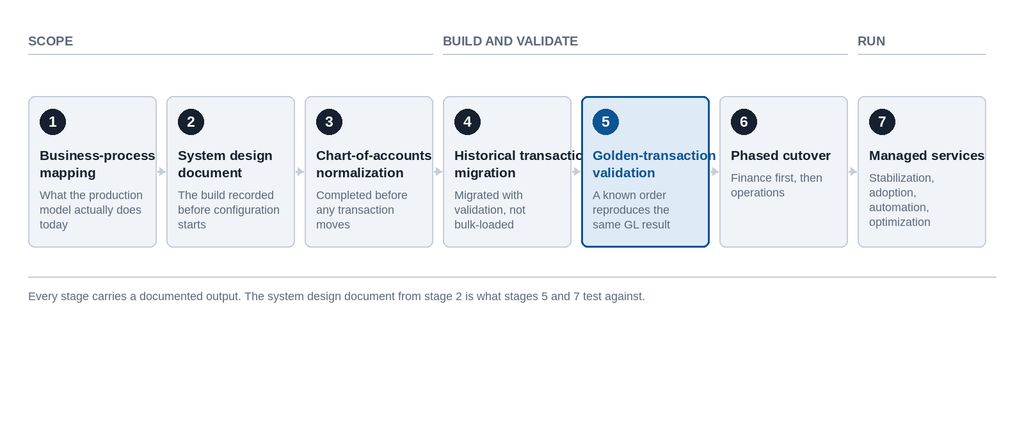
Chart-of-accounts normalization occurs before any transactions move. Golden-transaction testing then confirms that a known order reproduces the same GL result before cutover.
Bring IT has run legacy ERP migrations into NetSuite from Sage, Infor, SAP Business One, and Epicor. What those projects have in common is the shape of the problem, not the source system. Each one starts with master data that carried a decade of workarounds, and each one ends with a first close that has to reconcile to the old system. The source platform changes which customizations exist and how the data comes out. It does not change the sequence, and it does not change what has to be true before cutover.
Grover Gaming replaced Sage with NetSuite and automated 80% of its critical business processes, achieving full ROI in under six months. Migrations off Infor follow the same method, with one difference. Customizations that carry a production model within a specialized engine have to be rebuilt as NetSuite configuration, and that scoping should be done before the SOW.
How to Decide: Production Depth or Consolidated Control
Production method and entity count carry most of the weight here. An unusual production method pulls toward Infor. A rising entity count pulls toward NetSuite.
| Condition in the business | Stronger fit |
|---|---|
| Recipes, formulas, allergen control, or shelf life are core to production | Infor, on the M3-based editions |
| Engineer-to-order or project-driven manufacturing with deep shop-floor scheduling | Infor, on LN or CloudSuite Industrial |
| Production method is unusual, and corporate reporting is simple | Infor |
| Several legal entities consolidating into one set of financials | NetSuite |
| Finance owns the platform decision, and reporting is the binding constraint | NetSuite |
| A lean IT function of one or two people will run the platform after go-live | NetSuite |
| Growth by acquisition, with new entities onboarding regularly | NetSuite |
| Production method is ordinary and corporate reporting is complicated | NetSuite |
Most manufacturers land clearly on one side once they answer honestly. The conditions are not weighted equally. Two carry more than the rest: a production method that resists standard configuration, and an entity structure that has to close as one. A company matching either of those decisively has its answer regardless of how the remaining conditions fall.
A company that splits evenly is usually one whose production complexity and entity count are rising together. The move is to price the migration before committing, because moving later would cost more than the difference between the platforms today.
Pricing it means asking both vendors to scope the same two artifacts: a cost-variance report at the granularity the business actually runs at, and a consolidated close across the entity structure as it will look in three years. Feature checklists will not separate the two platforms, because both will tick most of the boxes. Those two artifacts will, because each one exercises the part of the architecture the other vendor is weakest on.
Manufacturers weighing the enterprise tier will find the same trade in the NetSuite vs SAP comparison.
Weighing the two against a live production model? Contact Bring IT for a structural comparison against your entity structure and cost-reporting requirements.
Frequently Asked Questions
How long does a migration from Infor to NetSuite take?
Two variables set the timeline, and both are knowable before a contract is signed. The first is the condition of master data: record counts, duplicate counts, and whether historical transactions are transferred or only balances. The second is how much of the production model lived in customizations, since each one is either scoped as configuration or retired. A partner quoting a duration before auditing those two is quoting a template.
Can NetSuite handle recipe and formula-based manufacturing?
Native NetSuite covers assembly and work-order production well, and handles lot tracking and shelf life. Formula-based production with variable yields, catch-weight processing, or recipe versioning often requires an additional layer, and Bring IT implements blendERP for formula management in those cases. The question during evaluation is whether the requirement is genuinely formula-based or assembly work described in recipe language.
What happens to Infor customizations that have no NetSuite equivalent?
They fall into two categories, and separating them is the first task of the migration scope. Some encode genuine business rules and are rebuilt as configuration, workflows, or SuiteCloud extensions. Others worked around a limitation in the old data model that does not travel to the new platform. Companies carrying every customization across pay twice: once to rebuild the logic they no longer need, and again to maintain it.
Does NetSuite have an equivalent to Infor’s industry editions?
NetSuite’s answer is SuiteSuccess, a set of pre-configured industry editions shipping with roles, dashboards, KPIs, and reports already built. The approaches differ under the hood: Infor packages a separate codebase per industry, while NetSuite packages a single codebase with a separate configuration. Where a requirement outruns the standard edition, the depth comes from a partner’s vertical products.
How does Infor Leap affect a company mid-renewal?
Leap changes the timing more than the answer. It puts on-premise customers into a decision window they would not otherwise have entered, usually at a maintenance renewal or an upgrade conversation. A company already committing a budget to a re-platform can run the alternative architecture through the same evaluation at low marginal cost. Those who skip that step tend to rediscover the original constraint on the new platform.
What should a manufacturer ask an implementation partner before signing, whichever platform wins?
Two questions separate delivery experience from familiarity. First, ask for a cost-variance report configured against the company’s own cost structure rather than a demo dataset. Watch whether the consultant asks about the cost center and dimension first. Second, ask how the integration architecture gets decided, and when. A partner who names the criteria and puts the choice in the SOW is describing a method. One who defers it to the build is describing a discovery process that the company will fund.