

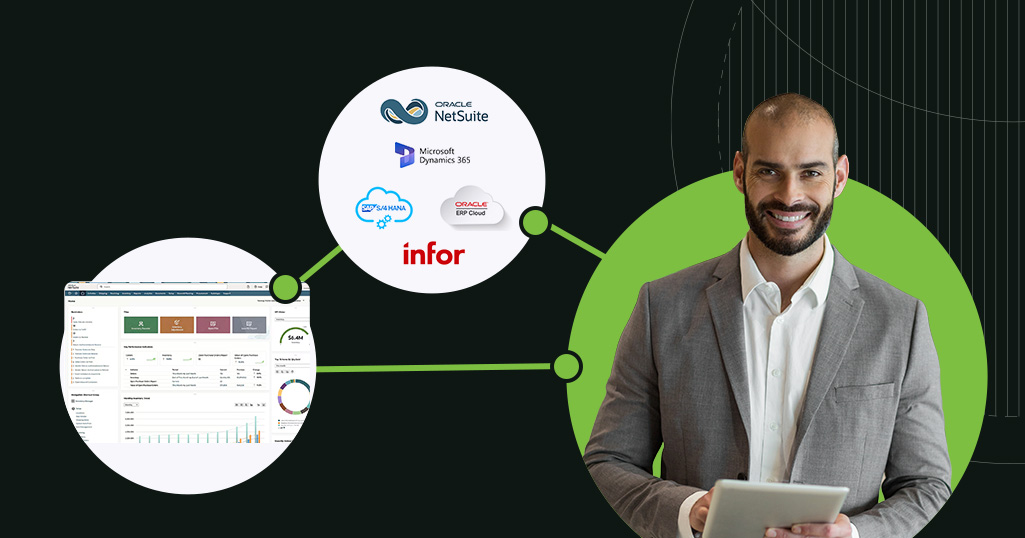
What ERP systems examples actually refer to
ERP systems examples are real platforms companies use to manage finance, operations, and reporting across entities. They show how different architectures support consolidation, integration, and decision-making at scale.
Why executives are searching for ERP systems examples
If you are closing your books late, reconciling across multiple systems, or questioning your numbers before board meetings, the issue is rarely your team. It is how your systems are structured.
US companies are dealing with:
- Growth across multiple subsidiaries
- Disconnected finance and operational systems
- Increasing pressure for faster reporting and audit readiness
The consequence is predictable. Financial data exists, but it is not aligned. Decisions are delayed, and risk increases.
Reviewing ERP systems examples helps leadership understand which platforms are actually used to solve these problems and how they perform under real operational pressure.
Quick summary: what matters when comparing ERP systems
Before going into detailed ERP software comparison, the key factors are straightforward:
- Architecture determines how data flows and consolidates
- Integration defines whether systems connect cleanly or require ongoing maintenance
- Financial consolidation impacts how quickly and accurately you close
- Scalability defines whether the system supports growth or becomes a constraint
ERP systems comparison
| ERP | Architecture | Integration Model | Best Fit |
| NetSuite | Unified cloud | Native integration | Multi-entity growth |
| SAP S/4HANA | Enterprise layered | Middleware heavy | Large global enterprises |
| Microsoft Dynamics 365 | Modular cloud | Platform-based integration | Microsoft ecosystem companies |
| Oracle ERP Cloud | Enterprise cloud | Structured integration layer | Complex global organizations |
| Infor | Industry cloud | Variable integration | Industry-specific operations |
ERP systems examples: detailed breakdown
1. NetSuite
If you are managing multiple subsidiaries and still consolidating data in spreadsheets, the issue is not volume. It is structure.
NetSuite works well when finance needs to operate as a single source of truth across entities.
Where it works well
- Companies expanding across states or countries
- Private equity-backed growth requiring fast consolidation
- Finance teams needing real-time visibility
Where it becomes complex
- Highly customized legacy processes that resist standardization
- Organizations expecting heavy on-premise style customization
Real-world scenario
A US-based services company with 12 subsidiaries reduced its close cycle from 12 days to under 6 after centralizing financials in NetSuite. The gain did not come from automation alone. It came from removing reconciliation layers.
Trade-offs
NetSuite prioritizes structural consistency over deep customization. For most mid-market companies, this is an advantage. For highly specialized industries, it may require adaptation.
This is why companies exploring NetSuite ERP implementation focus on redesigning financial architecture rather than replicating legacy systems .
2. SAP S/4HANA
SAP becomes relevant when operational complexity is already high and regulatory requirements are non-negotiable.
Where it works well
- Large enterprises with global compliance requirements
- Manufacturing or asset-intensive industries
- Organizations with existing SAP environments
Where it becomes complex
- Transformation from legacy SAP systems
- High dependency on specialized resources
- Longer implementation timelines
Real-world scenario
A global manufacturer migrating from SAP ECC to S/4HANA improved reporting depth but required a multi-year transformation and significant process redesign.
Trade-offs
SAP offers depth and control. It also introduces complexity. If your organization does not require that level of structure, the overhead may outweigh the benefits.
SAP is often better than NetSuite when scale, regulatory complexity, and industry requirements demand deep customization and control.
3. Microsoft Dynamics 365
Dynamics is often considered when companies are already invested in Microsoft tools.
Where it works well
- Organizations using Azure, Office, and Power Platform
- Mid-market companies with moderate complexity
- Teams prioritizing familiarity and ecosystem alignment
Where it becomes complex
- Multi-entity consolidation across separate modules
- Integration between different Dynamics applications
- Maintaining data consistency over time
Real-world scenario
A distribution company using Dynamics improved operational visibility but required ongoing integration work to align finance and operations data.
Trade-offs
Dynamics can be sufficient for companies with moderate complexity. As scale increases, integration effort grows. The system does not always enforce a unified structure by default.
4. Oracle ERP Cloud
Oracle becomes relevant when financial operations require advanced capabilities and global scale.
Where it works well
- Large enterprises with complex financial structures
- Organizations requiring advanced compliance and reporting
- Businesses with dedicated IT and finance transformation teams
Where it becomes complex
- Implementation and configuration effort
- Dependency on specialized expertise
- Longer time to value
Real-world scenario
A multinational organization implemented Oracle ERP Cloud to standardize financial reporting across regions. The result was improved compliance, but the project required significant investment and governance.
Trade-offs
Oracle is justified when complexity already exists and must be managed at scale. For mid-market companies, it can introduce unnecessary overhead.
5. Infor
Infor focuses on industry-specific ERP platforms.
Where it works well
- Manufacturing, healthcare, and distribution
- Companies with well-defined operational models
- Organizations seeking industry-aligned processes
Where it becomes complex
- Diversified business models
- Multi-entity financial consolidation
- Integration across non-standard systems
Real-world scenario
A manufacturing company improved operational workflows using Infor but required additional tools for financial consolidation as the business expanded.
Trade-offs
Infor performs well within specific industries. It becomes less effective when organizational complexity extends beyond those boundaries.
Key insight: ERP performance is driven by architecture
- ERP performance is determined by architecture, not features
- Integration complexity increases when systems are not unified
- Financial visibility depends on data consistency, not reporting tools
- Growth amplifies structural weaknesses
A fragmented system environment leads to:
- Longer close cycles
- Manual reconciliation effort
- Inconsistent reporting
- Increased compliance risk
A unified architecture reduces these issues and improves decision-making confidence.
This is why defining an enterprise integration approach early is critical. ERP should function as the financial backbone, not as another system to reconcile.
How to evaluate ERP systems examples
When reviewing ERP systems examples, focus on four criteria:
- Architecture
Is the system unified or modular? Does it require multiple data layers? - Integration model
Does it support native integration or depend on middleware? - Financial consolidation
Can you close across entities in real time or rely on external processes? - Scalability
Will the system support growth without adding complexity?
These four factors determine whether ERP will reduce operational friction or amplify it.
Strategic conclusion: ERP is a structural decision
ERP selection is often approached as a software comparison. That is a mistake.
What you are really deciding is how your organization will structure financial data, integrate systems, and scale operations.
Among the ERP platforms for finance teams, NetSuite stands out for companies that need:
- Real-time consolidation
- Consistent data across entities
- Reduced integration complexity
- Faster and more reliable reporting
Other systems have clear roles:
- SAP for large, regulated enterprises
- Oracle for highly complex global environments
- Dynamics for ecosystem-driven organizations
- Infor for industry-focused operations
The right choice depends on your structure, not on feature lists.
Where Bring IT adds value
Most ERP projects fail at the architecture level, not at the software level.
This is where experienced partners make a difference.
Through NetSuite consulting services organizations redesign how financial data flows, how systems integrate, and how decisions are made.
For industries with operational complexity, solutions like Hotel 360 extend ERP into industry-specific workflows without breaking financial structure.
And when execution matters, structured NetSuite implementation services ensure the system delivers measurable outcomes, not just deployment.
FAQ
1. What are ERP systems examples used in the US?
ERP systems examples include NetSuite, SAP S/4HANA, Microsoft Dynamics 365, Oracle ERP Cloud, and Infor. These platforms are widely used to manage finance, operations, and reporting.
2. How should CFOs evaluate ERP systems examples?
Focus on architecture, integration, consolidation capabilities, and scalability. These factors determine financial visibility and operational control.
3. What is the best ERP system for US companies?
There is no single answer. NetSuite is often preferred for multi-entity growth, while SAP and Oracle fit large enterprises with complex requirements.
4. Why is ERP architecture more important than features?
Because architecture defines how data flows, integrates, and consolidates. Features do not solve structural issues.
5. What is the biggest risk in ERP selection?
Choosing a system that does not align with your operating model, leading to fragmented data and increased manual processes.


