For the Chief Executive or Chief Financial Officer of a hotel group, the primary obstacle to growth is rarely a lack of software. It is the structural ceiling created by disconnected data. Most established properties operate with a collection of high performance tools that simply do not communicate, leaving leadership with a fragmented view of the business.
To achieve true operational control, senior hospitality leaders are moving beyond the Property Management System as their sole focus. They are adopting a model where Opera manages the stay, the POS captures the spend, and the ERP controls the finance. This hotel PMS POS ERP integration is a strategic move to secure revenue integrity, accelerate the month end close, and provide the clarity required for high stakes decision making in the hotel sector.
Moving beyond the visibility gap
The Property Management System is a vital engine for reservations, but for a CEO or CFO, it is insufficient as a tool for corporate governance. It cannot manage the complexity of a modern hospitality business that relies on diverse revenue streams from food and beverage, events, and retail.
When these systems are not integrated, the business suffers from a visibility gap. The rooms may be full, but the true margin of an event or the real time cash flow position remains obscured. Control is only possible when the stay, the spend, and the finance layers work as a single trusted operating model with the ERP at the centre of the business.
Solving the inefficiency in Rooms and Finance
Operational complexity often masks the leaks that erode profitability. Pedro Salazar, Director of Industry Products at Bring IT, identifies that the largest inefficiencies often sit within Rooms and Finance. This is because these departments act as the primary bridge between guest activity and financial recording. When that bridge is manual, the business loses momentum.
In many hotel groups, the finance team spends a significant portion of their month on manual hotel revenue reconciliation. This process involves comparing what the PMS production reports say against what the POS recorded and what the bank eventually received. Pedro Salazar notes that hospitality leaders must stop spending time on work that does not add value and start focusing on decisions with higher impact.
The goal of automation is not to replace the human side of hospitality. Instead, it is to remove the friction of manual rework so that teams can focus on high value guest decisions and operational excellence. By professionalising the back office, we allow the front of house to remain human.
Identifying the sources of hotel revenue leakage
Jacob Sánchez, Account Executive at Bring IT, observes that many hotel groups struggle because their data is dispersed across Excel files and external tools. This lack of a central financial exploitation model creates specific risks where revenue simply disappears from the radar.
Hotel revenue leakage is a silent threat that typically appears in specific areas:
- Deposits and advances: Money received but not correctly mapped to the guest folio or the bank.
- Folio closure and city ledger: Discrepancies in how accounts are settled or moved to corporate credit, often leading to uncollected funds.
- Group reservations and tour operators: Complexity in billing that often leads to services being consumed but never invoiced.
Without a direct Opera PMS ERP integration, these leaks are nearly impossible to identify in real time. A connected system turns the ERP into a command centre that identifies these deviations before they impact the bottom line.
A model for structured growth: Stay, Spend, and Finance
To secure a competitive advantage, the architecture of the hotel must be viewed through functional layers. This simple model clarifies how a hotel should operate at scale:
Opera manages the stay The Property Management System handles the room assets, guest profiles, and the core journey of the resident. It is the operating layer for the guest experience.
POS captures the spend The Point of Sale system captures every transaction beyond the room rate. Whether it is a meal at the bar, a spa treatment, or an event booking, the POS ensures that guest consumption is recorded at the point of origin.
ERP controls the finance The ERP serves as the final authority. It is the centre for data exploitation where operational activity is transformed into a trusted ledger, managing procurement, payroll, and revenue recognition.
Integration is the essential bond. The objective is to allow specialised systems to perform their specific roles while the data flows automatically into one trusted view. Jacob Sánchez emphasizes that the ideal model does not force every department into one tool. It allows each area to use the correct system while connecting the data into one financial view.
The CFO Perspective: Financial discipline and audit readiness
For a CFO, the return on integration is measured in reporting confidence and cleaner audit trails. A connected system allows for a faster month end close because the data has already been reconciled at the point of entry.
Manual rework is replaced by a governed environment. Jacob Sánchez warns that when systems are not integrated, teams often create informal workarounds in unmanaged spreadsheets and shared folders. This increases the security risk around sensitive guest and payment data. By moving into an integrated ERP model, the finance team can eliminate these risks and ensure the business is always audit ready.
Standardisation as a prerequisite for USALI reporting
There is much discussion regarding the potential of artificial intelligence in hospitality. However, AI cannot provide insights from a broken data architecture. For forecasting or personalisation to be effective, the underlying data must be clean, governed, and standardised.
Hotels must adopt a shared financial language. Implementing USALI reporting ensures that every property is measured by the same standards. Pedro Salazar notes that standardising the chart of accounts, the month end close checklist, and USALI aligned reporting is essential. This foundation is what allows a business to move from basic reporting to advanced predictive analytics.
Strategic evaluation for hotel groups
When assessing the next stage of maturity, senior leaders should evaluate their current strategy against these benchmarks:
- Does data from the stay (Opera) flow into the finance layer (ERP) without manual mapping?
- Is every guest spend (POS) reconciled against the bank and the ledger automatically?
- Can the group generate accurate USALI reporting across all departments in a single view?
- Are teams still relying on unmanaged spreadsheets for core financial reconciliation?
- Can the leadership identify revenue leakage in areas like tour operator billing or city ledger in real time?
- Does the technology partner understand the nuances of hotel operations or only software code?
Reassurance for the Board: Derisking the transformation
The primary hesitation for many boards is the perceived risk of disruption. However, a structured integration strategy is designed to protect the front of house operations while professionalising the back office. The risk of transformation is far lower than the risk of remaining in a model that cannot scale and relies on the heroic efforts of a finance team to find the truth in spreadsheets.
The measurable return on investment is found in reduced labour hours, eliminated revenue leaks, and the ability to make decisions with absolute confidence in the data.
How Bring IT enables structured hotel growth
At Bring IT, we believe that technology is the vehicle, but the objective is always better structure and stronger control. We are a global firm with deep local expertise, helping hospitality leaders design the systems required for structured growth.
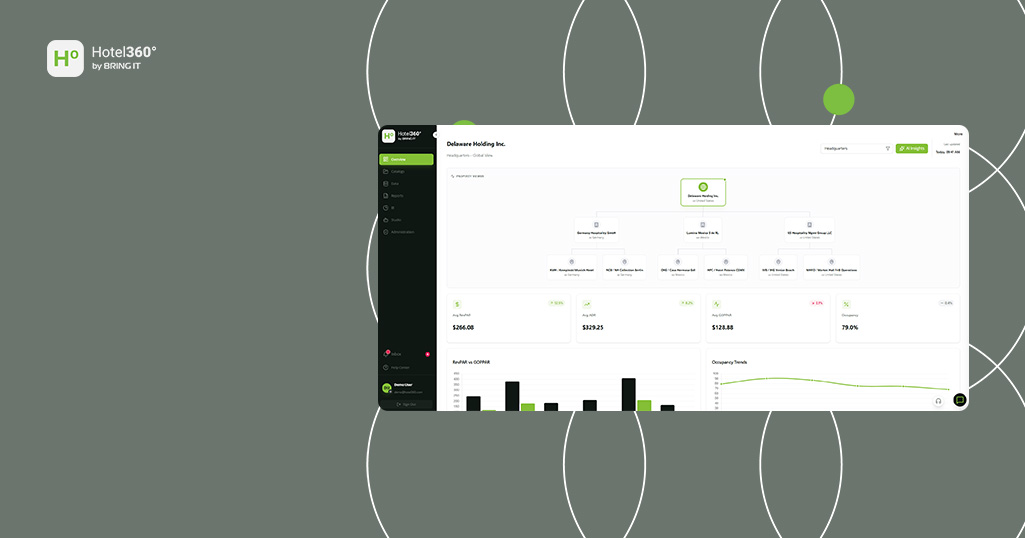
Through our specialisation in NetSuite transformation and hospitality architecture, including solutions like Hotel 360, we connect Opera, POS systems, and the financial ledger into a single operating model. We do not just provide software. We provide the structural integrity and industry knowledge required to lead a modern hotel group.
Strategic Clarity for the Modern Hotel Group
Top hotel groups are moving beyond the standalone PMS because they require a wider model of control. Opera manages the stay. The POS captures the spend. The ERP controls the finance. By connecting these systems, leadership gains the clarity needed to drive profitability and enhance the guest experience. This is the foundation of a resilient and scalable hotel group.
FAQs
- What is hotel PMS POS ERP integration?
Hotel PMS POS ERP integration is the strategic connection of your property management system, your points of sale, and your financial ledger into a single automated data flow. This ensures that guest data from the stay, transaction data from the spend, and financial data from the ERP are synchronised. This replaces manual reconciliation with a direct link between guest activity and accounting, creating a single source of truth for the entire hotel group.
- Why should hotels integrate Opera PMS with ERP?
Hotels should use Opera PMS ERP integration to achieve immediate financial visibility and eliminate the delays of the traditional month end close. In a competitive market, this integration removes the manual work that leads to errors in tax compliance or revenue recognition. It provides a standardised platform where new properties can be added without a proportional increase in administrative staff costs.
- How does POS and ERP integration reduce hotel revenue leakage?
Integration reduces hotel revenue leakage by tracking every transaction against the bank and the ledger in real time. Leakage often occurs when guest spend at an outlet is not correctly mapped to the financial ledger or when deposits are misplaced. Integrated systems allow management to identify and correct these discrepancies immediately, whether they are related to city ledger issues or incorrect closure of guest folios.
- What is the importance of USALI reporting in hotel ERP systems?
USALI reporting provides the industry standard for financial reporting in hospitality. By aligning the ERP with USALI, hotel groups ensure that their financial statements are consistent across all properties. This standardisation is vital for CEOs and CFOs who need to compare performance, manage costs across different departments, and provide transparent reports to investors or stakeholders in the hotel sector.
- How can hotel CEOs and CFOs know if their systems are ready for integration?
A hotel group is ready for integration when the leadership feels that their financial data is always lagging behind operational reality. If the finance team is overwhelmed by manual hotel revenue reconciliation in Excel or if the month end close takes more than five days, the current model has reached its limit. A readiness assessment will evaluate your existing data structure in Opera and the POS to ensure a smooth transition.