The Direct Answer
The short answer is that NetSuite can support HIPAA aligned operations when the right safeguards, configurations, agreements, access controls, and integration governance are in place. However, HIPAA compliance is not achieved by software alone. It is a shared responsibility model where the platform provides robust security capabilities, but the final compliance outcome depends on how your organization governs data, defines internal processes, and manages the architecture of your clinical and financial systems.
Why Healthcare Executives Ask This Question
For CFOs and CEOs in the United States, the ERP decision is no longer just about accounting. It is about managing regulatory risk while driving operational growth. Executives are under pressure to improve financial accountability and audit readiness without creating massive data liabilities.
In a healthcare environment, the question of compliance usually surfaces during moments of business transformation. Whether you are scaling through acquisition or preparing for a capital event, you need a system that can handle the complexity of healthcare finance while respecting the strict privacy standards required by federal law.
The Real Issue Is Not NetSuite Alone
A common mistake is treating compliance as a software feature that can be turned on. Real risk lives in the governance of data flows and the volume of sensitive information moving across your enterprise. Compliance exposure often appears in the gaps where staff manually move data between systems or where too much Protected Health Information (PHI) is unnecessarily ingested into the financial back office.
“The biggest failure we see is the assumption that a clinical system can manage the financial and administrative complexity of a growing organization,” says Pedro Salazar, Director of Industry Products at Bring IT. “It cannot. When clinical activity is not structurally connected to financial outcomes, you lose visibility. That lack of visibility is where revenue leakage happens. However, the solution is not to flood the ERP with clinical data, but to integrate based on the principle of minimum necessary data to maintain control without increasing risk.”
The Strategic Framework: EMR, ERP, and the Integration Layer
To build a secure and scalable operation, leaders must define clear boundaries between their clinical and financial environments. This structural separation is what defines your risk profile.
1. The EMR: The Clinical System of Record: Your Electronic Medical Record (EMR) is the primary source of truth for patient care. It is designed to hold granular PHI, clinical notes, and treatment history. To maintain a clean compliance posture, the EMR should remain the primary silo for sensitive clinical data.
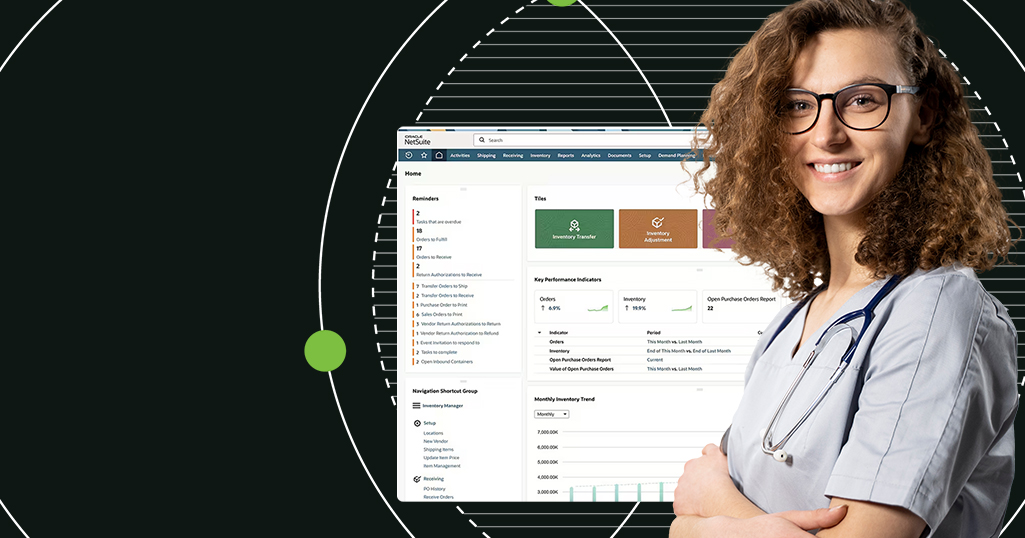
2. The ERP: The Financial and Operational Control Layer: NetSuite serves as the administrative brain of the business. Its role is to provide a single version of the truth for your financial health, managing the general ledger, procurement, and reporting. It receives financial signals from the clinical side to drive the business, but it is not intended to store detailed clinical narratives.
3. The Integration Layer: The Critical Risk and Governance Zone: The space between the EMR and the ERP is the integration layer. This is where compliance is actually executed. A mature integration architecture determines what data travels, why it moves, and who can access it. This layer acts as a filter, ensuring that the ERP receives exactly what it needs for financial accuracy and nothing more.
The Logic of Minimum Necessary Data
A mature executive decision is not about how much patient data NetSuite can hold. The better question is what minimum patient linked data the business truly needs to support billing, reporting, procurement, auditability, and decision making. By limiting the movement of PHI to the “minimum necessary,” you achieve two critical business objectives: you reduce your audit surface and you protect the organization from unnecessary liability.
Krizza del Rosario, Implementation Consultant Lead at NetSuite for Bring IT, emphasizes this architectural choice. “We often make the intentional decision to keep sensitive patient details entirely outside the ERP environment. Even if a system has the capacity to hold PHI, storing it in the ERP unnecessarily increases your risk. We design integrations to use unique identifiers or abstracted data so the finance team can achieve full reporting accuracy without ever touching sensitive clinical information that does not serve a financial purpose.”
What CFOs and CEOs Should Validate
Before moving forward, executives must ensure their teams and partners have addressed these foundational pillars of a governed architecture:
- Business Associate Agreement (BAA): Ensure a proper BAA is in place with all relevant vendors.
- Access Controls and User Roles: Define who can see what data based on their business function, following the minimum necessary access principle.
- Audit Trails: Verify that the system can produce a clear record of who accessed or changed specific records.
- Integration Governance: Define exactly what clinical triggers move data to the ERP and ensure no unnecessary PHI is included in the transfer.
- Internal Ownership: Identify who owns the governance of the data bridge between clinical and financial teams.
Risk Signals: The Executive Warning Signs
If your organization shows these signs, your current architecture is likely a business control issue:
- Slow Month End Close: If it takes weeks to reconcile clinical activity with the ledger, your data flows are disconnected and likely overcomplicated with irrelevant data.
- Excel Dependency: If your compliance depends on staff manually adjusting spreadsheets outside of the system, your audit trails are broken.
- Unclear Integration Ownership: If no one can explain exactly what data moves from the EMR to the ERP, you have a major risk zone.
- Data Redundancy: If sensitive PHI is being stored in the ERP without a clear financial or administrative purpose, you are increasing liability.
Strategic Outcome: What Good Looks Like
A well designed NetSuite architecture allows you to scale without increasing your risk surface. When you separate clinical records from financial control while maintaining a governed integration, you achieve:
- Confidential Reporting: Access to real time financial data without compromising patient privacy.
- Orderly Audits: A clear digital breadcrumb trail that connects bank deposits to clinical activity using de-identified tokens.
- Scalability: The ability to add new sites or entities quickly using a standardized data governance model.
- Decision Confidence: Leadership can act on financial insights knowing the underlying data is accurate and secure.
The Final Verdict for Healthcare Leaders
Does NetSuite guarantee HIPAA compliance? No software can. However, NetSuite provides the robust security framework required to build a HIPAA aligned enterprise. The final result depends on your configuration, internal controls, and architectural decisions. By following a NetSuite Managed Services approach that prioritizes structural separation and minimum necessary data, you create an environment that is both compliant and built for growth.
FAQs
- Is NetSuite HIPAA compliant?
NetSuite can support HIPAA aligned operations when the organization implements the necessary safeguards, configurations, and Business Associate Agreements. Compliance is a shared responsibility between the software provider and the user organization.
- Can NetSuite store PHI?
NetSuite has the technical capacity to store data securely, but healthcare best practices suggest keeping Protected Health Information (PHI) in the clinical system of record (EMR). The ERP should only hold the minimum necessary data required for financial and operational purposes.
- What does minimum necessary data mean in a healthcare ERP?
In the context of an ERP, it means only integrating the specific data points required for billing, procurement, or reporting. If a clinical data point does not add value to a financial or administrative decision, it should remain in the EMR to reduce risk exposure.
- What is the difference between EMR and ERP in HIPAA related workflows?
The EMR is the clinical system of record focused on patient care. The ERP is the financial and administrative control layer focused on the business operations. A secure integration layer connects the two while ensuring PHI is handled according to governed rules.
- What should CFOs validate before using NetSuite in a healthcare environment?
CFOs should validate the existence of a BAA, the design of role based access controls, the integrity of audit trails, and the specific architecture of the integration layer to ensure it follows the principle of minimum necessary data.