For a UK hospitality CFO, the board meeting is the ultimate test of data confidence. You present the performance figures from your Property Management System (PMS) only to find they do not align with the final profit and loss statement in your ERP. This creates an immediate gap in trust with investors and ownership groups.
This discrepancy is not a minor accounting quirk. It is a structural failure that leads to cash flow uncertainty, a sluggish month end close, and invisible revenue leakage. When operational activity and financial reporting are at odds, you are making multi million pound decisions based on fragmented truths.
The root cause is rarely the PMS software itself. The issue lies in the lack of a governed operating model that connects operational guest activity to financial accountability.
Featured Snippet Answer
Hotel PMS data usually does not match financial reports because operational systems, finance systems, and reporting structures are not aligned. The mismatch stems from disconnected PMS, POS, and ERP platforms, inconsistent transaction codes, and manual reconciliation of deposits. Fixing this requires a structured integration model where the ERP acts as the final source of financial truth, ensuring every guest folio and advance payment is traceable and auditable.
The problem is not just your PMS
A Property Management System is built for the front desk and the housekeeping team. It excels at room inventory and guest check ins. However, it is not an auditable accounting engine. It records activity, but it does not inherently understand the governance required for complex financial consolidation.
The gap appears when data ownership is unclear. Jacob Sánchez, Account Executive at Bring IT, notes that information is often dispersed across external sheets and auxiliary programmes. This fragmentation prevents the finance team from seeing production and payments in an integrated way. Without an ERP to act as the financial control layer, the business relies on manual work to bridge the gap between a reservation and a bank deposit.
Why PMS data and financial reports do not match
To resolve the mismatch, you must identify where the financial integrity of your data breaks down during the guest journey.
Disconnected PMS, POS, and ERP systems
When your systems operate in silos, data moves via manual exports or basic CSV uploads. This creates a dangerous lag. Pedro Salazar, Director of Industry Products at Bring IT, explains that fragmented software creates an enormous amount of manual work. If the systems do not share a common language in real time, discrepancies become a permanent feature of your reporting.
Inconsistent operational codes
If your London property uses one code for parking and your Edinburgh property uses another, your group level reporting is compromised from the start. Jacob Sánchez highlights that many leaders are not working to the industry standard, such as USALI. When transaction codes are not standardised, a service billed in the PMS will not map correctly to the general ledger, leading to misclassified revenue and skewed margin visibility.
Manual reconciliation and spreadsheet dependency
If your month end close depends on a team of accountants matching folios to bank statements in Excel, your business is at risk. Manual processes are where human error thrives and audit trails die. Pedro Salazar points out that finance teams often invest excessive time in reconciliation, which is exactly why modern hotel groups are moving towards automated tools that link the PMS and POS directly to the ERP.
Deposits and advance payment complexity
Decision making around advance payments is a major friction point. Jacob Sánchez observes that decisions regarding deposits are critical, yet traceability is often lost between the initial booking and the final stay. Without clear integration, it is difficult for a CFO to track exactly which deposit belongs to which guest folio, leading to cash flow confusion.
City ledger and intermediary risk
Managing tour operators and corporate accounts introduces high risk for revenue leakage. The city ledger requires meticulous tracking to ensure that what was booked via an intermediary matches the final payment. Without automated reconciliation, these discrepancies often go unnoticed, resulting in lost margin that is never recovered.
What this mismatch costs the business
The cost of doing nothing is far higher than the cost of integration.
- Cash flow uncertainty: If you cannot trust your deposit reporting, you cannot accurately forecast your cash position.
- Slow month end close: Your finance team spends 90 percent of their time moving data and only 10 percent on strategic analysis.
- Hidden revenue leakage: Uncaptured ancillary services like minibar or late checkouts represent a significant loss of pure profit.
- Weak investor reporting: Inconsistent data undermines owner confidence and can impact the valuation of the hotel group.
How to fix the gap between PMS data and financial reports
The solution is to rethink your operating structure so that financial truth is managed by the ERP, not the PMS.
Make the ERP the financial source of truth
The ERP must be the final authority. Systems like NetSuite allow you to centralise data from multiple properties into one environment, ensuring that the chart of accounts is the primary driver of reporting.
Standardise via USALI
Alignment with the Uniform System of Accounts for the Lodging Industry (USALI) is essential. It ensures every property reports performance in the same way, allowing for accurate benchmarking and clear profitability analysis across the entire portfolio.
Automate the reconciliation process
Automation removes the manual bottleneck. By integrating your operational layer with your financial layer, you achieve automatic reconciliation of production and payments. Pedro Salazar explains that the month end close is where finance validates what was produced, charged, and accounted for. Automation makes this validation a continuous process rather than an end of month crisis.
What a strong hotel finance architecture looks like
A modern architecture should be designed in four distinct layers.
- Operational Layer: PMS and POS systems focused on the guest experience.
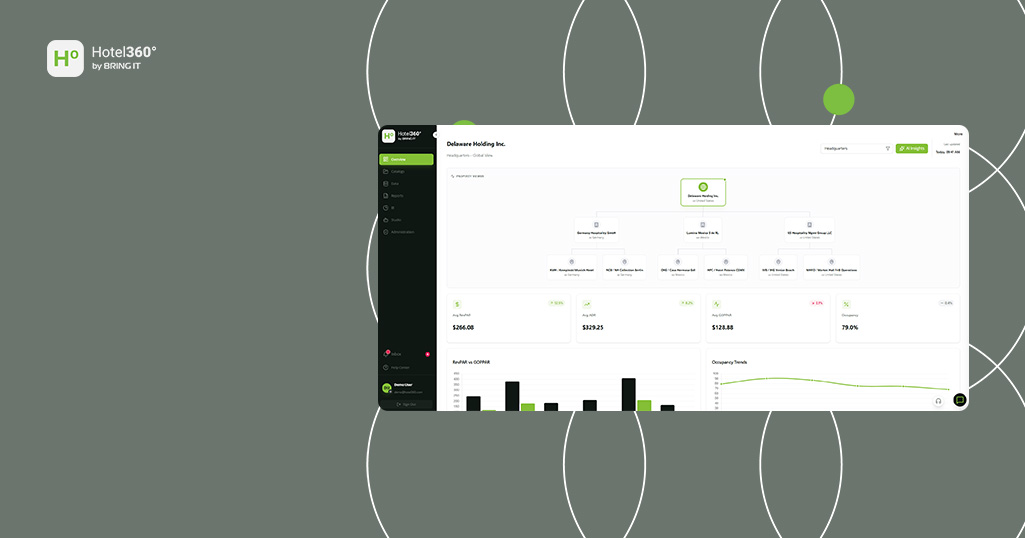
- Integration Layer: A connector like Hotel 360 that validates and maps data before it reaches the back office.
- Financial Layer: An ERP like NetSuite managing accounts receivable, accounts payable, and consolidation.
- Decision Layer: Real time dashboards for CEOs and CFOs to monitor profitability and revenue leakage.
As Jacob Sánchez notes, the ideal architecture is not one single system for every task, but specialised systems connected into one integrated financial view.
Questions CFOs should ask before investing
- Can we trace a booking from the initial reservation to the final payment without opening a spreadsheet?
- Do our transaction codes match across all properties in our group?
- How much of our month end close process relies on manual data entry?
- Can we identify exactly where our revenue leakage is happening in real time?
- Does our ownership group have full confidence in our profitability reports?
Final takeaway
If your PMS data does not match your financial reports, the answer is not more manual checking or more complex spreadsheets. The answer is a better operating structure. By integrating your systems and standardising your processes, you allow hotel activity to flow into finance with control and accountability. This transition moves your finance team from a role of historical reporting to one of strategic growth.
Are you ready to bridge the gap between operations and finance?
Bring IT helps hospitality groups design structured growth models using NetSuite and specialised integration tools. We focus on creating visibility and control so you can stop reconciling and start growing.
FAQs
- Why does my PMS data rarely match my financial reports?
Discrepancies occur because the PMS is an operational tool while financial reports require auditable and standardised data. The mismatch usually stems from disconnected systems, inconsistent transaction codes between properties, and the manual moving of data for advance deposits or city ledger billing which leads to human error and lost traceability.
- How does PMS ERP integration fix financial reporting?
Integration ensures that operational activity is automatically mapped to your general ledger accounts. This removes the need for manual exports and spreadsheets, allowing production, payments, and refunds to be recorded in the ERP in real time. The result is a single version of financial truth and a significantly faster month end close.
- What are the main causes of hotel revenue leakage?
Revenue leakage often happens due to uncaptured ancillary charges, incorrectly applied transaction codes, or manual folio adjustments during check in and checkout. It is also common when managing complex intermediary payments in the city ledger. Without automated reconciliation, these small errors aggregate into a significant loss of margin over time.
- Why is USALI reporting important for hospitality finance leaders?
The Uniform System of Accounts for the Lodging Industry (USALI) provides a standardised framework for hospitality accounting. Adhering to these standards ensures that revenue and expenses are categorised consistently across multiple properties. This is vital for accurate benchmarking, investor reporting, and identifying operational inefficiencies that impact profitability.
- How can hotel CFOs reduce month end close issues in hotels?
CFOs can accelerate the close by eliminating spreadsheet dependencies and automating the reconciliation between the PMS, POS, and ERP. Implementing a structured framework for data governance ensures that errors are identified and corrected during the month. This allows the finance team to focus on validating figures rather than moving data manually.