For CEOs and CFOs of hotel groups, the complexity of modern operations often feels like a balancing act between guest satisfaction and financial discipline. While a platform like Opera PMS is essential for managing stays and guest profiles, it is not a financial control system. When the gap between operational activity and financial truth is bridged by manual work and spreadsheets, the business faces significant risks to its EBITDA and cash flow integrity.
Protecting margins and improving cash visibility are the primary drivers for leadership today. To achieve this, hotel groups must move beyond seeing technology as a set of disconnected tools. Financial control depends on how stay data flows from the PMS into the ERP, payments, POS, procurement and final reporting.
How Hotel Financial Control Improves When Systems Are Integrated
The PMS captures operational truth, but finance requires validated and structured data to ensure fiscal integrity. In many hotel environments, these two worlds remain separate, creating a void where financial control begins to erode. The erosion of margin is most visible in Rooms and Finance, where Pedro Salazar, Director of Industry Products at Bring IT, notes that processes often remain fragmented even if the software is relatively modern.
Finance teams frequently spend a disproportionate amount of time on manual reconciliation. When systems do not talk to each other, teams are forced to manually verify whether every transaction in the PMS matches the bank and the general ledger. As Pedro Salazar observes, the future of hospitality depends on reducing this low value work so that leaders can focus on high impact decision making. Without integration, the month end close is delayed, and reporting remains reactive rather than a strategic tool for managing liquidity.
The Five Hotel Processes That Impact Revenue and Cost
To achieve true financial control, five core processes must be integrated. Pedro Salazar explains that these have the greatest impact on revenue, cost and the guest experience.
1. Reservation
The journey begins here. Integration ensures that deposits and booking details are captured accurately. When systems are disconnected, tracking advance deposits becomes a manual burden, increasing the risk of unallocated cash and accounting errors before the guest even arrives.
2. Check in
This is a critical moment for financial accuracy. Errors at check in create a ripple effect through the entire financial chain. Integration ensures that guest data and payment methods are validated immediately, reducing the need for costly and time consuming downstream corrections.
3. Check out
At check out, the goal is clean folio closure. Disconnected systems often lead to unbilled ancillary services or incorrect charges. This results in credit notes and payment reversals, which impact both guest satisfaction and the bottom line.
4. Supplier purchasing
Procurement must be tied to the financial core. Integrating purchasing with inventory and the ERP allows for better supplier cost control and ensures that stock levels are optimised across properties to protect working capital.
5. Month end close
The month end close is where finance validates production, charges and returns. Pedro Salazar points out that automated reconciliation between the PMS and ERP significantly reduces the hours spent checking whether the data is correct, leading to a faster and more reliable close.
Designing a Modern Hotel Technology Stack for Growth
An ideal architecture does not force every department into a single system. Instead, it allows teams to use the best tools for their specific roles while unifying the data for leadership. Jacob Sánchez, Account Executive at Bring IT, explains that the goal is integration rather than consolidation into one tool.
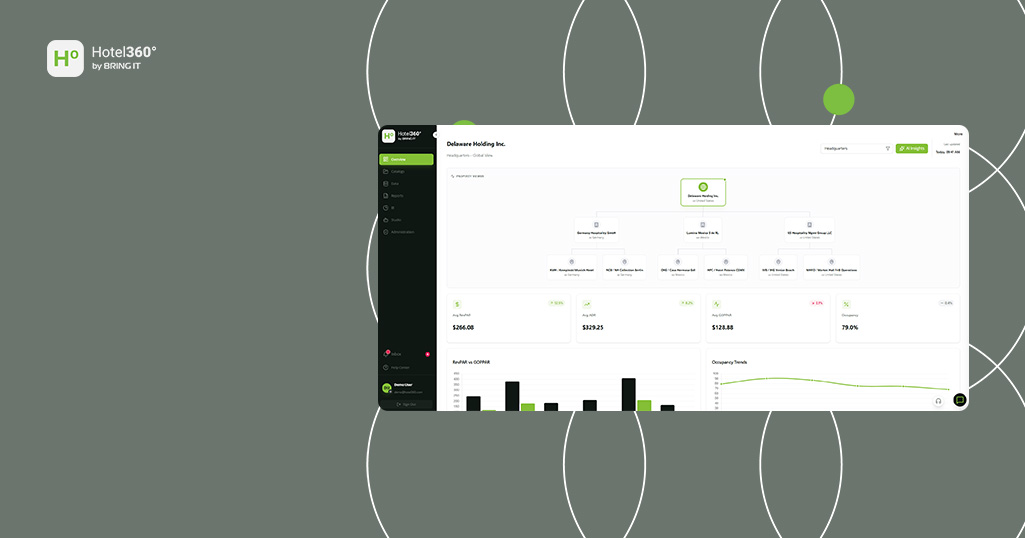
In a mature stack, Opera PMS handles operational stays, while specialised POS systems manage food and beverage outlets. These systems feed into an integration layer, such as Hotel 360, which structures the data before moving it into NetSuite. NetSuite then serves as the single source of truth for financial control, USALI reporting and executive visibility. This allows each department to remain productive without creating data silos for the CFO.
Managing Data Flow from Opera PMS to NetSuite
A controlled data flow is about moving the right information in the right structure. Stay activity captured in the PMS and outlet activity from the POS must meet cash and settlement data from payment systems.
The integration layer acts as the bridge. It translates operational codes into financial dimensions. When this data lands in NetSuite, it is already structured for USALI reporting. This means the CFO is not just looking at a total revenue figure but can see performance by department, property and guest segment without manual intervention.
Why Revenue Leakage Occurs in Disconnected Hotel Operations
Revenue leakage is often the result of small, invisible gaps in the process that compound over time. Jacob Sánchez highlights several areas where profitability is frequently lost, particularly in the management of advance deposits and folio closure. Without automated checks, unbilled ancillary services and incorrect guest codes can go unnoticed for weeks.
The complexity increases with tour operators and intermediaries. Jacob Sánchez warns that without automated city ledger reconciliation, it is easy to lose track of what is owed versus what has been paid. Manual rework, credit notes and payment reversals are clear signs of a disconnected system. When operational data does not reach the invoice automatically, the business is essentially losing margin on every transaction.
The Strategic Importance of USALI Standardisation
USALI provides a common financial language for the global hotel industry. Pedro Salazar argues that aligning a chart of accounts to USALI is one of the most beneficial steps a hotel group can take. It allows for comparable performance analysis across properties and reduces the need for spreadsheet adjustments.
Standardisation also prepares the business for the future. Structured data is a requirement for advanced forecasting and the use of AI. When a hotel group uses a standardised framework, reporting is faster, and the board can have full confidence in the profitability figures they are reviewing.
CFO Perspective: Measurable Benefits of Financial Control
For the CFO, the primary outcome of an integrated stack is confidence in the numbers. You should expect faster reconciliation across all outlets and a cleaner month end close. By reducing manual dependency, the finance team can shift from data entry to high value analysis. This visibility extends to refunds, deposits and ancillary revenue, ensuring that cash flow is tightly controlled and the audit trail is always clear for investors.
CEO Perspective: Scaling Operations Across Multiple Properties
A CEO needs a model that can scale without adding overhead. Whether the group is growing through independent ownership, management contracts or franchise models, integration ensures that growth does not multiply manual complexity. Pedro Salazar explains that the technology must adapt to the operating model of the property. With a unified stack, adding a new hotel to the estate becomes a repeatable process rather than a new architectural challenge.
CIO Perspective: Ensuring Security and Data Integrity
From a CIO perspective, the integrity of the data is paramount. Jacob Sánchez points out that disconnected systems create significant security risks. When teams cannot move data automatically, they often resort to shadow spreadsheets or shared folders to store sensitive guest and payment information. An integrated stack enforces system of record discipline, ensuring that guest data remains secure and data migration quality is maintained across the estate.
Assessing if Your Hotel Stack is Ready for Financial Control
If your leadership team is experiencing any of the following, your technology stack may be hindering your financial control:
- Finance teams reconcile the PMS and ERP manually every day.
- USALI reports require significant adjustment in Excel before board meetings.
- Advance deposits are tracked outside of the main financial system.
- Group bookings and multi payer folios cause constant billing errors.
- Ancillary revenue is difficult to validate against outlet production.
- Month end close relies on lengthy operational explanations rather than system data.
- Different properties in the group use inconsistent codes for the same services.
Roadmap for Building an Integrated Hotel Stack
Moving towards a fully integrated stack involves a clear sequence of steps:
- Map every process from the initial guest operation to the final financial record.
- Clearly define which system is the source of truth for each data type.
- Standardise the chart of accounts and codes using the USALI framework.
- Design an integration layer that can handle multi PMS environments.
- Automate reconciliation controls to flag deviations immediately.
- Build custom reporting dashboards for CFOs, CEOs and owners.
- Prepare the data structure for future forecasting and predictive analytics.
Choosing the Right Integration Partner
The right partner must understand how a hotel actually works. Pedro Salazar warns against integrators who sell technology without understanding the underlying operating model. An expert partner should have deep knowledge of Opera PMS, NetSuite ERP and the USALI framework. They should be able to translate complex hotel operations into finance ready reporting that gives leadership the visibility they need to grow.
Achieving Sustainable Financial Control
True financial control in the hospitality sector starts when hotel operations and finance are connected by design. Opera PMS is a vital tool for the guest journey, but it requires a robust architecture to turn operational activity into financial truth. A fully integrated stack gives CEOs and CFOs faster reconciliation, stronger cash visibility and the confidence to make decisions based on real time data.
Explore how Bring IT can help your hotel group move from disconnected data to total financial control. Our experts can assess your current technology stack and help you build an architecture designed for the unique demands of the hospitality market.
FAQs
- What is an integrated hotel technology stack?
An integrated hotel technology stack is a configuration where operational systems like the PMS and POS are digitally connected to a central ERP. This ensures that data flows automatically between departments, reducing manual work and improving financial accuracy.
- How does Opera PMS integrate with NetSuite?
Integration usually happens through a middle layer such as Hotel 360. This layer captures stay and production data from Opera, structures it according to the hotel group requirements, and pushes it into NetSuite for accounting and reporting.
- Why is PMS to ERP integration important for hotel CFOs?
It eliminates the need for manual reconciliation between guest activity and financial records. This leads to a faster month end close, reduced revenue leakage and better visibility into cash flow and deposits.
- Where does revenue leakage happen in hotel operations?
Leakage often occurs during folio closure, city ledger reconciliation and the handling of advance deposits. Without integration, unbilled ancillary services or incorrect guest codes can lead to significant lost revenue.
- How does USALI reporting improve hotel financial control?
USALI provides a standardised format for hotel accounting. When integrated into an ERP like NetSuite, it allows leadership to compare performance across different properties using a consistent financial language.