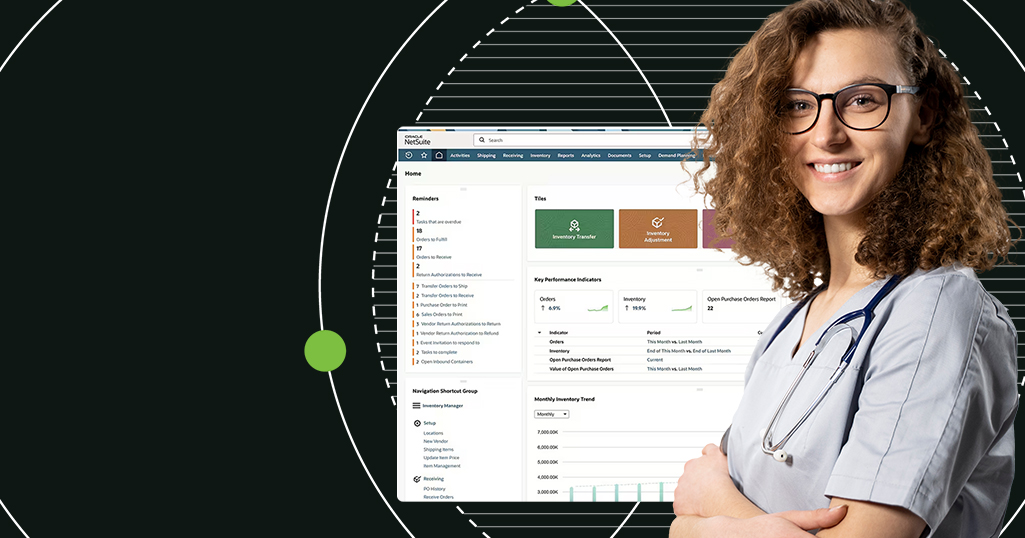

Healthcare ERP implementations fail when organizations treat the system as accounting software instead of the operating core that connects clinical activity, revenue cycle, procurement, and reporting. Success requires moving beyond simple ledger management to a model where clinical encounters automatically drive financial and operational outcomes.
Bring IT frames this strategic shift through the Healthcare Operating Core Framework. This approach recognizes that clinical activity is the primary source of financial truth. Consider a common scenario: a patient receives a complex procedure recorded in the EMR, but the finance department only sees the revenue impact weeks later. By the time the CFO identifies the result, the organization may already be struggling with delayed billing, coding errors, manual reconciliation, or incomplete profitability reporting.
Why healthcare CFOs lose visibility between clinical activity and financial results
Visibility vanishes when there is no granular integration between medical and financial systems. CFOs are often left analyzing green or red numbers without knowing the clinical drivers behind them. As Pedro Salazar, Director of Industry Products at Bring IT, explains, “Visibility is lost when there is no granular integration… when I do not have the detail of all the procedures done, all the diagnoses made, and the insurers covering those services.”
The most significant financial risk in this gap is revenue leakage. Currently, the industry faces an insurance claim rejection rate between 10 and 12 percent. This failure in revenue integrity usually happens because clinical coding does not justify a diagnosis or when insurers do not cover specific procedures. Without a connected business transformation strategy, these errors are only caught after the clinical event, leading to wasted effort and lost cash flow.
ERP vs EMR: what belongs in each system?
To build a scalable organization, leadership must distinguish between the heart and the brain of the facility. A frequent governance error is believing a clinical system can handle the complex financial and administrative layers of a growing enterprise.
Bring IT utilizes the Healthcare Operating Core Framework to define these roles:
- Clinical Heart: The EMR or EHR remains the system of record for clinical activity, patient encounters, procedures, diagnosis, prescriptions, and care delivery.
- Financial Brain: The ERP provides the financial and operational control layer, connecting revenue, procurement, inventory, month end close, reporting, and profitability.
- Integration Layer: Revenue cycle management connects the clinical journey with billing, claims, payers, coding, diagnosis validation, and payment outcomes.
- Decision Layer: Executives use KPIs and dashboards to see profitability by doctor, procedure, payer, facility, and service line through advanced analytics and reporting.
- Optimization Layer: Once the operating core is connected, organizations can improve claim automation, procurement forecasting, and inventory control.
“The EMR is the heart of the hospital and the ERP is the brain,” Salazar notes. While the strategic platform does not need a patient’s vital signs, it must see every procedure performed to ensure clinical effort reflects accurately in the financial backbone.
Why revenue cycle management is the core healthcare ERP integration layer
Revenue cycle management or RCM is the only process that follows the patient from the initial clinical need to the final payment. It is the integration layer within our framework that ensures care delivery translates into revenue integrity.
Effective RCM integration within a specialized healthcare management solution ensures that appointment motives are linked to procedural codes to predict future cash flows accurately. It also automates revenue recognition so that every clinical action triggers a financial transaction in the backbone. When these systems are not aligned, claim rejections and coding gaps become chronic operational costs rather than isolated billing issues.
How multi facility healthcare organizations standardize finance, procurement, and reporting
When an organization grows from a single site to multiple facilities, structural logic changes. Decision making becomes slower and more complex. Leaders must homogenize administrative and financial processes to maintain quality of care across the entire group.
Standardization focuses on three critical areas:
- Centralized Procurement: Moving to a unified warehouse model to gain market leverage and control supply costs.
- Clinical Consistency: Ensuring that specialized services are delivered and billed identically across fifteen different locations.
- Unified Reporting: Establishing a single source of truth that avoids manual consolidation of facility level data.
What healthcare leaders should know before integrating ERP and EMR systems
Interoperability is not an IT concern in healthcare. It is the mechanism within our integration layer that determines whether clinical work becomes trusted financial data. Standard business systems often fail here because they struggle with archaic data exchange standards.
Executive leadership must prioritize modern integrations that respect Protected Health Information or PHI under federal mandates. “A data integration is useful for the business when all the data being integrated has a purpose,” Salazar notes. This means moving beyond generic order to cash models toward an architecture that handles the complexity of doctors acting as autonomous professionals with specific fee structures.
When Should a Healthcare Organization Consider This Model?
If your organization recognizes any of the following signs, your current operating model has reached its scalability limit:
- Month end close takes more than 10 days due to manual reconciliations.
- Claims are frequently rejected because of coding or diagnosis gaps between systems.
- The EMR is being forced to handle complex financial or procurement logic.
- Procurement is reactive instead of predictive, leading to stock issues and high costs.
- CFOs cannot see profitability by doctor, procedure, payer, or facility in real time.
- Multi facility reporting requires extensive manual data consolidation.
Turning Data into Operational Confidence
Technology is abundant, but success depends on human adoption and data purpose. A major risk is physicians spending the majority of a consultation entering data into archaic systems instead of treating patients. The goal of a connected operating core is to humanize care by reducing data entry and providing the CFO with key indicators for decision making.
As Salazar concludes, “you have to have good human teams to be able to execute everything.” For organizations already running EMR or EHR systems, the question is not whether data exists. The question is whether that data can be translated into financial visibility, revenue integrity, and operational confidence through a unified Healthcare Operating Core.
FAQs
1. What is healthcare ERP implementation?
It is the process of integrating a centralized enterprise management platform with clinical operations to manage finance, procurement, and human resources. It aligns the patient journey with the financial outcomes of the organization.
2. Why do healthcare ERP implementations fail?
They fail when organizations treat the ERP as a generic accounting tool rather than the operating core. Failure often results from a lack of granular integration with clinical data, leading to revenue leakage and manual reconciliation errors.
3. What is the difference between ERP and EMR in healthcare?
The EMR is the master of clinical practice and patient history, acting as the heart of the operation. The ERP acts as the strategic brain, governing financial logic, administrative workflows, and business strategy.
4. Why is revenue cycle management important in healthcare ERP?
RCM is the integration layer that bridges care delivery and cash flow. Integrating RCM with the ERP ensures that clinical procedures are correctly coded and billed, reducing claim rejection rates and improving revenue forecasting.
5. Can NetSuite integrate with an EMR or EHR?
Yes, NetSuite can integrate with existing clinical systems through a structured approach like Bring IT Healthcare 360. In this model, the EMR or EHR remains the clinical system of record while NetSuite supports the financial and operational layer. This ensures clinical activity flows seamlessly into the financial backbone without requiring a system replacement.