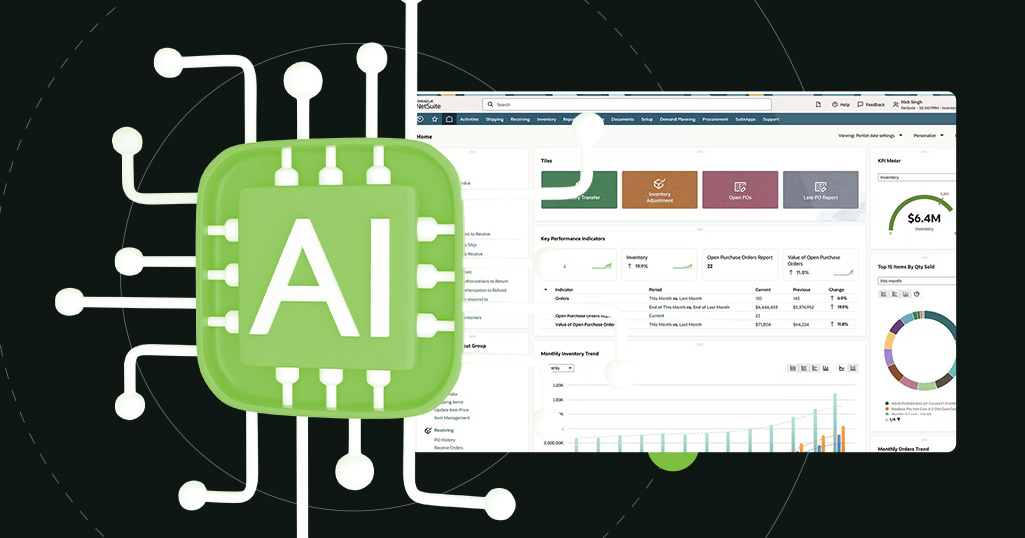
Executive leaders are currently managing a significant gap between the data stored in their systems and the insights required to run their businesses. While ERP systems have historically functioned as reliable systems of record, the sheer volume of transactions often obscures the signals that require immediate attention. Modern financial and operational control requires a platform that does more than store history; it must actively identify variance and risk.
As Isidro Spencer, Solutions Architecture Lead at Bring IT, notes, the focus of ERP is shifting. For decades, the priority was capturing every transaction. Today, the priority is helping finance and operations teams filter the noise to support faster, more reliable decisions.
Defining Intelligence Through Operational Outcomes
Within the business transformation framework, intelligence in NetSuite is defined by its ability to make high-volume data actionable. It is not a separate layer of technology, but a set of capabilities embedded in the business logic to handle specific operational friction points:
- Exception Identification: Moving from manual audits to a system that flags anomalies, such as a journal entry posted to an incorrect subsidiary or a duplicate vendor invoice that bypassed standard matching.
- Automated Variance Explanation: Highlighting the drivers behind budget-to-actual gaps, such as unforecasted shipping surcharges, reducing the time controllers spend in the general ledger.
- Financial Risk Detection: Identifying vendor performance issues or payment timing delays that threaten cash flow discipline before they manifest in month-end reports.
- Decision Support: Connecting operational signals (like warehouse delays) to financial impacts (like revenue recognition timing) to help leaders prioritize the risks that actually impact the balance sheet.
Beyond Static Rule-Based Automation
Traditional ERP automation relies on rigid, “If-Then” logic: “If an invoice is over $50,000, route it for CFO approval.” This is a baseline control, but it is blind to behavior. Contextual intelligence analyzes the patterns behind the data to provide a more sophisticated layer of protection.
“Rule-based automation is explicit and rigid,” Spencer explains. “Context-driven intelligence is different; it analyzes the environment and behavior to surface issues that rules might miss.”
In an Accounts Payable scenario, this changes the control environment. The system might flag a $40,000 invoice, which would normally bypass executive review, because the amount is unusual for that specific vendor or the payment terms have changed. This strengthens financial control at the point of entry, not after the cash has left the building.
Operational Reality: The Month-End Close
The practical impact of these tools is most visible during the month-end close, where controllers traditionally spend the first week of the month investigating data discrepancies.
In an intelligent ERP environment, the workflow shifts from data hunting to exception management. The controller’s dashboard provides immediate visibility into:
- Prioritized Reconciliations: The system handles routine bank and credit card matches, presenting only the variances that require professional judgment.
- Anomalous Journal Entries: Flagging entries that deviate from historical trends or peer-group behavior for manual verification.
- Dynamic Close Dependencies: Real-time visibility into delayed tasks, such as unbilled purchase orders or open receipts, that threaten the reporting timeline.
This reduces the repetitive back-and-forth between finance and operations, making the close cycle shorter and more predictable.
Forecasting and Cash Flow Discipline
For the CEO and leadership team, the benefit is realized during forecasting meetings. The discussion moves away from debating data accuracy and toward reacting to real-time signals.
Embedded forecasting engines use continuous recalibration to highlight operational risks:
- Demand Shifts: Early detection of a slowdown in high-margin product lines, allowing for immediate production or procurement adjustments.
- Margin Erosion: Identifying where rising raw material costs in the warehouse are compressing profitability on specific sales orders before the month-end P&L is run.
- Revenue Recognition Timing: Flagging delays in project milestones that will prevent revenue from being recognized in the current period.
This allows for capital allocation decisions based on current behavior rather than historical snapshots.
The Prerequisites of Success: Data Integrity and Process
It is a core principle at Bring IT that technology cannot compensate for fragmented processes or disconnected systems. The reliability of any automated insight depends on the quality of the underlying technology environment and the discipline of the people running it.
“AI does not fix a broken process; it accelerates it,” Spencer warns. “Applying advanced automation to fragmented data or siloed integrations simply leads to faster errors.”
To gain value from these systems, organizations must prioritize:
- Data Quality: Ensuring transactions are clean, consistent, and categorized correctly at the source.
- Process Ownership: Establishing clear accountability for workflows across procurement, sales, and finance to prevent data silos.
- Integration Integrity: Ensuring that data from external systems arrives in real-time and follows consistent mapping, as fragmented integrations degrade AI reliability.
Human review remains the cornerstone of governance. The system handles the high-volume data matching, but leaders remain responsible for judgment and final accountability.
Outcome: Operational Stability and Financial Control
Integrating intelligence into NetSuite is about reducing the manual labor of data verification to spend more time on strategy. The result is an organization that responds to market signals faster and maintains stronger control over its margins.
By moving from historical record-keeping to a forward-looking operational model, companies can operate with a level of visibility and control that traditional ERP systems could not provide.
FAQs
- How does NetSuite AI differ from traditional ERP automation?
NetSuite AI differs from traditional automation by using contextual logic and behavior analysis instead of rigid “If-Then” rules. While automation executes repetitive tasks based on pre-defined thresholds, AI identifies hidden patterns and anomalies, providing proactive decision support and strengthening financial governance.
2. Can NetSuite AI replace human financial judgment and accountability?
No, NetSuite AI is designed as a decision-support tool, not a replacement for human judgment. The system surfaces risks and filters data noise to compress decision time, but human oversight remains essential for final accountability, governance, and complex strategic interpretation.
3. How does NetSuite AI accelerate the month-end close process?
NetSuite AI accelerates the close process by shifting finance teams from “data hunting” to “exception management.” It automates routine reconciliations and flags anomalous journal entries in real-time, allowing controllers to focus exclusively on variances that require professional review.
4. What are the core prerequisites for a successful NetSuite AI implementation?
The primary prerequisites for AI success are clean data quality, disciplined business processes, and robust system integration. Advanced predictive models rely on consistent, real-time data; fragmented processes or siloed integrations will significantly degrade the reliability of AI-driven insights.
5. How does AI-driven forecasting impact margin management and profitability?
AI-driven forecasting connects operational signals,such as warehouse cost increases or demand shifts, directly to financial outcomes. This real-time visibility allows leadership to identify margin erosion as it happens, enabling immediate adjustments to procurement and production to protect overall profitability.